Direct Answer
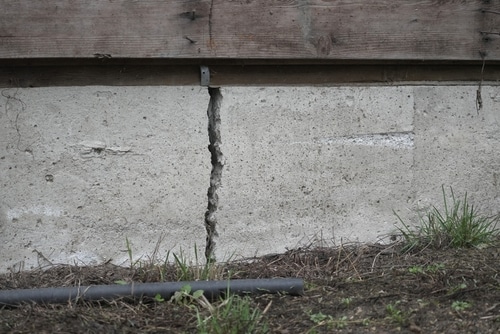
Yes, stair-step cracking in concrete block walls can be a serious foundation warning sign. In Florida homes, this type of cracking often indicates that part of the foundation is settling downward because the soils beneath the home are no longer supporting the structure evenly.
A small hairline stair-step crack does not always mean the home is in immediate danger, but it should not be ignored. If the crack continues to open, spreads through the block, appears near windows or doors, or is paired with sticking doors, uneven floors, or gaps around frames, the underlying settlement may continue and become more expensive to repair.
At Helicon, we do not look at a stair-step crack as just a crack in the wall. We look at what caused it. The real question is whether the crack is cosmetic, caused by shallow soil settlement, or related to deeper foundation movement. Once that is understood, the goal is to recommend the least invasive repair that actually solves the cause.
Read more: Foundation Problems in Florida: The Complete Homeowner Guide
What Stair-Step Cracks Usually Mean
Stair-step cracks usually follow the mortar joints in a concrete block wall. Instead of running in a straight vertical or horizontal line, the crack steps up or down through the wall in a pattern that looks like stairs.
That pattern matters because concrete block walls are rigid. When one part of the foundation settles lower than another part, the wall above it can begin to separate along the weakest points, which are often the mortar joints between the blocks.
In many Florida homes, stair-step cracking is a sign of differential settlement. That means one section of the home is moving differently than another section. The foundation may be settling downward in one area while the rest of the home remains more stable.
| Common Location | Why It Matters |
| Garage openings | Large openings can show stress when the structure moves |
| Window and door corners | Movement often concentrates around framed openings |
| Exterior block wall corners | Corners can reveal differential settlement between sections of the home |
| Interior garage block walls | May show both wall movement and garage slab settlement |
| Additions or transitions | Different parts of the structure may settle at different rates |
The crack itself is the visible symptom. The more important issue is what is happening beneath the home.
Read more: Signs Your Home Foundation Is Sinking in Florida
Why Stair-Step Cracks Happen in Florida Block Homes
Florida homes are especially vulnerable to foundation movement because of the soil conditions found throughout the state. Many homes are built on sandy soils, loose fill, shallow weak soils, or soils affected by heavy rainfall, poor drainage, erosion, and changing groundwater conditions.
The most common cause Helicon sees with stair-step cracking is shallow loose or weak soils, often within roughly the upper 10 feet below the home. When these soils are not dense enough to support the weight of the structure, part of the foundation can begin to settle.
In more advanced cases, settlement may be related to deeper soils below that upper zone. When deeper soils are involved, or when the foundation has already moved significantly, piers may be needed to stabilize and lift the affected area.
Some stair-step cracking is also tied to construction conditions. In certain areas of Florida, including places such as Spring Hill, many slab-on-grade homes were built without traditional footers or continuous wall footings. When a slab-on-grade structure is built on loose, weak, sandy soils without the additional support of a proper footing system, the exterior walls can be more vulnerable to settlement.
In other cases, the original soils beneath the foundation, wall footing, or floor slab may not have been compacted properly before the concrete was poured. If the soil under the home was loose from the beginning, settlement may show up years later as the structure places more stress on those weak areas.
Common causes include:
- Loose shallow sandy soils
- Poorly compacted fill beneath the foundation
- Weak soils from roughly 10 feet to the surface
- Deeper soil settlement below the shallow treatment zone
- Slab-on-grade homes without adequate footers or wall footings
- Heavy rainfall and soil softening
- Poor drainage near the foundation
- Soil erosion or washout
- Voids beneath the slab or foundation
- Sinkhole-related activity in certain areas of Florida
The key point is that stair-step cracking is rarely just a wall problem. It is often a soil support problem.
Read more: How Florida Soil Affects Foundations
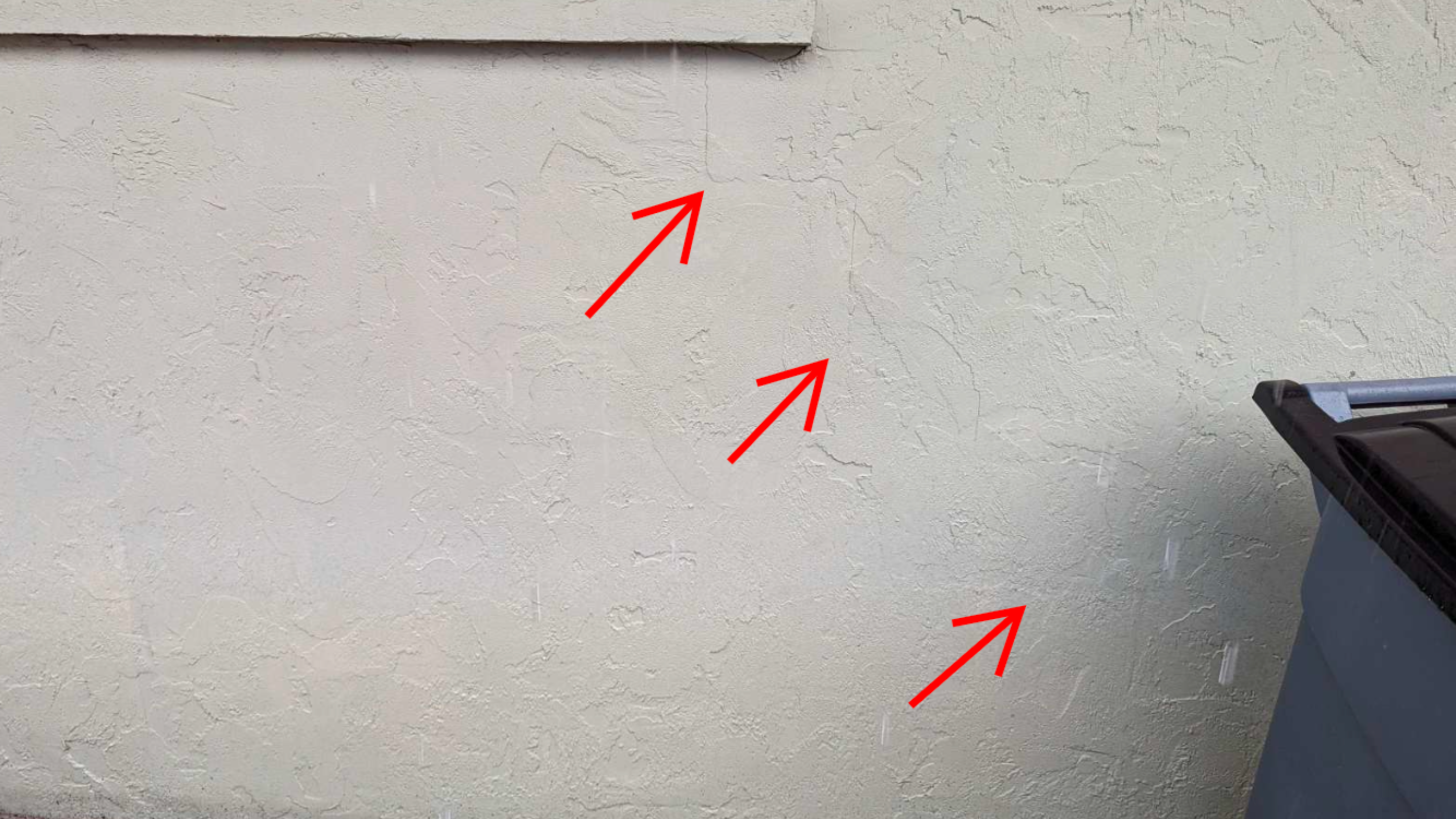
Stair-Step Crack or Stucco Crack: How to Tell the Difference
Not every crack on a Florida home is a foundation problem. Some cracks are cosmetic and may be limited to the stucco finish. Others continue through the concrete block wall and may indicate structural movement.
Stucco cracks can happen from normal expansion and contraction, temperature changes, water intrusion, or improper stucco application. If the stucco was not applied correctly, or if the base coat did not cure properly before additional coats were applied, small cracks may develop over time.
A cosmetic stucco crack is usually thinner, more surface-level, and may not continue through the block wall underneath. A structural stair-step crack is more concerning when it follows the block mortar joints, widens over time, or appears on both the exterior and interior side of a wall.
| More Likely Cosmetic | More Likely Structural |
| Crack is only in the stucco surface | Crack follows block mortar joints in a stair-step pattern |
| Crack does not follow the block joints | Crack is wider than a hairline crack |
| Crack has not changed over time | Crack continues to grow |
| No other signs of movement are present | Crack appears near windows, doors, corners, or garage openings |
| Wall, doors, windows, and floors nearby remain stable | Crack shows on both sides of the wall |
| Surface finish appears to be the main issue | Doors or windows nearby begin sticking, Gaps appear around frames or trim, Floors nearby feel uneven or sloped, Crack has been patched before and reopened |
Read more: Cracks in Stucco vs Structural Cracks: What’s the Difference?
Signs the Foundation Problem Is Getting Worse
The size of the crack matters, but movement over time matters even more.
A hairline stair-step crack may be an early warning sign. A wider crack may indicate more advanced movement. A crack that continues to open, spreads, or comes back after patching is usually more concerning than a crack that has remained unchanged for years.
Practical warning signs include:
- A hairline stair-step crack that is getting longer
- A crack opening to 1/8 inch or more
- A crack reaching 1/4 inch or wider
- A crack approaching 1/2 inch or more
- Gaps in block walls
- Cracks near windows or doors
- Doors rubbing, dragging, or not latching
- Windows becoming difficult to open or close
- Gaps around window frames or door frames
- Uneven or sloping floors
- Interior drywall cracks near the same area
- Exterior stucco cracking that reopens after repair
- Separation between walls, ceilings, trim, or floors
A crack that is 1/4 inch wide is not automatically the same problem on every home. A small crack with active movement may be more important than a larger crack that has been stable for a long time. That is why the inspection should focus on whether the structure is still moving.
Read more: Gaps Around Windows and Doors: Foundation Problem or Normal Settling?
Stair-Step Crack Severity Guide
| What You See | What It May Mean | Level of Concern |
| Hairline stair-step crack that has not changed | Possible early movement or minor cracking | Monitor and document |
| Hairline crack that is growing longer | Possible active settlement | Should be inspected |
| Crack opening to 1/8 inch or more | Possible foundation movement | Higher concern |
| Crack reaching 1/4 inch or wider | More advanced movement may be occurring | Inspection recommended promptly |
| Crack approaching 1/2 inch or more | Significant movement may be present | Higher urgency |
| Crack near doors, windows, corners, or garage openings | Stress may be affecting structural openings | Higher concern |
| Crack that reopens after patching | Cause was likely not corrected | Should be inspected |
| Crack paired with sticking doors, uneven floors, or gaps | Multiple signs of settlement may be present | Higher urgency |
This table is a general guide, not a diagnosis. Crack width matters, but the most important question is whether the crack is active, widening, or connected to other signs of foundation movement.
Homeowner Tip: Take a clear photo of the crack with a ruler or tape measure next to it. Repeat the photo every 30 to 60 days. If the crack is widening, spreading, or paired with sticking doors, gaps, or uneven floors, schedule an inspection.
What Happens If You Wait Too Long
Foundation settlement rarely becomes easier to repair by waiting.
If the soil beneath part of the home continues to lose strength or density, the foundation can continue to move downward. As the structure settles, the crack may widen, more cracks may appear, and nearby doors, windows, floors, and finishes may become affected.
Waiting can create several problems:
- The crack may become wider and more difficult to close
- More areas of the home may become affected
- Cosmetic repairs may need to be repeated
- Doors and windows may become more misaligned
- The repair may shift from soil stabilization to underpinning
- More piers may be needed if settlement spreads
- Interior damage may become more expensive to restore
Early-stage settlement may sometimes be addressed with soil stabilization if the issue is shallow, and the foundation has not dropped significantly. More advanced settlement may require push piers, helical piers, or drilled piers to stabilize and lift the affected portion of the structure.
The earlier the cause is identified, the more options a homeowner usually has.
Read more: Can I Wait to Fix Foundation Issues or Will It Get Worse?
How Helicon Repairs Stair-Step Cracking Caused by Settlement
Helicon does not repair stair-step cracking by simply patching the wall. Patching may hide the symptom for a while, but it does not address the soil movement or foundation settlement that caused the crack.
The right repair depends on what is happening beneath the home. For some homes, the issue is shallow, weak soil near the foundation. For others, the foundation has already settled enough that structural underpinning is needed. In more complex cases, Helicon may recommend a combination of piers and structural polyurethane injection.
| Repair Option | What It Is Designed to Do | Best Fit |
| Polyurethane soil stabilization | Densify and strengthen weak shallow soils | Early-stage settlement caused by shallow weak soils |
| Push piers | Transfer the affected foundation area to deeper load-bearing strata | Heavier structures with deeper settlement |
| Helical piers | Screw into the ground to support the affected foundation area | Lighter structures, specific soil conditions, or engineered applications |
| Drilled piers | Provide deep support in specialized conditions | Limited counterweight, interior support, or unique site needs |
| Structural polyurethane void filling after lifting | Fill voids that remain after foundation lifting | Projects where lifting creates or reveals unsupported areas |
Each solution has a different purpose. The best repair is not always the biggest repair. The best repair is the one that solves the actual cause of the movement with the right combination of technique, equipment, and value for the customer.
Read more: Foundation Repair
Polyurethane Soil Stabilization for Early-Stage Settlement
For many shallow soil settlement conditions, treatment may focus on the upper soil zone, often from roughly 10 feet below grade back toward the surface.
Helicon installs injection rods near the foundation, usually spaced approximately 5 feet apart. The rods are installed with a slight angle, so the expanding structural polyurethane foam can be placed as close as possible to the soil directly beneath the foundation.
The goal is to densify and compact weak shallow soils, fill small voids, and strengthen the soil’s ability to support the foundation, so it is less likely to continue settling.
A typical shallow soil stabilization process may involve injecting at a deeper starting point, such as 10 to 15 feet below grade, then working upward in stages. For example, if the treatment depth is 10 feet, the injection may begin at that depth, then the rod may be raised to around 5 feet for additional injection.
During the process, the structure is monitored with a laser level. If grout comes to the surface or the structure begins to lift, pumping is stopped in that area.
Polyurethane soil stabilization is typically used more for stabilization than precision foundation lifting. It can improve the support capacity of the shallow soils, but it does not provide the same controlled foundation lifting ability as a pier system.
This option may be appropriate when:
- The settlement is early-stage
- The crack is small or moderate
- The issue is related to shallow weak soils
- The home does not require major lifting
- The goal is to stabilize the soils and help prevent further settlement
In some ways, when weak shallow soils exist beneath exterior foundation walls, polyurethane soil stabilization can function like added support beneath the foundation area by improving the soils that should have been stronger and better compacted before the home was built.
Read more: Polyurethane Soil Stabilization
Push Piers, Helical Piers, and Drilled Piers
When a foundation has settled significantly, when deeper soils are the problem, or when precision lifting is needed, piers may be required.
Piers are designed to transfer the load of the affected area where the piers are installed to deeper competent bearing soils. Many homeowners describe this as putting part of the home on underground stilts. Technically, the goal is to bypass the unstable soil zone at the affected area and support that portion of the foundation on stronger material below.
Push piers are hydraulically driven using the weight of the structure as resistance. They are commonly used when the home has enough weight to allow the pier sections to be advanced to competent bearing strata.
Helical piers are screwed into the ground using hydraulic equipment. They are often useful where the structure is lighter, where specific soil conditions call for them, or where design requirements make helical piers a better fit.
Drilled piers are less common in typical residential foundation repair, but Helicon does use them when the situation calls for it. They may be considered when there is not enough structural counterweight to install a push pier, or when interior walls or interior floor slabs need support using a specialized interior slab bracket.
In some cases, Helicon may perform a simultaneous lift. Multiple piers are used at the same time to lift an affected area, such as an entire corner of a home, back toward its proper position with greater control and precision.
After major lifting with piers, voids may remain beneath portions of the foundation or slab. In those cases, structural polyurethane foam may be recommended to fill those voids and provide additional support.
Read more: Push Pier Foundation Repair
Soil Stabilization vs Piers: Which Repair Is Needed?
The difference between soil stabilization and piers comes down to the cause, depth, severity, and repair goal.
Polyurethane soil stabilization is often considered when the issue is shallow, weak soil, and the goal is to improve soil support and help stop continued settlement. It is generally less invasive and may be a strong option when the foundation has not dropped significantly.
Piers are often needed when the structure requires precision lifting, when settlement is more advanced, or when deeper soils cannot support the affected area properly. Piers allow the affected portion of the foundation to be lifted and stabilized from multiple points, then supported by deeper load-bearing strata.
| Repair Type | Simple Explanation | Common Use |
| Polyurethane soil stabilization | Strengthens weak shallow soils | Early-stage settlement, shallow weak soils, stabilization without major lifting |
| Piers | Transfer the load of the affected area where the piers are installed to deeper competent bearing soils | Deeper settlement, significant movement, controlled lifting |
| Structural polyurethane after pier lifting | Fills voids under slabs or foundations after lifting | Combined repairs where voids remain after elevation correction |
Helicon evaluates each project on a case-by-case basis. The best repair is not always the biggest repair. The best repair is the one that solves the actual cause of the movement.
What Homeowners Should Not Do
The most common mistake homeowners make is caulking, patching, or painting over a stair-step crack before understanding why it formed.
That may improve the appearance temporarily, but it does not stop foundation movement. If the soil beneath the foundation is still settling, the crack can reopen, widen, or show up in another area.
Homeowners should avoid:
- Caulking the crack and assuming the problem is solved
- Painting over the crack without monitoring movement
- Repairing stucco before checking for foundation settlement
- Replacing drywall or finishes before stabilizing the structure
- Waiting until the crack becomes much wider
- Assuming all cracks are cosmetic
- Assuming every crack requires major foundation repair
The right first step is not panic. The right first step is diagnosis.
A qualified inspection can help determine whether the crack is cosmetic, shallow soil-related, or part of a larger foundation movement issue.
How Much Does It Cost to Repair Stair-Step Cracking?
The cost to repair a stair-step crack depends on what caused it.
If the crack is cosmetic and limited to the stucco surface, the repair may only involve cosmetic work by a stucco or paint contractor. If the crack is caused by foundation settlement, the cost depends on the severity of the movement, the repair method, access, soil conditions, engineering requirements, and how much of the home is affected.
| Repair Type | Typical Cost Range | Notes |
| Cosmetic stucco or paint repair | Contractor-specific | Only appropriate if the crack is cosmetic and not caused by active settlement |
| Concrete lifting or slab support | Around $1,500 to $8,000 | Applies when nearby slabs or concrete have lost support |
| Polyurethane soil stabilization | Around $5,000 to $20,000 | Depends on treatment area, depth, and soil conditions |
| Underpinning systems with piers | Around $10,000 to $60,000 | Depends on number of piers, depth, access, and severity |
| Combined pier and polyurethane repairs | Project-specific | Often used when lifting and void filling are both needed |
*These are typical Florida pricing examples based on published industry resources and contractor pricing guides. They are intended for educational purposes only and are not Helicon’s pricing. Every home is different, and a professional inspection is the only way to determine the appropriate repair and provide an accurate quote.
A small crack does not automatically mean a small repair, and a wide crack does not automatically mean the entire home needs underpinning. The repair cost should be based on inspection findings, not guesswork.
If you receive two very different repair estimates, compare the diagnosis, repair method, and scope before comparing price.
Read more: Why Foundation Repair Quotes Vary So Much
The most important cost factor is whether the issue is caught early enough to stabilize the soils before settlement becomes more advanced.
Read more: How Much Does Foundation Repair Cost in Florida?
Checklist: When Stair-Step Cracking Should Be Inspected
Use this checklist as a practical guide. If one or more of these signs are present, the crack should be evaluated more closely.
- The crack is new
- The crack is getting longer
- The crack is getting wider
- The crack follows the block mortar joints
- The crack is near a window, door, corner, or garage opening
- The crack appears on both sides of the wall
- The crack reopened after being patched
- Doors or windows nearby are sticking
- Gaps are forming around windows, doors, trim, walls, or ceilings
- Floors nearby feel uneven or sloped
- Exterior concrete near the home is settling
- Soil near the foundation feels loose, soft, or washed out
- Drainage is sending water toward the foundation
- There are multiple cracks in the same area
A stair-step crack does not automatically mean the home needs major foundation repair. It does mean the crack should be understood before it is patched, painted, or ignored.
When to Schedule a Foundation Inspection
You should schedule a foundation inspection if a stair-step crack appears in a concrete block wall, especially if it is new, widening, near an opening, or connected to other signs of movement.
Call an expert if you notice:
- Stair-step cracking in a block wall
- Cracks that continue to grow
- Doors or windows sticking near the crack
- Gaps around windows, doors, trim, or walls
- Uneven or sloping floors
- Cracks that reopen after patching
- Multiple cracks in the same area
- Settlement near a corner of the home
- Concern that the crack may go through the block, not just the stucco
An inspection should look beyond the crack itself. At Helicon, the goal is to determine whether the issue is cosmetic, shallow soil settlement, or deeper foundation movement. From there, the repair recommendation should match the actual cause.
Read more: What a Foundation Inspection Looks Like
Why Florida Homeowners Trust Helicon
Helicon has been helping Florida homeowners solve foundation repair, soil stabilization, concrete lifting, sinkhole repair, and seawall stabilization problems since 2004.
As a family-owned Florida company, Helicon understands the soil conditions, construction practices, and settlement patterns that affect homes across Tampa Bay, Orlando, Southwest Florida, and surrounding areas. Our team works on both residential and complex commercial stabilization projects, often in coordination with engineers, property owners, municipalities, builders, and other construction professionals.
We are not there to simply sell a repair because a crack exists. We are there to determine what the crack means.
Sometimes the issue is cosmetic. Sometimes it is shallow weak soil that can be stabilized. Sometimes the home needs piers to lift and permanently support the affected area. Sometimes the best repair is a combination of solutions.
The goal is always the same: identify the cause, protect the structure, and recommend the least invasive repair that properly addresses the movement.
Schedule a Free Foundation Inspection
Not sure if your stair-step crack is cosmetic or structural? Helicon can inspect the crack, evaluate the surrounding signs of movement, and help determine whether the issue is active foundation settlement or a minor cosmetic concern.
If your home is showing signs of stair-step cracking, foundation settlement, sticking doors, uneven floors, or structural movement, schedule a free foundation inspection with Helicon.
FAQ
Is stair-step cracking always a foundation problem?
No. Some cracks may be limited to stucco or cosmetic finishes. However, stair-step cracking that follows the mortar joints in a concrete block wall is often associated with foundation movement and should be inspected, especially if it is widening or paired with other signs of settlement.
Are stair-step cracks worse than vertical cracks?
Stair-step cracks in block walls are often more concerning than small isolated hairline cracks because they can indicate differential settlement. Vertical cracks may also be serious depending on their location, width, and whether they are growing. The pattern, movement, and surrounding symptoms all matter.
How wide does a stair-step crack need to be before I should worry?
Width matters, but movement matters more. A hairline crack that is growing can be more important than a wider crack that has been stable for years. As a practical rule, cracks that are widening, reaching 1/8 inch or more, approaching 1/4 inch, or appearing with other movement signs should be inspected.
Can I just patch or caulk a stair-step crack?
You can patch the appearance of the crack, but that does not fix the cause if the foundation is settling. If the soil beneath the home is still moving, the crack may reopen or continue to widen after cosmetic repair.
Can polyurethane injection fix stair-step cracking?
Polyurethane injection may help stabilize shallow, weak soils that are contributing to early-stage settlement. It is generally used for soil stabilization rather than precision foundation lifting. If the foundation has dropped significantly or needs controlled lifting, piers may be required.
When are piers needed for stair-step cracking?
Piers may be needed when there is significant foundation settlement, deeper soil movement, wide cracks, or a need to lift part of the affected area back toward its proper position. Push piers, helical piers, or drilled piers may be used depending on the structure, soil conditions, and access.
What is a simultaneous lift?
A simultaneous lift is when multiple piers are used at the same time to lift an affected section of the home, such as a corner, with greater control. This allows the repair team to raise the structure more evenly instead of lifting from only one point at a time.
Why do Florida block homes get stair-step cracks?
Florida block homes often develop stair-step cracks because of sandy soils, loose fill, poor compaction, heavy rainfall, drainage problems, shallow, weak soils, or deeper settlement. Some homes were also built without adequate footers or soils that were not compacted properly before construction.
Should I repair the stucco before fixing the foundation?
If the crack is caused by foundation movement, the foundation or soil issue should be addressed first. Otherwise, the stucco repair may crack again as the structure continues to move.
Does a stair-step crack mean my house is unsafe?
Not always. A stair-step crack does not automatically mean the home is unsafe, but it can be a warning sign of foundation settlement. The safest approach is to have the crack inspected so the cause and severity can be determined.