Direct Answer
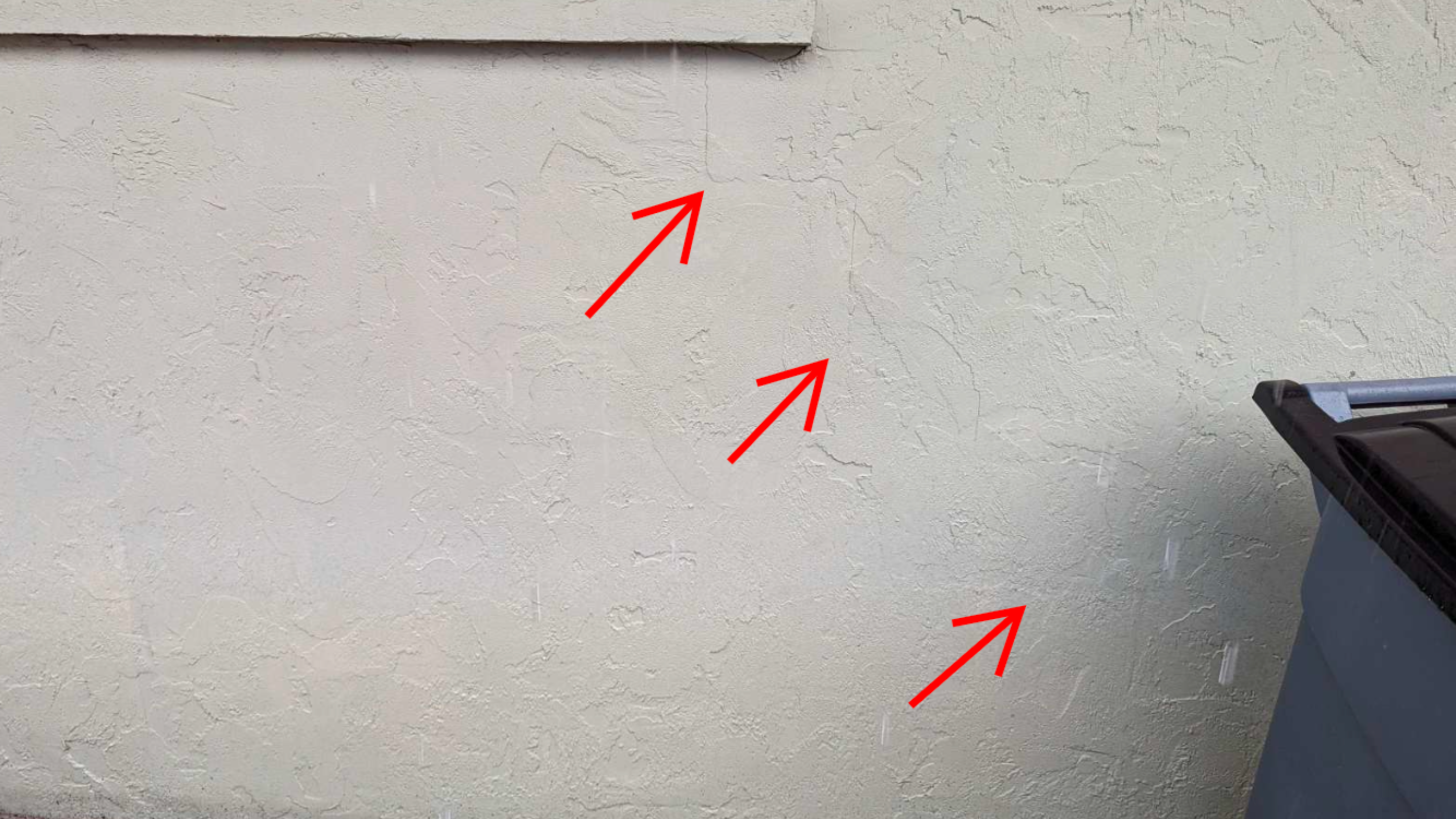
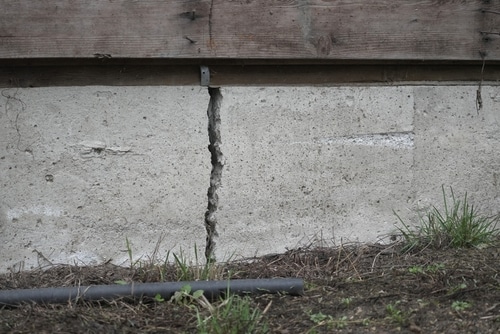
Stucco cracks are often cosmetic and may be caused by normal expansion, contraction, weather exposure, or improper stucco application. Structural cracks are more concerning because they may indicate foundation settlement, soil movement, wall movement, or stress in the home’s structure.
In Florida homes, the difference usually comes down to the crack pattern, width, location, whether the crack is growing, and whether other warning signs are present. Hairline stucco cracks may only affect the surface finish, but stair step cracks, widening cracks, horizontal cracks, cracks around windows and doors, or cracks that return after repair should be inspected to determine whether the issue is cosmetic or structural.
Some stucco cracks are only skin-deep. Others are the surface sign of movement in the block wall, foundation, or soils below the home. The job is to identify which one you have before spending money on the wrong repair.
Read more: Foundation Problems in Florida: The Complete Homeowner Guide
Why Stucco Cracks Are Common in Florida Homes
Stucco cracking is common in Florida because many homes are built with concrete block walls covered by an exterior stucco finish. Stucco is durable, but it is exposed to heat, humidity, heavy rain, wind-driven moisture, and daily temperature changes.
Florida homes also sit on soils that can shift, soften, wash out, or settle over time. Sandy soils, poorly compacted fill, heavy rainfall, drainage problems, sinkhole-related conditions in certain areas, and coastal or waterfront erosion can all create stress around a home.
That means a crack on the outside of a Florida home may be a surface-level stucco issue, or it may be a sign that something behind the stucco is moving.
| Common Reason Stucco Cracks Form | What It May Indicate |
| Normal expansion and contraction | Usually cosmetic |
| Temperature changes | Usually cosmetic |
| Moisture intrusion | Can be cosmetic or structural depending on severity |
| Improper stucco application | Usually cosmetic |
| Shrinkage during curing | Usually cosmetic |
| Settlement of the home | Possible structural movement |
| Movement in concrete block walls | Possible structural movement |
| Poor soil compaction beneath the home | Possible foundation movement |
| Weak shallow soils near the foundation | Possible foundation movement |
| Drainage problems or erosion | Possible soil support loss |
| Sinkhole-related settlement in certain areas | Possible structural movement |
The important question is not just, “Is there a crack?” The better question is, “Why did the crack form, and is it still moving?”
Read more: How Florida Soil Affects Foundations
Cosmetic Stucco Cracks vs Structural Cracks
Not every crack is a foundation problem. Some stucco cracks are cosmetic and only affect the exterior finish. Others may be structural and connected to movement in the wall, foundation, slab, or soils beneath the home.
Here is a simple way to compare the two.
| Crack Type | What It Usually Means | Typical Appearance | Level of Concern |
| Cosmetic stucco crack | Surface finish issue | Hairline, spiderweb, shallow, not widening | Usually lower concern |
| Shrinkage crack | Stucco curing or minor movement | Thin, random, limited area | Usually lower concern |
| Diagonal crack from window or door corner | Possible stress concentration or movement | Angled crack near opening | Moderate to higher concern |
| Stair step crack | Possible block wall or foundation settlement | Follows mortar joints in a step pattern | Higher concern |
| Horizontal crack | Possible wall movement, settlement, construction issue, or other stress | Runs sideways across wall | Higher concern |
| Widening crack | Active movement may be occurring | Crack grows longer or wider over time | Higher concern |
| Repaired crack that returns | Cause was not corrected | Same area cracks again after patching | Higher concern |
The table is not a substitute for an inspection, but it gives homeowners a practical starting point.
A cosmetic crack is usually limited to the stucco finish. A structural crack is more concerning because it may reflect movement in the wall system or foundation.
Homeowner Tip: Take a close-up photo and a wider photo of the crack before patching or painting. The close-up shows width and pattern. The wider photo shows the crack’s location, nearby windows or doors, and whether other symptoms may be connected.
Read more: How to Tell If Foundation Cracks Are Serious or Cosmetic
What Cosmetic Stucco Cracks Usually Look Like
Cosmetic stucco cracks are usually small, shallow, and stable. They may appear because of normal weather exposure, curing, minor shrinkage, or installation conditions.
A crack is more likely to be cosmetic if:
- It is hairline thin
- It appears only in the stucco surface
- It does not follow the concrete block joints
- It has not grown over time
- It does not continue around corners or through the wall
- There are no sticking doors or windows nearby
- There are no floor elevation changes
- There are no interior cracks in the same area
- There are no gaps around doors, windows, trim, or ceilings
Spiderweb cracking, also called map cracking, is often related to stucco application, curing, or surface conditions. Small isolated hairline cracks can also occur from expansion and contraction.
If the crack is cosmetic, the repair may be handled by a qualified stucco or paint contractor. If it keeps coming back, widens, or appears with other warning signs, the cause should be investigated before more cosmetic repairs are made.
What Structural Cracks Usually Look Like
Structural cracks are more concerning because they may indicate that the home, wall, foundation, or supporting soils are moving. These cracks are often wider, longer, recurring, or connected to other symptoms.
A crack is more likely to be structural if:
- It follows a stair step pattern in a block wall
- It runs horizontally across a wall
- It is diagonal from the corner of a window or door
- It is wider than a typical hairline crack
- It continues to grow
- It reopens after being patched
- It appears on both the exterior and interior side of a wall
- It is paired with sticking doors or windows
- It appears near gaps around frames, trim, walls, or ceilings
- It is located near uneven or sloping floors
- It appears close to settled concrete, erosion, or drainage issues
Structural cracking does not always mean the home is unsafe, but it does mean the crack deserves more attention. The goal is to determine whether the crack is caused by surface stucco movement or by movement in the structure behind it.
Read more: Is Stair-Step Cracking in Block Walls a Serious Foundation Issue?
Why Crack Location Matters
Where a crack appears can say a lot about what may be causing it.
Cracks around windows and doors are important because openings are natural weak points in walls. When a home settles or shifts, stress often shows up around these areas first.
Cracks near corners can also be meaningful. A settling corner of a home may create stair step cracking, diagonal cracking, separation, or gaps around nearby openings.
Cracks along garage openings are common because garage walls and openings can experience stress when the foundation below moves unevenly.
Cracks near settled driveways, patios, pool decks, or walkways may also indicate that soils near the home are loose, eroding, or poorly compacted.
| Crack Location | Why It Matters |
| Window or door corners | Openings are stress points where movement often appears |
| Home corners | May indicate differential settlement at one part of the structure |
| Garage openings | Large openings can show stress when the foundation moves unevenly |
| Near settled driveway, patio, or walkway | Nearby concrete settlement may suggest loose or washed-out soils |
| Near pool decks or exterior slabs | Settlement may point to poor compaction, erosion, or voids |
| Same area inside and outside | May indicate movement through the wall system, not only surface stucco |
Location does not prove the cause by itself, but it helps guide the inspection.
Read more: Gaps Around Windows and Doors: Foundation Problem or Normal Settling?
Stucco Application Problems vs Foundation Movement
Some stucco cracks are caused by how the stucco was installed. If the stucco was not applied correctly, if coats were not allowed to cure properly, or if the surface preparation was poor, cracks may form in the finish.
That is why Helicon does not treat every stucco crack as a foundation problem.
Many Florida homes are concrete block structures with stucco applied over the outside. Because of that, a surface crack may not tell the whole story. The question is whether the crack is only in the stucco layer or whether movement has transferred through the wall system.
| More Likely Stucco Application Issue | More Likely Foundation Movement |
| Cracking is widespread but very shallow | Crack follows the block joints |
| Cracks look like spiderweb or map cracking | Crack is stair step, horizontal, or diagonal near openings |
| Cracks are limited to the surface | Crack is widening |
| There are no signs of settlement nearby | Crack reappears after repair |
| Doors, windows, floors, and interior finishes remain stable | Doors and windows nearby are no longer operating properly |
| Surface finish appears to be the main concern | Floor elevations show movement, Soil near the foundation is loose or weak |
The mistake is assuming too quickly in either direction. Some homeowners dismiss structural cracks as “just stucco.” Others assume every stucco crack means major foundation repair. Both assumptions can lead to the wrong decision.
Read more: Foundation Repair
Florida Soil Conditions That Can Create Structural Cracks
Florida soil conditions are one of the biggest reasons cracks can become more than a cosmetic issue.
Many homes are built on sandy soils or fill soils that may not have been compacted well enough before construction. Over time, those soils can compress, erode, or lose support capacity. When the soil beneath part of the home can no longer carry the load evenly, the foundation or slab may settle.
Florida’s heavy rainfall can make the problem worse. Water can soften soils, wash out loose material, create voids, or cause erosion near the foundation. In coastal and waterfront areas, soil loss and changing water conditions can add more stress.
In some parts of Florida, sinkhole-related activity can also contribute to settlement or structural movement.
Florida-specific factors that may contribute to structural cracking include:
- Loose sandy soils
- Poorly compacted fill
- Weak shallow soils near the foundation
- Heavy rainfall and soil softening
- Drainage problems
- Erosion or washout near the home
- Voids beneath slabs or foundations
- Slab-on-grade construction without adequate support
- Settlement around older block homes
- Sinkhole-related conditions in certain regions
- Coastal or waterfront soil movement
This is why it is not enough to only look at the stucco. The soils around and beneath the home often tell part of the story.
Read more: What Causes Foundation Settlement in Florida?
How Helicon Evaluates Stucco and Structural Cracks
When a homeowner calls Helicon about cracking, the inspection is not limited to the crack itself. The crack is treated as a clue.
A proper evaluation may include:
- Reviewing the crack pattern, width, and location
- Looking for stair step, horizontal, diagonal, or widening cracks
- Checking whether the crack appears limited to stucco or connected to block movement
- Inspecting nearby doors and windows
- Looking for gaps around frames, trim, ceilings, or floors
- Checking for interior cracking in the same area
- Reviewing floor elevations with a laser level when needed
- Looking for signs of settlement around the home
- Checking drainage patterns near the foundation
- Looking for erosion, washout, or settled concrete nearby
- Using a soil probe to evaluate how loose or weak the upper soils are near the foundation
The soil probe is important because it gives the inspector a practical way to evaluate the upper soil conditions near the foundation. If the upper several feet of soil are loose or weak, that may support the possibility that shallow soil conditions are contributing to movement.
The goal is not to force every crack into the same repair category. The goal is to determine whether the crack is cosmetic, related to shallow soil settlement, or connected to deeper foundation movement.
Read more: What a Foundation Inspection Looks Like
What Homeowners Should Not Do
There are two common mistakes homeowners make with stucco cracks.
The first mistake is patching, caulking, or painting over the crack before understanding why it formed. That may improve the appearance temporarily, but if the crack is caused by movement, it may reopen.
The second mistake is assuming every stucco crack is a major foundation problem. Some cracks are cosmetic and may not require structural repair.
Homeowners should avoid:
- Caulking a crack and assuming it is solved
- Painting over a crack that is still moving
- Repairing stucco before checking for structural signs
- Ignoring cracks that return after repair
- Assuming all cracks are cosmetic
- Assuming all cracks require foundation repair
- Waiting until cracks widen significantly before asking questions
- Spending money on cosmetic repairs before diagnosing the cause
The right first step is to understand what type of crack it is.
Checklist: When a Crack Should Be Inspected
Use this checklist as a practical guide. If one or more of these signs are present, the crack should be looked at more closely.
- The crack is widening
- The crack is longer than it used to be
- The crack returned after patching or painting
- The crack follows a stair step pattern
- The crack runs horizontally across a wall
- The crack starts at the corner of a window or door
- Doors or windows nearby are sticking
- Gaps are forming around frames or trim
- Interior drywall cracks appear in the same area
- Floors nearby feel uneven or sloped
- Exterior concrete near the wall is settling
- Water drains toward the foundation
- Soil near the foundation feels loose or washed out
- The crack appears to go through the block, not just the stucco
A single small hairline crack may not be urgent. A crack with movement, widening, or other symptoms should not be ignored.
Read more: Why Are My Doors and Windows Sticking?
How Much Does It Cost to Repair Stucco or Structural Cracks?
The cost depends on what caused the crack. Diagnosis determines the repair.
If the crack is cosmetic and limited to drywall, stucco, paint, grout, or other finish materials, repair costs depend on the material, affected area, access, and finish quality.
If the crack is a symptom of foundation settlement or soil movement, the cost depends on the underlying cause, severity, repair method, soil conditions, access, engineering requirements, and how much of the home is affected.
| Repair Type | Typical Cost Range | When It Applies |
| Cosmetic stucco repair | Contractor-specific | Surface-level stucco cracking, finish issues, repainting needs |
| Concrete lifting or slab support | Around $1,500 to $8,000 | Nearby slabs or concrete have lost support |
| Polyurethane soil stabilization | Around $5,000 to $20,000 | Shallow weak soils are contributing to movement |
| Underpinning systems with piers | Around $10,000 to $60,000 | Deeper settlement or controlled foundation lifting is needed |
| Combined pier and polyurethane repairs | Project-specific | Lifting and void filling are both needed |
*These are typical Florida pricing examples based on published industry resources and contractor pricing guides. They are intended for educational purposes only and are not Helicon’s pricing. Every home is different, and a professional inspection is the only way to determine the appropriate repair and provide an accurate quote.
The cost should be based on the cause, not just the visible crack. A drywall crack, stucco crack, block wall crack, and foundation settlement crack can look similar but have very different causes and repair needs.
If you receive two very different repair estimates, compare the diagnosis and recommended repair before comparing the price. The lowest price is only a better value if it is addressing the right problem.
Read more: Why Foundation Repair Quotes Vary So Much
For broader pricing guidance, see our foundation repair cost guide.
Read more: How Much Does Foundation Repair Cost in Florida
Should This Article Be About Repairs or Diagnosis?
For homeowners, diagnosis should come first.
If the issue is cosmetic, a stucco repair may be appropriate. If water is contributing to the problem, drainage corrections may be needed. If shallow weak soils are causing early settlement, polyurethane soil stabilization may be recommended. If the foundation has settled significantly or requires precision lifting, push piers, helical piers, or drilled piers may be needed.
The repair depends on the cause.
| If the Cause Is… | The Next Step May Be… |
| Cosmetic stucco cracking | Stucco or paint repair |
| Poor stucco application | Stucco contractor evaluation |
| Drainage sending water toward the foundation | Drainage correction plus crack monitoring |
| Shallow weak soils | Polyurethane soil stabilization |
| Slab voids or support loss | Structural polyurethane void filling or slab support |
| Significant foundation settlement | Push piers, helical piers, drilled piers, or engineered support |
| Sinkhole-related concern | Further evaluation, engineering, or geotechnical repair recommendations |
That is why this article is not meant to help homeowners pick a repair method from a list. It is meant to help them understand whether their crack is likely cosmetic or whether it should be evaluated as a possible structural issue.
Read more: Polyurethane Soil Stabilization
When to Schedule a Foundation Inspection
You should schedule a foundation inspection if a stucco crack appears to be widening, follows a stair step or horizontal pattern, returns after repair, appears near windows or doors, or is paired with other signs of movement.
Call an expert if you notice:
- Stair step cracking in stucco or block walls
- Horizontal cracks
- Diagonal cracks from window or door corners
- Cracks that keep reopening
- Gaps around windows, doors, trim, or ceilings
- Doors or windows that stick or no longer latch
- Uneven or sloping floors
- Interior cracks near the same area
- Settled concrete near the foundation
- Loose or washed-out soil near the home
- Drainage problems near the wall
Not sure if your crack is cosmetic or structural? Helicon can inspect the crack, evaluate the surrounding signs of movement, use soil probing when appropriate, and help determine whether the issue is surface-level stucco cracking or active foundation movement.
Why Florida Homeowners Trust Helicon
Helicon has been helping Florida homeowners solve foundation repair, soil stabilization, concrete lifting, sinkhole repair, and seawall stabilization problems since 2004.
As a family-owned Florida company, Helicon understands the soil conditions, construction practices, and settlement patterns that affect homes across Tampa Bay, Orlando, Southwest Florida, and surrounding areas. Our team works on both residential and complex commercial stabilization projects, often in coordination with engineers, property owners, municipalities, builders, and other construction professionals.
We are not there to tell every homeowner that every crack requires major foundation repair. We are there to determine what the crack means.
Sometimes the issue is cosmetic. Sometimes it is poor stucco application. Sometimes it is shallow weak soil. Sometimes the home needs structural underpinning. Sometimes the best solution is a combination of repairs.
The goal is always the same: identify the cause, protect the structure, and recommend the least invasive repair that properly addresses the movement.
Read more: About Helicon
Schedule a Free Foundation Inspection
If you are unsure whether a stucco crack is cosmetic or structural, Helicon can help. Our team can evaluate the crack pattern, nearby warning signs, soil conditions, and foundation movement indicators to help determine the right next step.
Schedule a free foundation inspection with Helicon to find out whether your crack is surface-level stucco cracking or a sign of a deeper structural issue.
Read more: Foundation Repair
FAQ
Are stucco cracks normal in Florida homes?
Yes, small hairline stucco cracks are common in Florida homes because of heat, humidity, expansion, contraction, weather exposure, and normal aging. However, cracks that widen, return after repair, follow a stair step pattern, or appear with other warning signs should be inspected.
How can I tell if a stucco crack is structural?
A stucco crack may be structural if it is widening, follows a stair step or horizontal pattern, appears near windows or doors, continues through the block wall, or is paired with sticking doors, uneven floors, interior cracks, or gaps around frames and trim.
Are hairline stucco cracks serious?
Hairline stucco cracks are often cosmetic, especially if they are stable, and there are no other signs of movement. They become more concerning if they grow, spread, reopen after repair, or appear near other foundation warning signs.
What does a stair step crack in stucco mean?
A stair step crack may indicate movement in the concrete block wall behind the stucco. In Florida homes, this can be a sign of differential foundation settlement caused by weak or loose soils beneath part of the home.
Are horizontal cracks in stucco serious?
Horizontal cracks can be concerning because they may indicate wall movement, settlement, construction issues, or other structural stress. The cause depends on the wall, crack location, soil conditions, and whether other signs of movement are present.
Can poor stucco installation cause cracks?
Yes. Improper stucco application, poor curing, inadequate surface preparation, or moisture issues can cause stucco cracks. If there are no signs of foundation movement, a stucco contractor may be the right professional to evaluate the finish.
Why do stucco cracks come back after repair?
A crack that returns after repair may mean the underlying cause was not corrected. If the crack was caused by movement in the wall, foundation, or soil beneath the home, cosmetic patching alone will not stop it from reopening.
Should I repair stucco cracks before calling a foundation company?
If the crack is small, stable, and clearly surface-level, a stucco repair may be appropriate. If the crack is widening, recurring, stair step, horizontal, near openings, or paired with other signs of movement, it is better to evaluate the cause before making cosmetic repairs.
Can soil problems cause stucco cracks?
Yes. Weak shallow soils, poorly compacted fill, erosion, drainage problems, voids, or deeper settlement can cause the foundation or wall system to move. That movement may show up as cracking in the stucco or block wall.
Does every stucco crack need foundation repair?
No. Many stucco cracks are cosmetic. The key is determining whether the crack is limited to the stucco finish or whether it reflects movement in the wall, foundation, slab, or soil beneath the home.