Direct Answer
Foundation and settlement issues Orlando-area homeowners may encounter include:
- Differential foundation settlement
- Cracks in concrete block, stucco, or drywall
- Sticking doors and windows
- Uneven or sloping floors
- Interior slab settlement
- Sinking driveways, sidewalks, patios, and pool decks
- Voids beneath concrete
- Settlement related to poorly compacted fill
- Plumbing- or drainage-related soil loss
- Movement around additions and construction transitions
- Ground depressions or subsidence
- In some cases, sinkhole-related movement
The challenge is that many of these problems can look similar from above ground even when their causes are very different.
A stair-step crack could be associated with shallow foundation settlement. A low interior floor could involve only the slab. A yard depression can have several possible causes.
And although Orlando is located in karst terrain where sinkholes are a legitimate concern, a crack, depression, or settling foundation is not automatically evidence of a sinkhole.
The symptom tells you something may be moving. It does not necessarily tell you why.
Read more: Foundation Problems in Florida: The Complete Homeowner Guide
Why Do Orlando Homes Experience Foundation and Settlement Problems?
Central Florida combines several soil, geologic, construction, and water-related conditions that can affect foundations and concrete.
Sandy and Variable Shallow Soils
Sandy soils are common throughout Florida.
That does not make sand a poor foundation material.
Dense, properly compacted sand can provide good support.
Problems can develop when shallow soils are:
- Loose
- Poorly compacted
- Disturbed during construction
- Mixed with unsuitable fill
- Eroded or washed out
- Containing organic material
- No longer providing uniform support
Read more: How Florida Soil Conditions Affect Your Home Foundation
Karst and Limestone Geology
The Orlando area is also karstic.
Karst develops where soluble rock, particularly limestone, is gradually dissolved by groundwater, creating subsurface openings, depressions, springs, and sinkholes.
That geology makes sinkhole-related movement a legitimate consideration in Central Florida.
But it does not mean every Orlando foundation problem is sinkhole-related.
Construction, Fill, and Development
Residential development can involve:
- Grading
- Placed fill
- Utility trenches
- Drainage construction
- Pool excavation
- Landscaping
- Other disturbed soils
If placed or disturbed soils are not uniformly compacted, they can compress over time and contribute to settlement.
Water, Plumbing, and Drainage
Water matters when it changes the supporting soil.
Plumbing leaks, irrigation leaks, runoff, drainage problems, or erosion can loosen or remove soil and create inconsistent support.
The useful question is not simply:
“Is there water?”
It is:
“Is water removing, loosening, or otherwise changing the soil supporting the structure?”
Orlando Does Not Have One Foundation Problem
Two Orlando-area homes can show similar symptoms and still have completely different underlying conditions.
| Condition or Setting | What May Be Happening | What Not to Assume |
| Crack at one corner of home | Differential movement, historic movement, construction-related cracking | The entire foundation needs repair |
| Low interior floor | Interior slab settlement, void, weak shallow soil | The perimeter foundation is sinking |
| Sinking driveway or pool deck | Poor compaction, erosion, voids, slab settlement | The house foundation is failing |
| New ground depression | Soil loss, organic material, buried debris, broken pipe, subsidence, possible sinkhole | Every depression is a confirmed sinkhole |
| Older Orlando home | Plumbing history, additions, previous repairs, established cracks | Age alone means structural failure |
| Newer development | Fill, utility trenches, disturbed soils, construction compaction | New homes cannot settle |
| Home near lakes or drainage features | Variable soils, drainage, erosion, fill, groundwater influences | Nearby water automatically caused the movement |
A location provides context.
It does not diagnose the ground beneath an individual home.
1. Differential Foundation Settlement
One of the most important structural conditions is differential settlement.
This occurs when one portion of the foundation moves more than another.
Possible signs include:
- Stair-step cracks through block or mortar
- Diagonal cracks near doors or windows
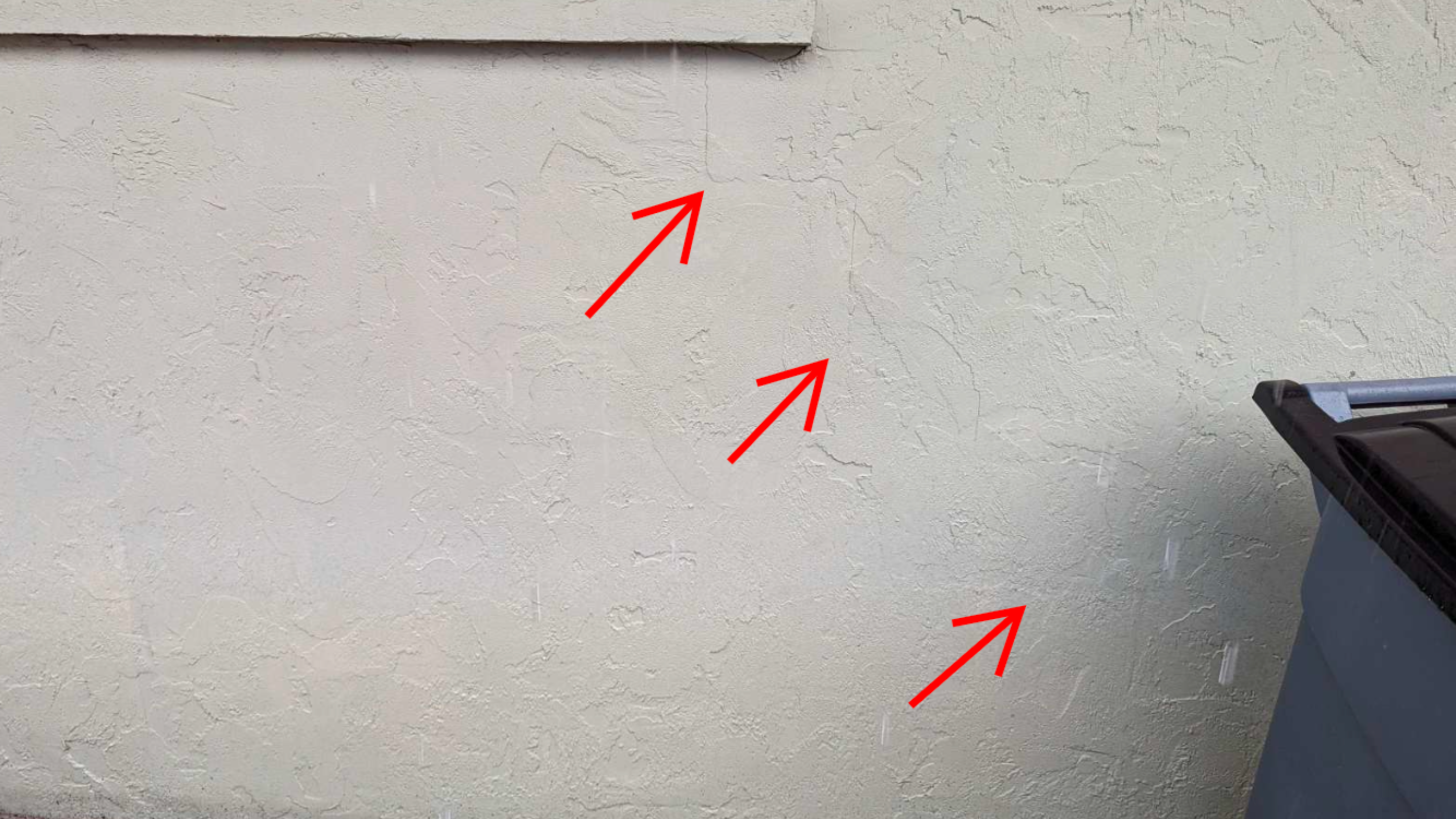
- Stucco cracks that reopen
- Doors or windows becoming difficult to operate
- Gaps around frames or trim
- Sloping floors
- Separation between portions of the structure
A foundation does not need to sink uniformly for damage to develop.
Uneven movement between two areas can place stress on the structure.
The crack is often evidence of movement—not the underlying cause of the movement.
Read more: Signs Your Home Foundation Is Sinking in Florida
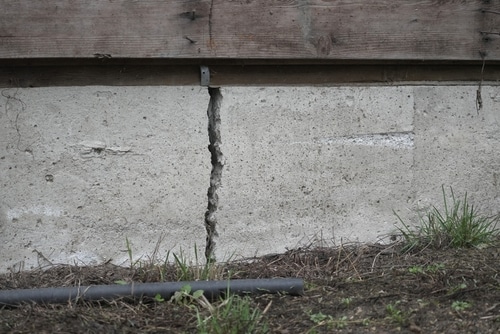
2. Foundation, Stucco, and Drywall Cracks
Cracking is one of the most common reasons homeowners become concerned.
But not every crack means the foundation needs repair.
Cracks can result from:
- Material shrinkage
- Stucco or drywall movement
- Thermal changes
- Construction joints
- Slab movement
- Foundation settlement
- Previous repairs
What matters more is the pattern and progression.
Conditions that deserve greater attention include:
- Cracks that continue widening
- Stair-step cracks through block or mortar
- Repaired cracks that repeatedly reopen
- Several cracks concentrated in one area
- Cracking accompanied by sticking doors or windows
- Cracking associated with measurable elevation differences
One crack should not become the diagnosis.
Read more: Foundation Cracks: When Should You Worry?
3. Interior Slab Settlement
One of the most misunderstood problems in Florida homes is interior slab settlement.
An interior floor can move even when the structural perimeter foundation remains comparatively stable.
Homeowners may notice:
- A room that feels low
- Sloping floors
- Cracked tile
- Gaps beneath baseboards
- Flooring separation
- Hollow-sounding areas
- Interior doors behaving differently
Possible causes include:
- Poorly compacted fill
- Plumbing leaks
- Soil loss
- Voids
- Loose shallow soils
- Buried organic material
This distinction matters because an interior slab problem may require a very different repair from structural foundation settlement.
In appropriate conditions, treatment may involve:
- Stabilizing weak soil beneath the slab
- Filling voids directly beneath the concrete
- Attempting controlled polyurethane slab lifting
Read more: Interior Slab Settlement: Causes, Signs & Repair Options
Read more: How Polyurethane Injection Works Under Your Home
4. Sinking Driveways, Sidewalks, Patios, and Pool Decks
Exterior concrete settlement is also common.
Homeowners may notice:
- Driveway slabs dropping
- Uneven sidewalks
- Pool deck settlement
- Sinking patios or lanais
- Trip hazards
- Gaps between concrete and the home
- New areas where water collects
Possible causes include loose fill, poor compaction, erosion, washout, voids, and organic material.
These slabs are lighter and supported differently from the structural foundation.
A sinking driveway or pool deck does not automatically mean your house foundation is settling.
Read more: Concrete Settlement and Lifting in Florida Guide
5. Poorly Compacted Fill
Fill and construction compaction deserve particular attention in growing residential areas.
A home, driveway, pool deck, patio, or addition may be built over soils that were:
- Excavated
- Replaced
- Graded
- Trenched
- Filled
- Otherwise disturbed
If those soils are not compacted uniformly, they may compress later under structural or slab loads.
Settlement may appear:
- Soon after construction
- Gradually over several years
- Only in one portion of the property
- Around utility trenches or additions
- Beneath exterior slabs while the home remains stable
The visible settlement does not necessarily mean the native soil is poor.
The problem may be the condition of the soil placed or disturbed during construction.
6. Plumbing-Leak-Related Settlement
A leaking pipe beneath or near an interior slab can affect the supporting soil.
Depending on the conditions, water may:
- Loosen soil
- Carry soil particles away
- Create voids
- Reduce slab support
This can contribute to interior settlement.
But:
A low floor does not prove there is a plumbing leak, and a plumbing leak does not prove the slab has settled.
When an active leak is contributing to soil loss, correcting the plumbing problem is generally part of the overall repair plan.
7. Voids and Soil Washout Beneath Concrete
When supporting soil moves away from beneath concrete, an unsupported space can form.
Homeowners may notice:
- Hollow-sounding concrete
- Cracks
- Settlement
- Rocking slabs
- Visible gaps at slab edges
The important distinction is whether the problem involves:
A void directly beneath the concrete
or
Weak soil deeper beneath the void
Those conditions may require different treatment objectives.
Filling the empty space and improving weak supporting soil are related—but they are not necessarily the same repair.
Read more: Voids Under Concrete Slabs: What Causes Them and How to Fix Them
8. Drainage and Erosion
Central Florida’s heavy rainfall can expose drainage problems around a property.
Possible concerns include:
- Roof runoff concentrated beside the home
- Low areas holding water
- Water repeatedly crossing one portion of the yard
- Erosion beside slabs
- Soil loss beneath concrete
- Irrigation leaks
- Broken drainage systems
Drainage matters when evidence shows that water is removing or disturbing supporting soil.
It should not become the automatic explanation for every crack.
9. Settlement Around Additions, Pools, and Construction Transitions
Movement can occur where one construction phase meets another.
Examples include:
- Room additions
- Porches
- Lanai enclosures
- Garage conversions
- Pool decks
- Patios
- Older and newer sections of a home
These areas may have different:
- Foundation systems
- Structural loads
- Fill
- Compaction
- Construction histories
A crack at a transition does not automatically indicate serious structural settlement.
But progressing separation or measurable elevation differences may justify further evaluation.
10. Sinkhole-Related Ground Movement
Sinkholes deserve particular attention in an Orlando article because Central Florida includes karst terrain.
As groundwater interacts with soluble limestone, subsurface openings and other karst features can develop.
Possible warning signs may include:
- New ground depressions
- Structural cracking
- Floor movement
- Doors becoming misaligned
- Localized ground settlement
- Soil loss
But similar symptoms can also result from:
- Poorly compacted soil
- Organic material
- Broken pipes
- Buried debris
- Shallow soil settlement
- Other forms of subsidence
A sinking foundation is not automatically a sinkhole.
And:
A foundation evaluation by itself generally cannot confirm or rule out whether a subsurface condition is sinkhole-related.
A foundation inspection can identify movement patterns that may warrant additional investigation. When evidence genuinely suggests deeper subsurface movement, a geotechnical investigation may be appropriate.
Read more: What Causes Sinkholes in Florida—and Should You Worry?
What About Seminole County, Lake Mary, Sanford, and the North Orlando Area?
The same diagnostic approach applies throughout the broader Orlando market.
Seminole County and communities such as Lake Mary and Sanford also sit within Central Florida’s carbonate geology, where sinkholes and land subsidence are recognized regional concerns.
That makes karst geology relevant.
It does not mean ordinary cracking or settlement should automatically be classified as sinkhole-related.
Surface depressions and structural movement can have several possible causes, so the property still needs to be evaluated on its own conditions.
Why Two Orlando Homes Can Have the Same Crack for Different Reasons
Consider two homes with similar stair-step cracking.
At one, loose shallow fill may have gradually compressed beneath the footing.
At another, the foundation could be experiencing a deeper support problem.
At a third, the crack could be historic and no longer progressing.
The visible symptom looks similar.
The correct response may be completely different.
The same applies to uneven floors. A low area could represent:
- Interior slab settlement
- Structural foundation movement
- Original construction variation
- Historic movement that is no longer active
The symptom identifies where to investigate—not which product to install.
What Signs Matter Most?
A pattern of related symptoms is generally more informative than one isolated condition.
For example:
Stair-step crack + measurable low elevation + sticking window + continued progression
provides much more information than one isolated hairline stucco crack.
Patterns worth investigating include:
- Several symptoms concentrated in one area
- Cracks continuing to widen
- Doors or windows becoming progressively harder to operate
- Measurable elevation changes
- Repeated cosmetic repairs reopening
- Separation between structural sections
- New ground depressions
- Visible erosion or soil loss
A foundation problem is usually diagnosed from a pattern—not one symptom.
What Can Look Like a Foundation Problem but May Not Be One?
Not every imperfection means the structural foundation needs repair.
Possible alternatives include:
- Cosmetic stucco cracking
- Drywall joint cracks
- Concrete shrinkage
- Exterior slab settlement
- Tile cracking unrelated to structural movement
- Door adjustment problems
- Localized slab voids
- Historic movement that is no longer progressing
- Poorly compacted fill affecting only exterior concrete
Sometimes monitoring is a reasonable decision instead of immediate repair.
Read more: When You Do NOT Need Foundation Repair
Does the Age of an Orlando Home Matter?
Age provides context but does not diagnose foundation condition.
Older Homes
Older Orlando-area homes may have:
- Older plumbing
- Additions
- Previous repairs
- Multiple construction phases
- Long-established cracks
A decades-old crack that has remained unchanged is different from one that appeared recently and continues to widen.
Newer Homes
Newer construction can still experience:
- Fill settlement
- Compaction problems
- Utility-trench settlement
- Drainage changes
- Exterior concrete settlement
New construction does not eliminate the possibility of ground movement.
The more useful question is:
What is moving now—and why?
How Should an Orlando Foundation Be Evaluated?
A useful evaluation should look beyond the visible crack.
Depending on the property and symptoms, Helicon may consider:
Symptom Patterns
Where are cracks, gaps, sticking openings, and other signs concentrated?
Relative Floor Elevations
A Zip Level may be used when appropriate to identify relative elevation patterns.
An elevation map provides useful evidence, but it does not identify the cause by itself.
Exterior Conditions
The evaluation may consider:
- Concrete settlement
- Drainage
- Erosion
- Additions
- Foundation transitions
- Soil loss
- Ground depressions
- Pool or patio construction
Shallow Soil Conditions
Soil probing may sometimes provide useful field information about apparent loose or weak shallow zones.
It does not replace a complete geotechnical investigation and does not establish the full soil classification, density, strength, or subsurface profile.
Property History
Useful information may include:
- Plumbing leaks
- Previous foundation repairs
- Additions
- Pool construction
- Drainage modifications
- Prior engineering reports
- Prior geotechnical testing
The goal is to determine:
What is moving, where is the support problem, and what repair objective—if any—is actually required?
Common Orlando Foundation Conditions and Possible Repair Objectives
| Condition Identified | Repair Objective | Repair That May Be Considered |
| Weak shallow soil beneath footing | Improve shallow foundation support | Polyurethane soil stabilization |
| Foundation requiring deeper support | Transfer structural loads deeper | Push or helical piers |
| Foundation requiring precise lifting | Support and control elevation recovery | Engineered underpinning with push piers, helical piers, or another appropriate foundation-support system |
| Weak soil beneath interior slab | Improve supporting soil | Polyurethane soil stabilization |
| Void beneath slab | Restore slab-to-soil contact | Structural void filling |
| Settled interior or exterior slab | Restore support and attempt elevation recovery | Polyurethane concrete lifting |
| Deeper weak soils | Improve deeper ground conditions | Compaction grouting or other engineered ground improvement |
| Engineered sinkhole remediation | Treat deeper and/or shallow subsurface conditions | Engineer-designed grouting and possibly underpinning |
| Active drainage or plumbing source | Stop continuing soil loss | Correct source as part of overall repair plan |
| No evidence of meaningful movement | Observe condition | Monitoring may be appropriate |
This is not a prescription table.
It illustrates why diagnosis and repair objective matter.
Soil Stabilization or Foundation Piers?
This is one of the most important repair distinctions.
Polyurethane Soil Stabilization
May make sense when an appropriate shallow soil zone has lost density or support.
Around a structural foundation, its primary objective is to improve supporting soil and help reduce additional settlement.
Foundation Piers
Push or helical piers may make more sense when:
- The support problem extends deeper
- Dependable structural support is required at greater depth
- The structural foundation requires precise, controlled lifting
Polyurethane improves the ground supporting the foundation. Underpinning gives direct support and greater control of the foundation itself.
Read more: Helical Piers vs. Push Piers: What’s the Difference?
Should Orlando Homeowners Be Worried About Every Crack?
No.
Stucco, drywall, and concrete can all crack without requiring structural foundation repair.
Pay attention to:
- Location
- Pattern
- Whether the crack is changing
- Whether it has reopened
- Whether other symptoms are occurring nearby
- Whether measurable movement is present
Be cautious with both fear and false reassurance.
Checklist: What Orlando Homeowners Should Look For
Inside the Home
- Look for new or progressing drywall cracks
- Check doors and windows that recently started sticking
- Look for gaps around trim or frames
- Check tile and flooring for new cracking or separation
- Note floors that feel noticeably low or sloped
- Photograph cracks so changes can be tracked
Around the Exterior Foundation
- Look for stair-step block or mortar cracks
- Check stucco around windows and doors
- Look for separation between different sections of the home
- Check for erosion or missing soil near the foundation
- Look for new ground depressions
- Note concentrated drainage near the home
Around Concrete
- Check driveways for settlement
- Look for sidewalk trip hazards
- Inspect pool decks for low or separated areas
- Check patios and lanais
- Look for visible voids along slab edges
Property History
- Note plumbing or irrigation leaks
- Identify additions or converted spaces
- Locate previous foundation or engineering reports
- Determine whether cracks have been repaired before
- Note recent pool, utility, drainage, or landscaping work
- Record whether symptoms are stable or changing
You do not need to diagnose the problem yourself.
The checklist provides better information for whoever evaluates the property.
When Should You Have an Orlando Foundation Evaluated?
Consider an evaluation when:
- Cracks continue changing
- Multiple symptoms develop in the same area
- Doors or windows suddenly become misaligned
- Floor elevations appear to be changing
- Cracks repeatedly reopen
- Sections of the structure appear to be separating
- Significant soil loss is visible
- A new depression develops
- You cannot tell whether the movement involves the slab or structural foundation
A rapidly developing depression or condition that appears immediately unsafe should be treated differently from ordinary cracking.
Avoid standing in or near an unstable depression and contact appropriate professionals or local authorities when immediate safety is a concern.
Why Orlando and Central Florida Experience Matter
Helicon has worked with Florida foundations and soils since 2004 and serves the Orlando and Central Florida market.
Our experience includes communities such as:
- Orlando
- Winter Park
- Maitland
- Apopka
- Winter Garden
- Ocoee
- Lake Mary
- Sanford
- Oviedo
- Altamonte Springs
- Kissimmee
- St. Cloud
- Clermont
- Surrounding Central Florida communities
The important lesson is not that these areas all have the same problem.
They do not.
Helicon works with:
- Push piers
- Helical piers
- Polyurethane soil stabilization
- Structural void filling
- Concrete lifting
- Compaction grouting
- Deep foundations
- Sinkhole remediation
The value of having multiple capabilities is not finding a reason to use more of them.
It is being able to distinguish between structural foundation settlement, interior slab settlement, weak shallow soils, deeper support problems, concrete settlement, fill-related movement, soil loss, possible sinkhole-related conditions, and situations that may only need monitoring.
Good foundation repair starts with understanding the structure and the ground beneath it—not choosing the product first.
Schedule a Foundation Inspection
If your Orlando-area home has cracks, uneven floors, sticking doors or windows, sinking concrete, gaps, or other signs of possible movement, you do not need to diagnose the repair yourself.
Start with:
- What is actually moving?
- Is the movement active?
- Is it the foundation or an interior slab?
- Is the support problem shallow or deeper?
- Could plumbing, drainage, fill, or erosion be contributing?
- Is there evidence that deserves deeper geotechnical investigation?
- Does the condition require repair at all?
Once those questions are answered, the appropriate next step becomes much clearer.
The goal is not to assume the worst. The goal is to determine what the evidence actually supports.
Read more: Foundation Repair
FAQ
What foundation problems are common in Orlando?
Common conditions include differential foundation settlement, interior slab settlement, sinking exterior concrete, poorly compacted fill, voids, plumbing- or drainage-related soil loss, and settlement around additions. Sinkhole-related movement is also a legitimate Central Florida concern.
Why do Orlando homes develop foundation problems?
Possible contributors include loose or poorly compacted soil, fill, erosion, plumbing leaks, drainage, construction disturbance, organic material, and deeper geologic conditions.
Is Orlando built on sinkhole-prone geology?
Orlando is located in karst terrain, so sinkholes and related geologic features are legitimate regional considerations. That does not mean every property or foundation problem is affected by sinkhole activity.
Does a crack mean my Orlando home has a sinkhole?
No. Foundation settlement, poor compaction, slab movement, soil loss, and other conditions can also cause cracking.
Can a foundation inspection confirm a sinkhole?
A foundation evaluation can identify movement patterns that may warrant further investigation, but it generally cannot by itself confirm or rule out a sinkhole-related subsurface condition.
Can an interior floor sink without the foundation sinking?
Yes. An interior slab can lose support while the structural perimeter foundation remains comparatively stable.
Does a sinking driveway mean my foundation is failing?
No. Exterior slabs can settle independently because their loads and support conditions differ from the home’s structural foundation.
Can poorly compacted fill cause settlement?
Yes. Fill or disturbed soils that are not uniformly compacted can compress under loads and contribute to settlement.
Can plumbing leaks cause floor settlement?
They can contribute if leaking water disturbs or removes supporting soil beneath the slab.
Can heavy rain cause foundation problems?
Rain can contribute when concentrated water flow erodes, loosens, or removes supporting soil. Rain alone does not mean a foundation will settle.
Are newer Orlando homes protected from settlement?
No. New construction can still be affected by fill, compaction, utility trenches, drainage, and other disturbed soils.
Are older Orlando homes more likely to have foundation problems?
Age alone does not determine foundation condition. Older homes may simply have more plumbing history, additions, previous repairs, and long-established cracks to evaluate.
Is polyurethane injection used for Orlando foundation problems?
It may be appropriate when weak or loose shallow soils are contributing to loss of support. Around a structural foundation, its primary objective is foundation soil stabilization rather than precise foundation lifting.
When are foundation piers used?
Push or helical piers may be appropriate when a foundation requires deeper structural support or controlled, precise lifting.
When is compaction grouting used?
Compaction grouting may be appropriate when deeper soil improvement is required. It is also commonly used as part of engineer-designed sinkhole remediation when deeper soils need treatment.
How do I know whether I need soil stabilization or foundation piers?
It depends on where support has been lost and what the repair needs to accomplish. Weak shallow soil may call for ground improvement, while deeper structural support or precise foundation lifting may call for underpinning.
Does every foundation crack need repair?
No. Some cracking is cosmetic or historic and may only need monitoring. Pattern, progression, location, and accompanying symptoms matter.
What should I do if a depression appears in my yard?
Do not automatically assume it is a sinkhole. Avoid the area if it appears unstable or rapidly changing, document the condition, and have it appropriately evaluated.
What should I do first if I notice a possible foundation problem?
Document the symptoms and whether they are changing. If several signs occur together, movement appears to be progressing, or you cannot tell what part of the home is moving, have the condition evaluated before choosing a repair.