Direct Answer
Common seawall-related problems Southwest Florida homeowners may encounter include:
- Soil washing out through seawall panel joints
- Voids developing behind the wall
- Depressions or holes forming near the seawall
- Settling pavers, patios, or pool decks
- Cracks or gaps between seawall panels
- Poor drainage or excessive water pressure behind the wall
- Soil loss around seawall ends, corners, or other openings
- Cracked or damaged seawall caps
- Leaning, bowing, or displaced seawall panels
- Storm- or high-water-related erosion
The most important distinction is that a seawall problem is not always a structural seawall problem.
In many cases, the wall may still be functioning while soil escapes from behind it through panel joints, cracks, gaps, or other pathways.
In other cases, the wall itself may be structurally damaged and require repair or replacement by a qualified marine contractor or engineer.
Sometimes both conditions exist.
The first question should not be “How do we repair the seawall?” It should be “Is the problem the wall, the soil behind the wall, the drainage—or some combination of them?”
Read more: Seawall Failure & Soil Erosion: A Homeowner’s Guide
Why Are Seawall Problems Common in Southwest Florida?
Southwest Florida has thousands of waterfront homes along canals, rivers, bays, and coastal waterways.
Properties in communities such as Cape Coral, Fort Myers, Fort Myers Beach, Bonita Springs, Estero, Naples, Marco Island, Pine Island, and surrounding areas can experience:
- Sandy backfill soils
- Changing water levels
- Heavy rainfall
- Storms and high-water events
- Drainage from the land side of the wall
- Wave or boat-wake activity
- Aging seawall components
- Soil movement through joints and openings
- Pool decks, pavers, docks, and other improvements close to the wall
None of these conditions automatically means a seawall will fail.
But waterfront structures operate in an environment where water must be relieved without allowing the soil behind the seawall to escape.
The Seawall, the Soil, and the Drainage Are Different Parts of the System
Homeowners often refer to everything along the waterfront as “the seawall.”
It helps to separate the system into three parts.
| Part of the System | Its Job | Common Problem |
| Seawall structure | Retain soil and resist forces from the land and water | Cracking, bowing, leaning, displaced panels, structural deterioration |
| Backfill soil | Support the yard, pool deck, pavers, and other improvements behind the wall | Erosion, voids, loose soil, settlement |
| Drainage / pressure relief | Allow water behind the wall to escape without carrying soil with it | Blocked, inadequate, or uncontrolled drainage |
A repair that addresses only one part may not correct a problem involving another.
For example:
- Injecting soil behind a severely failing structural wall does not rebuild the wall.
- Structurally repairing a wall without addressing continuing soil loss may leave unsupported areas behind it.
- Sealing uncontrolled openings without providing appropriate pressure relief can create another problem.
A good seawall repair plan should address both where soil is escaping and how water pressure will be relieved.
1. Soil Loss Through Seawall Panel Joints
One of the most common conditions Helicon encounters is soil escaping through joints between seawall panels.
Concrete seawalls are commonly built from individual panels. Where those panels meet, openings can develop or enlarge over time.
Water moving through those openings may carry fine soil particles toward the water.
Homeowners may first notice:
- A small depression near the wall
- Sand disappearing from behind the cap
- Pavers beginning to settle
- A hole developing along the seawall
- Soil visibly moving through a joint
As more soil is lost, voids can form behind the wall even while the wall itself still appears relatively straight.
2. Cracks, Gaps, and Other Soil-Loss Pathways
Panel joints are not the only places where soil can escape.
Potential pathways include:
- Cracks in seawall panels
- Open panel joints
- Gaps beneath the seawall cap
- Openings around penetrations
- Damaged areas of the wall
- Gaps near wall ends or returns
- Other breaches communicating with the water
Water follows available pathways.
If those pathways are large enough to carry fine soil particles, backfill can gradually disappear from behind the wall.
A small opening in the wall can create a much larger problem in the soil behind it.
3. Voids Behind the Seawall
As soil escapes, unsupported areas can develop behind the seawall.
A void may exist beneath:
- Grass
- Pavers
- A patio
- A pool deck
- Landscaping
- Walkways
- Other waterfront improvements
The surface may temporarily bridge over the empty space, so the yard can look normal even after support has been lost below.
Eventually homeowners may notice:
- Hollow or soft areas
- Sudden depressions
- Settling pavers
- Cracked concrete
- Holes opening near the wall
Before simply filling the surface depression, determine:
- Why did the soil disappear?
- Has the pathway allowing soil loss been addressed?
- Is the surrounding soil still loose or unstable?
Adding fill from above may only be temporary if soil continues escaping through the wall.
4. Depressions or “Sinkholes” Behind the Seawall
Homeowners sometimes call a hole behind a seawall a “sinkhole.”
In many cases, the depression is actually caused by localized soil erosion or washout behind the wall, not a geologic sinkhole.
The sequence can be simple:
soil escapes → void forms → surface settles into the void
That can create a dramatic hole without involving limestone-related sinkhole activity.
A hole behind a seawall is not automatically a geological sinkhole.
Read more: What Causes Sinkholes in Florida—and Should You Worry?
5. Settling Pavers, Pool Decks, and Patios
Waterfront improvements are often located close to seawalls.
When the soil beneath them loses support, homeowners may see:
- Pavers dipping toward the seawall
- Pool decks cracking or settling
- Patios developing low areas
- Gaps beneath concrete
- Walkways becoming uneven
This does not necessarily mean the pavers or concrete are defective.
The supporting soil may be disappearing or becoming loose.
The repair sequence matters.
Lifting a settled slab without addressing continuing soil loss can correct the symptom while leaving the cause in place.
Read more: Voids Under Concrete Slabs: What Causes Them and How to Fix Them
Read more: Pool Deck Settlement: Causes and Repair Options
6. Hydrostatic Pressure Behind the Seawall
Water exists on both sides of a seawall.
The canal, river, or bay is on the water side, while rainfall and groundwater can accumulate in the soil behind the wall.
After heavy rain or high water, the land-side water level may remain elevated even after the waterway level drops.
That difference can create hydrostatic pressure pushing outward on the seawall.
A seawall therefore needs appropriate drainage.
The objective is simple:
Allow water to escape without allowing soil to escape with it.
7. Poor or Uncontrolled Pressure Relief
An open joint or crack may allow water pressure to dissipate, but if soil travels with that water, the drainage is uncontrolled.
A better objective is:
Provide a controlled path for water while retaining the soil behind the seawall.
On appropriate projects, Helicon may install a Jet Filter pressure-relief system.
Jet Filters can allow water behind the seawall to dissipate while helping retain backfill soil.
That means a repair can address both sides of the equation:
- Seal uncontrolled soil-loss pathways
- Stabilize weak or eroded soil
- Provide filtered locations where water can safely escape
Stopping soil loss does not mean trapping all water behind the seawall.
Read more: Seawall Repair
8. Soil Loss Around Wall Ends, Corners, and Returns
Not all erosion occurs through the face of the wall.
Soil can also move around:
- Wall ends
- Corners
- Return walls
- Transitions between seawall types
- Connections to neighboring properties
- Areas around docks or other structures
A homeowner may see settlement concentrated near one end while the rest of the seawall appears stable.
That localized pattern matters.
The repair should follow the actual soil-loss pathway rather than assuming the entire wall has the same problem.
9. Storms, High Water, and Overtopping
Southwest Florida waterfront properties can experience major changes in water level during severe weather.
High water can:
- Overtop a seawall
- Saturate backfill
- Move soil
- Expose existing gaps
- Worsen erosion
- Affect already weak areas
After the water recedes, homeowners may discover:
- New depressions
- Missing soil
- Settled pavers
- Enlarged joints
- New voids
- Changes in wall alignment
A storm may expose or accelerate an existing weakness rather than being the sole cause.
After significant high water, inspect both:
The seawall structure
and
The soil behind it.
10. Drainage, Irrigation, and Water Coming From the Property
Not all seawall erosion originates from the waterway.
Water may also come from:
- Downspouts
- Landscape drainage
- Irrigation leaks
- Pool overflow
- Broken pipes
- Concentrated surface runoff
- Drain lines discharging near the seawall
Repeated land-side water flow can contribute to soil movement or increase activity at an existing breach.
Correcting the seawall pathway without addressing a continuing water source may leave part of the problem unresolved.
11. Structural Seawall Damage
Some seawall problems are primarily structural.
Warning signs may include:
- Significant leaning
- Bowing
- Displaced panels
- Major structural cracks
- Broken panels
- Severe concrete deterioration
- Failed or displaced caps
- Evidence of tieback or anchoring problems
- Large changes in wall alignment
These conditions may require evaluation by a structural or marine engineer and repair by a qualified seawall or marine contractor.
Polyurethane soil stabilization does not rebuild a structurally failed seawall.
Helicon’s seawall work focuses on soil stabilization behind the wall, soil-loss pathways, voids, and pressure relief—not structural replacement of the seawall itself.
If the wall is structurally failing, stabilizing the soil alone may not be enough.
Soil Erosion or Structural Seawall Failure: What’s the Difference?
| What You See | Possible Issue | What May Need Evaluation |
| Small depression behind otherwise straight wall | Soil loss or void | Soil stabilization / breach location |
| Sand washing through panel joint | Active soil-loss pathway | Joint sealing and soil stabilization |
| Settled pavers behind wall | Loss of soil support | Backfill condition and ongoing erosion |
| Pool deck settling near wall | Soil loss, void, or weak supporting soil | Seawall area plus slab support |
| Water flowing through open joints with soil | Uncontrolled drainage and soil loss | Breach sealing plus pressure relief |
| Wall significantly leaning or bowing | Possible structural seawall problem | Structural/marine evaluation |
| Broken or displaced panel | Structural damage | Structural seawall repair |
| Cracked cap but wall remains aligned | Cap deterioration or localized structural issue | Cap/wall evaluation |
| Hole opens behind wall | Backfill loss or localized collapse | Determine source before filling |
| Problems concentrated at wall end | Flanking or localized soil-loss pathway | End/return condition |
The visible symptom is the starting point.
It is not necessarily the diagnosis.
How Polyurethane Soil Stabilization Works Behind a Seawall
When the wall is an appropriate candidate for soil stabilization, Helicon may use expanding structural polyurethane to improve the soil behind it and seal pathways where soil is escaping.
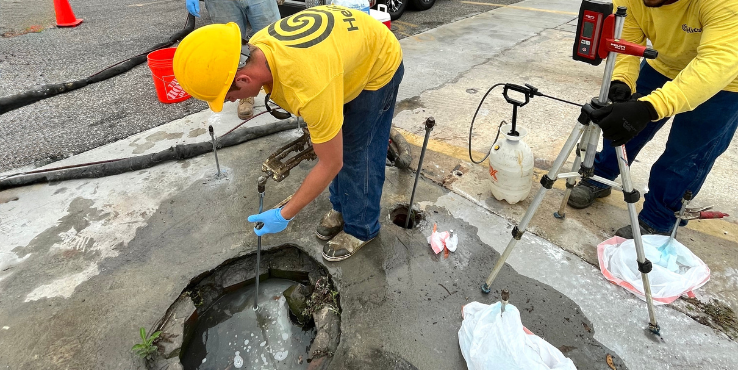
Step 1: Inspect the Seawall and Soil Behind It
The evaluation may look for:
- Open panel joints
- Cracks or breaches
- Depressions
- Settled pavers or concrete
- Visible voids
- Wall alignment
- Drainage conditions
- Existing pressure-relief systems
Helicon may also use soil probing to gather field information about apparent loose, weak, or voided areas behind the wall.
The goal is to determine:
Where has support been lost, and where is the soil escaping?
Step 2: Lay Out Injection Locations
Depending on site conditions, injection points may be spaced approximately 5 feet apart or positioned at seawall panel joints, which are common pathways for soil loss.
Actual spacing can depend on:
- Wall construction
- Visible breaches
- Soil conditions
- Existing voids
- Settlement patterns
- Access
- Repair design
Step 3: Install the Injection Rod
The injection rod may be inserted to approximately one foot below the mudline behind the seawall.
Treatment then progresses upward through the affected soil profile.
Step 4: Inject in Controlled Stages
Polyurethane may be pumped upward in stages, often in approximately one-foot increments, until the treatment reaches the surface.
This allows the soil to be treated through the affected vertical zone rather than at only one depth.
Step 5: Stabilize the Soil and Seal Soil-Loss Pathways
The structural polyurethane Helicon uses can expand many times its original liquid volume—approximately 50 times for certain formulations.
Depending on the soil and formulation, it can:
- Expand into voids
- Permeate portions of granular soil
- Bind soil particles
- Densify and stabilize loose soil
- Seal cracks and panel joints from the soil side
- Reduce pathways where backfill has been escaping
As the polyurethane expands, permeates, and binds with surrounding soil, it can create a hardened, stabilized mass behind the seawall.
A simple way to think about it is:
The process helps build a “wall behind the wall,” while also sealing many of the pathways where soil has been escaping.
Read more: What Is Soil Stabilization and How Does It Work?
Does Polyurethane Push the Seawall Toward the Water?
Expanding polyurethane can exert pressure, which is why seawall injection must be controlled.
The objective is to use that expansion to:
- Fill voids
- Improve soil support
- Seal breaches
- Stabilize loose backfill
Not to force the seawall outward.
Technicians monitor the injection response and adjust material placement as needed.
The goal is controlled soil stabilization—not simply injecting as much polyurethane as possible.
Why Add Jet Filters After Sealing Leaks?
This can sound contradictory.
If the repair seals openings in the seawall, why create filtered openings?
Because the two have different purposes.
Uncontrolled Joint or Crack
May allow:
Water + soil to escape
Filtered Pressure-Relief Opening
Designed to allow:
Water to escape while retaining soil
On appropriate projects, Jet Filters can provide controlled drainage after major soil-loss pathways have been sealed.
The objective is not to make the seawall watertight. It is to stop the loss of soil while still allowing appropriate pressure relief.
Does the Entire Seawall Need to Be Excavated?
Often, no.
Polyurethane soil stabilization can frequently be performed with little or no excavation behind the seawall.
Injection rods allow treatment at depth without excavating the entire waterfront area.
That can reduce disruption to:
- Landscaping
- Pavers
- Pool decks
- Patios
- Fences
- Waterfront yards
Less disruption is useful, but it should not determine the repair by itself.
The goal is the least invasive repair that properly addresses the problem.
Can Polyurethane Repair a Structurally Damaged Seawall?
Not by itself.
Polyurethane can be effective for:
- Soil stabilization
- Void filling
- Sealing soil-loss pathways
- Supporting settled areas behind the wall
It does not replace:
- Broken structural panels
- Failed tiebacks
- Severely leaning walls
- Major structural deterioration
- A seawall requiring replacement
Some properties may need both structural seawall work and soil stabilization behind the repaired wall.
Can You Just Fill the Hole With Dirt?
You can fill a depression, but that does not necessarily repair the cause.
If the pathway that allowed the original soil to escape remains open, new fill can follow the same route.
Before repeatedly adding dirt, ask:
Where did the original soil go?
If it escaped through or around the seawall, that pathway should be addressed.
What About Concrete Lifting Behind the Seawall?
If a pool deck, patio, or other slab has settled because support was lost near the seawall, polyurethane may sometimes be used to restore support and attempt controlled lifting.
But if active erosion is still occurring:
Stop the soil loss first.
Then address:
The settled concrete.
Read more: Polyurethane vs. Mudjacking vs. Replacement: An Honest Comparison
When Is Seawall Soil Stabilization Appropriate?
It may make sense when:
- Soil is washing through panel joints
- Voids are developing behind the wall
- The yard is settling near the seawall
- Pavers or slabs are losing support
- Backfill has become loose or eroded
- Cracks or breaches are allowing soil loss
- Appropriate pressure relief needs to be added or improved
- The structural wall is still appropriate for stabilization
That last point matters.
If the wall itself is seriously compromised, the structural condition also needs to be addressed.
When Is Polyurethane NOT Enough?
Additional structural evaluation may be needed when:
- The wall is significantly leaning
- Panels are broken or displaced
- Large structural cracks are present
- The cap or anchoring system has significantly failed
- Tiebacks appear compromised
- The wall has lost structural integrity
- Replacement may be necessary
The fact that the soil can be stabilized does not mean the seawall structure itself is sound.
Checklist: What Southwest Florida Homeowners Should Look For
Walk the waterfront periodically and document changes.
Behind the Seawall
- Look for new depressions or holes
- Check for soft or hollow-feeling areas
- Look for pavers beginning to settle
- Check pool decks and patios for new low areas
- Look for gaps beneath slabs or pavers
- Note areas repeatedly requiring added fill
At the Seawall
- Look for open panel joints
- Check for cracks or visible gaps
- Look for soil or sand appearing through joints
- Check whether the cap has cracked or shifted
- Look for wall sections that appear to lean or bow
- Check wall ends and corners for soil loss
Drainage
- Identify where roof and yard drainage goes
- Look for irrigation leaks
- Check for water concentrating near the wall
- Determine whether pressure-relief openings exist
- Look for uncontrolled water flow carrying soil through the wall
After High Water or a Major Storm
- Check for newly missing soil
- Look for fresh depressions
- Check pavers and slabs for new movement
- Compare wall alignment with previous photographs
- Look for newly opened joints or cracks
- Document changes before filling depressions
The purpose is not to diagnose the repair yourself.
It is to identify what changed and where.
How Helicon Evaluates Seawall Soil-Loss Problems
Helicon has worked with Florida soils and structures since 2004 and serves waterfront properties throughout Southwest Florida.
An evaluation may consider:
- Seawall joints, cracks, and breaches
- Visible soil loss
- Depressions and voids
- Settlement behind the wall
- Pavers and concrete
- Drainage and pressure relief
- Wall alignment
- Soil conditions behind the wall
Soil probing may also help identify apparent loose, weak, or voided areas behind the seawall.
The key questions are:
- Is soil actively escaping?
- Where is it escaping?
- Has a void developed?
- Is the backfill loose or unstable?
- Is pressure relief contributing to the problem?
- Are pavers or slabs losing support?
- Does the wall appear structurally sound enough for soil stabilization to be appropriate?
- Should a structural marine contractor or engineer become involved?
Helicon’s seawall service focuses on soil stabilization behind the wall, sealing soil-loss pathways, filling voids, and improving pressure relief. We do not structurally rebuild or replace seawalls.
The value of seawall soil stabilization is not finding a way to inject every wall. It is knowing when the problem is the soil—and when it is the structure.
Schedule a Seawall Inspection
If you see depressions, disappearing soil, settling pavers, sinking pool decks, open panel joints, or other changes along your Southwest Florida seawall, do not assume the entire wall needs replacement.
But do not repeatedly fill the hole and ignore it either.
Start by determining:
- Where is the soil going?
- What pathway is allowing it to escape?
- Has a void developed?
- Is the soil behind the wall still providing support?
- Can water pressure escape appropriately?
- Is the wall itself structurally damaged?
- Is the problem soil-related, structural, or both?
The goal is not simply to fill the hole. The goal is to stop the soil loss, restore support, and provide an appropriate path for water pressure to escape.
FAQ
What are the most common seawall problems in Southwest Florida?
Common problems include soil loss through panel joints or cracks, voids behind the wall, depressions, settling pavers or pool decks, inadequate pressure relief, and structural wall deterioration.
Why is dirt disappearing behind my seawall?
Soil may be escaping through joints, cracks, gaps, wall ends, or other openings as water moves through or around the seawall.
Why is a hole forming behind my seawall?
A depression can form when backfill is lost, a void develops, and the surface settles into the unsupported area.
Is a hole behind my seawall a sinkhole?
Not necessarily. Many depressions immediately behind seawalls are caused by localized soil loss or washout rather than geologic sinkhole activity.
Why are my pavers sinking near the seawall?
The supporting soil may have become loose, eroded, or partially washed away.
Can a pool deck settle because of seawall erosion?
Yes. Soil loss near the seawall can reduce support beneath a nearby pool deck.
Can polyurethane repair seawall erosion?
In appropriate conditions, polyurethane can stabilize soil, fill voids, and seal many soil-loss pathways behind the wall.
Does Helicon repair the actual seawall structure?
Helicon focuses on soil stabilization behind the wall, void filling, sealing soil-loss pathways, and pressure relief. Structural repair or replacement may require a qualified marine contractor and/or engineer.
How is polyurethane injected behind a seawall?
Injection points may be about 5 feet apart or positioned at panel joints. Rods may extend to approximately one foot below the mudline, with polyurethane injected upward in controlled stages.
How much does the polyurethane expand?
Certain structural polyurethane formulations used by Helicon can expand approximately 50 times their original liquid volume, depending on the formulation and site conditions.
What does “wall behind the wall” mean?
The polyurethane can expand, permeate, and bind with surrounding soil to create a hardened stabilized mass behind the seawall while helping seal soil-loss pathways.
What are Jet Filters?
Jet Filters are pressure-relief devices designed to allow water to escape from behind the seawall while helping retain the backfill soil.
Why install filters after sealing seawall joints?
The goal is to close uncontrolled openings that allow soil loss while providing filtered locations where water can still escape.
Should a seawall be completely watertight?
Not necessarily. Appropriate pressure relief is important. The objective is to stop soil loss without trapping excessive water pressure behind the wall.
Can polyurethane straighten a leaning seawall?
Polyurethane soil stabilization is not a substitute for structural seawall repair. A significantly leaning, bowing, broken, or displaced wall should be evaluated structurally.
Do you have to excavate behind the seawall?
Often, no. Injection rods can frequently treat affected soils with little or no excavation.
Can I just add dirt where the yard has settled?
That may temporarily fill the depression, but it will not stop continued soil loss if the pathway through or around the wall remains open.
Should seawall erosion be repaired before lifting a pool deck?
If active soil loss is contributing to the settlement, the erosion problem should generally be addressed first.
Does every crack in a seawall mean it needs replacement?
No. The significance depends on the crack, wall alignment, structural condition, soil loss, and other symptoms.
What should I do first if I notice seawall settlement?
Document what is changing and have the condition evaluated to determine whether the problem involves soil loss, drainage, structural seawall damage, or some combination of these.