Direct Answer
Homes in coastal Florida do not automatically settle more simply because they are near salt water.
But coastal properties can be exposed to additional conditions that contribute to foundation, slab, and soil movement, including:
- Loose or poorly compacted sandy soils
- Placed or disturbed fill
- Shallow groundwater
- Erosion and soil washout
- Seawall-related soil loss
- Storm surge and high-water events
- Heavy rainfall and drainage problems
- Localized organic or compressible soils
- Pool, utility, and other construction disturbance
- Voids beneath concrete
These conditions can affect different parts of a property independently.
A pool deck can settle while the home foundation remains stable.
Soil can wash out behind a seawall without affecting the house.
An interior slab can lose support even when the perimeter foundation remains comparatively stable.
And a structural foundation can settle because of shallow or deeper soil conditions unrelated to the waterfront.
Coastal location provides context. It does not provide the diagnosis.
The goal is to determine what is moving, why support has been lost, and what repair objective—if any—is actually required.
Read more: Foundation Problems in Florida: The Complete Homeowner Guide
Do Coastal Florida Homes Really Settle More?
Not necessarily.
Properly designed homes built on competent, appropriately prepared soils can perform well in coastal environments.
What changes near the coast is the number of potential influences on the ground.
Depending on the property, those may include:
- High or changing water levels
- Waterfront erosion
- Seawalls and canals
- Loose or placed fill
- Sandy soils that can be transported by moving water
- Storm surge
- Low-lying sites
- Organic or compressible soils
- Development and site disturbance
The coast does not automatically cause settlement. It can create additional pathways for support to be lost.
Not All Coastal Properties Have the Same Risk
A beachfront home, canal-front house, low-lying subdivision, and property several miles inland may all be considered “coastal Florida,” but the relevant conditions can be very different.
| Coastal Setting | Conditions That May Matter | What Not to Assume |
| Beachfront or barrier island | Sandy soils, shallow groundwater, storm surge, shoreline erosion | Sand automatically provides poor support |
| Canal-front property | Seawall backfill, soil loss, pressure relief, fill, drainage | Settlement near the seawall means the house foundation is sinking |
| Bay, river, or intracoastal property | Erosion, waterfront structures, variable fill, high water | Water nearby automatically caused the movement |
| Low-lying coastal neighborhood | Shallow groundwater, drainage, fill, localized organic soils | High groundwater automatically means foundation failure |
| Newer coastal development | Grading, placed fill, utility trenches, pool construction | New construction cannot settle |
| Older waterfront neighborhood | Plumbing history, additions, seawalls, previous repairs | Every existing crack represents active movement |
The individual property’s construction and subsurface conditions matter more than simply how close it is to the coast.
1. Sandy Soils Can Move When Support Conditions Change
Florida’s coastal areas are commonly associated with sand.
That sometimes leads homeowners to assume:
“My house is settling because it was built on sand.”
That is too simple.
Dense, properly compacted sand can provide good foundation support.
Problems are more likely when sandy soils are:
- Loose
- Poorly compacted
- Disturbed
- Washed out
- Mixed with unsuitable material
- Placed as fill without adequate compaction
- No longer providing consistent support
The issue is not simply sand.
It is the condition of the sand and whether it continues to support the structure uniformly.
Read more: How Florida Soil Conditions Affect Your Home Foundation
2. Coastal Development Often Involves Fill and Disturbed Soil
Construction near waterfront areas frequently involves grading, utilities, drainage, pools, roads, landscaping, and other site modifications.
Some properties also include placed fill.
Any time soil is:
- Excavated
- Replaced
- Trenched
- Filled
- Regraded
- Otherwise disturbed
its performance depends partly on how it was placed and compacted.
If fill or disturbed soil is not uniformly compacted, portions can compress after construction.
That can contribute to:
- Foundation settlement
- Interior floor settlement
- Driveway settlement
- Pool deck movement
- Patio settlement
- Utility-trench settlement
A property can therefore have suitable natural soil at depth while still experiencing settlement within the shallower placed or disturbed soils above it.
3. Shallow Groundwater Changes the Site Conditions
Many low-lying coastal areas have relatively shallow groundwater.
But:
A high groundwater table does not automatically make a house settle.
Groundwater becomes more relevant when it interacts with other conditions, such as:
- Heavy rainfall
- Drainage problems
- Excavation
- Leaking utilities
- Erosion pathways
- Seawalls
- High-water events
- Changes in surrounding water levels
For foundation diagnosis, groundwater is therefore part of the site context—not a diagnosis by itself.
4. Moving Water Can Carry Supporting Soil Away
One of the most important coastal settlement mechanisms is soil loss.
Water moving through an opening can carry fine soil particles with it.
Over time:
soil moves → support decreases → a void develops → the surface or slab above may settle
Possible pathways include:
- Seawall joints
- Cracks or gaps
- Drainage outlets
- Slab edges
- Broken plumbing
- Utility trenches
- Areas of concentrated runoff
- Eroded shorelines
This is different from soil simply compressing under a load.
The soil may literally be leaving the area it once supported.
That matters because lifting the settled surface alone may not stop the continuing soil loss.
5. Seawalls Can Create a Unique Settlement Pattern
Canal-front and waterfront properties deserve separate consideration.
If backfill escapes through:
- Panel joints
- Cracks
- Gaps
- Wall ends
- Other breaches
Voids can develop behind the seawall.
Homeowners may then see:
- Yard depressions
- Settling pavers
- Sinking pool decks
- Patio settlement
- Holes behind the wall
This does not automatically mean the house foundation is settling.
A soil-loss problem can remain concentrated near the waterfront.
Conversely, a house can experience foundation settlement that has little to do with the seawall.
A waterfront property can have several different settlement problems at the same time—and they should not automatically be treated as one problem.
Read more: Seawall Problems in Southwest Florida Homes
Read more: Seawall Failure & Soil Erosion: A Homeowner’s Guide
6. Storm Surge and High Water Can Expose Existing Weaknesses
Coastal Florida properties can experience major changes in water level during tropical storms, hurricanes, and other high-water events.
High water can:
- Saturate backfill
- Overtop seawalls
- Move loose soil
- Enlarge existing soil-loss pathways
- Create or worsen voids
- Expose areas that were already poorly supported
Homeowners may first notice a problem after a storm.
That does not necessarily mean the storm created the entire condition.
Sometimes severe weather reveals or accelerates a weakness that already existed.
7. Coastal Erosion Can Directly Remove Support
Properties close to beaches, dunes, rivers, bays, or unprotected shorelines can experience erosion of the ground itself.
Waves, currents, boat activity, storm surge, and severe weather can remove coastal sediment.
For a home well inland from an eroding shoreline, that may have little relevance.
For a structure close to active erosion, however, the question changes from ordinary settlement to whether the ground itself is being removed from around or beneath the structure.
That condition may require a different type of evaluation than typical foundation settlement.
8. Organic or Compressible Soils Can Exist Beneath the Surface
Not every coastal soil condition involves sand.
Localized organic or compressible materials can occur beneath Florida properties, particularly in areas associated with former wetlands or other depositional environments.
Those layers may not be visible from the surface.
If they compress or lose volume over time, settlement can occur even though the yard appears sandy above.
That is another reason a homeowner cannot determine the complete subsurface profile simply by looking at the soil visible at grade.
9. Pools, Utilities, and Other Construction Can Create Local Settlement
Coastal Florida properties often include pools, lanais, patios, docks, drainage systems, utilities, landscaping, and other improvements.
Each can disturb soil.
That means settlement may be highly localized.
For example:
- A utility trench may settle while surrounding soil remains stable.
- A pool deck may settle over disturbed backfill.
- A patio may lose support near a drainage outlet.
- An addition may behave differently from the original home.
- Pavers may settle where seawall backfill has washed out.
The fact that one area settles does not automatically mean nearby structures have the same problem.
10. Exterior Concrete Often Settles Independently of the House
Driveways, sidewalks, patios, lanais, and pool decks are lighter than the structural foundation and may have different site preparation beneath them.
As a result, homeowners can see significant exterior concrete settlement while the house remains structurally stable.
Possible signs include:
- Uneven driveway sections
- Pool deck trip hazards
- Patio settlement
- Gaps beneath slabs
- Sidewalk movement
- New low areas holding water
A sinking pool deck or driveway is evidence of a support problem beneath that concrete—not proof that the house foundation is sinking.
Read more: Concrete Settlement and Lifting in Florida Guide
11. Interior Slab Settlement Is Not Automatically Foundation Settlement
The same principle applies inside many slab-on-grade homes.
The interior floor slab and load-bearing perimeter foundation do not necessarily move together.
An interior slab may lose support because of:
- Loose fill
- Poor compaction
- Plumbing-related soil loss
- Voids
- Organic material
- Other shallow soil conditions
Homeowners may notice:
- Low floors
- Cracked tile
- Gaps beneath baseboards
- Flooring separation
- Hollow areas
Meanwhile, the structural perimeter foundation may remain comparatively stable.
That distinction can completely change the repair recommendation.
Read more: Interior Slab Settlement: Causes, Signs & Repair Options
What About Saltwater?
Saltwater is an obvious difference between many coastal and inland properties, so homeowners sometimes assume saltwater itself causes settlement.
Usually, that is not the most useful way to diagnose the problem.
For residential settlement, the more important questions are:
- Is the soil loose?
- Is soil being washed away?
- Was fill properly compacted?
- Are voids present?
- Is drainage contributing?
- Is seawall backfill being lost?
- Are organic or compressible layers present?
- Does the foundation require deeper support?
Saltwater exposure can matter greatly for material durability and corrosion, depending on the structure and repair system.
But proximity to saltwater does not by itself explain why the ground beneath a particular home moved.
Why Similar Coastal Cracks Can Have Completely Different Causes
Imagine three waterfront homes with similar stair-step cracks.
At one, loose shallow fill has compressed beneath a portion of the foundation.
At another, the foundation needs support at greater depth.
At the third, the crack is old with no meaningful evidence of continuing movement.
The visible symptom looks similar.
The correct response may be completely different.
The same applies to settlement around a pool deck.
One property may have poor compaction.
Another may have a drainage-related void.
Another may be losing soil through a seawall.
The symptom identifies where to investigate—not which product to install.
What Signs Matter Most in a Coastal Home?
One symptom rarely tells the entire story.
Patterns provide more useful information.
For a structural foundation:
stair-step cracking + measurable low elevation + sticking opening + continued progression
For a seawall area:
settling pavers + depression + visible soil loss
For an interior slab:
localized low floor + flooring damage + comparatively stable perimeter foundation
One symptom should not become the diagnosis.
How Should Settlement in a Coastal Florida Home Be Evaluated?
A useful evaluation should distinguish between different parts of the property.
Structural Foundation
Look for:
- Crack patterns
- Sticking doors and windows
- Gaps or separation
- Relative floor elevations
- Concentrated movement
Interior Slab
Determine whether the floor itself may have lost support independently of the perimeter foundation.
Exterior Concrete
Evaluate driveways, patios, pool decks, and walkways separately rather than assuming they reflect structural foundation movement.
Waterfront / Seawall Area
Look for:
- Soil loss
- Depressions
- Open joints
- Voids
- Settled pavers
- Drainage and pressure-relief conditions
- Wall alignment
Soil Conditions
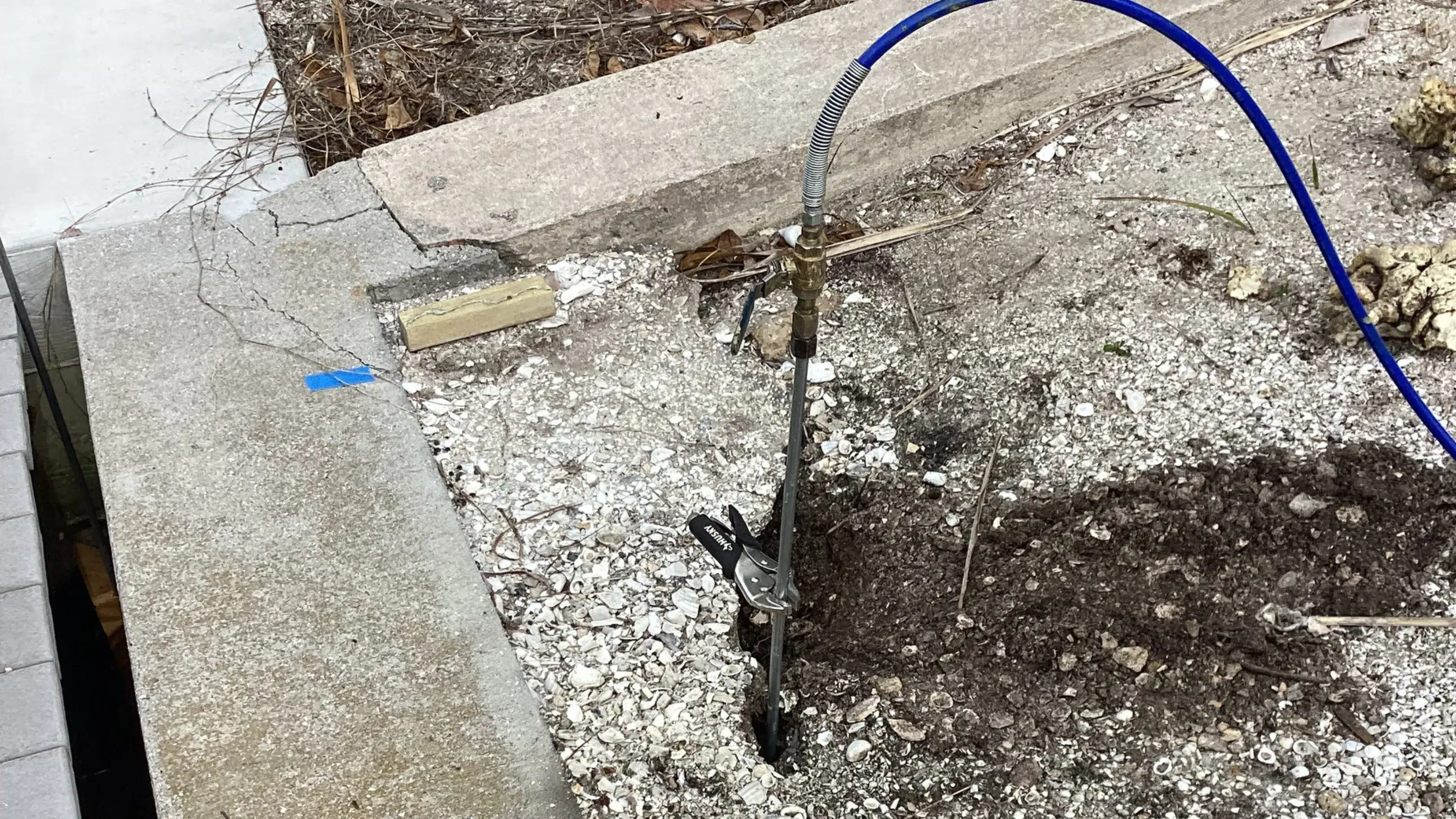
Soil probing may sometimes provide useful field information about apparent loose or weak shallow zones.
It does not replace a geotechnical investigation or establish the complete soil classification, density, strength, or subsurface profile.
Property History
Relevant information may include:
- Previous storms
- Plumbing leaks
- Seawall repairs
- Pool construction
- Additions
- Drainage changes
- Previous foundation work
- Engineering or geotechnical reports
The central question remains:
What is moving, where is support being lost, and what repair objective does the evidence support?
Different Coastal Problems Require Different Repair Objectives
| Condition Identified | Repair Objective | Repair That May Be Considered |
| Weak shallow soil beneath foundation | Improve shallow support | Polyurethane soil stabilization |
| Deeper foundation support problem | Transfer structural loads deeper | Push or helical piers |
| Foundation requiring precise lifting | Directly support and control elevation recovery | Engineered underpinning |
| Weak soil beneath interior slab | Improve supporting soil | Polyurethane soil stabilization |
| Void directly beneath slab | Restore contact and support | Structural polyurethane void filling |
| Settled concrete slab | Restore support and attempt elevation recovery | Polyurethane concrete lifting |
| Deeper weak soils | Improve deeper ground support | Compaction grouting or other engineered ground improvement |
| Seawall backfill loss | Stop soil loss and restore support | Seawall soil stabilization, breach sealing, and appropriate pressure relief |
| Structurally damaged seawall | Repair structural waterfront system | Marine contractor / engineer |
| Active drainage or plumbing source | Stop continued soil disturbance | Correct source as part of overall repair |
| No meaningful evidence of active movement | Observe condition | Monitoring may be appropriate |
This is not a prescription table.
The repair should follow the condition and repair objective.
Polyurethane or Foundation Piers?
Coastal location does not determine the foundation repair method.
Polyurethane Soil Stabilization
May be appropriate when weak or loose shallow soils beneath a foundation need improvement.
Its primary objective around a structural foundation is to improve supporting soil and help reduce additional settlement.
Push or Helical Piers
May be appropriate when:
- Support is needed at greater depth
- Shallow treatment would not address the problem
- The foundation requires direct structural support
- Precise, controlled lifting is needed
Polyurethane improves the ground supporting the foundation. Underpinning gives direct support and greater control of the foundation itself.
Read more: How Polyurethane Injection Works Under Your Home
Read more: Helical Piers vs. Push Piers: What’s the Difference?
Why Coastal Soil Conditions Matter Before Construction
For a new waterfront or coastal home, identifying problematic soil before construction provides far more options than discovering it after the structure begins moving.
An appropriate geotechnical soil investigation can help identify:
- Loose soils
- Poorly compacted or variable fill
- Organic or compressible layers
- Groundwater conditions
- Soil layering
- Depth of suitable bearing material
Depending on the findings and engineering design, options may include:
- Improving soils before construction
- Excavating unsuitable material and replacing it with suitable compacted fill
- Modifying site preparation
- Changing the foundation design
- Installing pre-construction deep foundations that transfer loads to deeper competent bearing soils or other suitable bearing material
The best time to discover a support problem is before the foundation is built—not after the home begins to move.
Read more: Pre-Construction Piers
Checklist: What Coastal Florida Homeowners Should Watch For
Around the Home
- Look for new or progressing stair-step cracks
- Check doors and windows that recently started sticking
- Watch for gaps around frames or trim
- Note floors that appear lower or more sloped
- Photograph cracks so changes can be compared over time
Around Exterior Concrete
- Look for sinking driveways or sidewalks
- Check patios and lanais
- Inspect pool decks for settlement
- Look for gaps beneath slab edges
- Note new areas where water collects
Around the Waterfront
- Look for soil disappearing near the seawall
- Check for depressions or holes
- Watch for settling pavers
- Look for open seawall joints or cracks
- Note wall sections that lean, bow, or change alignment
- Check wall ends and returns for erosion
Drainage and Property History
- Check for plumbing or irrigation leaks
- Identify concentrated runoff
- Note recent storms or high-water events
- Identify recent pool, utility, or landscaping work
- Locate previous foundation, seawall, or engineering reports
- Determine whether symptoms are stable or progressing
You do not need to diagnose the condition yourself.
The purpose is to document what is changing, where it is changing, and whether several symptoms appear connected.
When Should a Coastal Home Be Evaluated?
Consider an evaluation when:
- Cracks continue changing
- Several structural symptoms occur in the same area
- Floors appear to be changing elevation
- Doors or windows become progressively misaligned
- Exterior concrete develops significant settlement
- Soil is visibly disappearing
- New voids or depressions develop
- Pavers or pool decks begin settling near a seawall
- Storm damage exposes previously supported areas
- You cannot determine whether the problem involves the foundation, slab, seawall area, or something else
A rapidly developing depression, severe shoreline erosion, or obviously unstable structure should be treated differently from ordinary cosmetic cracking and may require immediate evaluation by the appropriate professionals or authorities.
Why Experience With Different Types of Settlement Matters
Helicon has worked with Florida soils and structures since 2004.
Across Florida’s Gulf and Atlantic coastal communities, settlement can involve:
- Structural foundations
- Interior slabs
- Exterior concrete
- Shallow soils
- Deeper soils
- Seawall backfill
- Waterfront erosion
- Drainage-related soil loss
Helicon works with foundation underpinning, polyurethane soil stabilization, structural void filling, concrete lifting, compaction grouting, deep foundations, and seawall soil stabilization.
The value of having multiple repair capabilities is not finding more things to repair.
It is being able to distinguish among the different ways support can be lost.
Good foundation repair starts with understanding what is moving and why—not choosing the product first.
Schedule an Evaluation
If your coastal Florida property has foundation cracks, uneven floors, sinking concrete, soil loss, seawall settlement, or other signs of movement, start by determining:
- What is actually moving?
- Is the structural foundation involved?
- Is the problem limited to an interior or exterior slab?
- Is support being lost through erosion or washout?
- Are shallow soils weak or loose?
- Is deeper structural support required?
- Is the seawall area contributing?
- Is there an active drainage or plumbing source?
- Does the condition require repair at all?
The goal is not to assume the worst. The goal is to determine what the evidence actually supports.
Read more: Foundation Repair
FAQ
Why do coastal Florida homes settle?
Possible contributors include loose or disturbed soils, placed fill, shallow groundwater, erosion, seawall-related soil loss, storm events, organic soils, and construction disturbance. The cause varies by property.
Does living near the ocean automatically mean my home will settle?
No. Properly prepared coastal soils can support structures successfully. Coastal location simply introduces additional conditions that may need to be considered.
Is Florida sand bad for foundations?
No. Dense, properly compacted sand can provide good support. Problems develop when sand is loose, disturbed, eroded, poorly compacted, or otherwise unable to provide uniform support.
Does high groundwater cause foundation settlement?
Not automatically. Groundwater becomes relevant when it interacts with erosion, drainage, organic soils, construction, or other conditions that change support.
Does saltwater make a house foundation sink?
Saltwater itself is generally not the diagnosis. Soil condition, compaction, erosion, drainage, and required support depth are more useful factors to investigate.
Can storm surge cause settlement?
Storm surge and high water can move soil, worsen erosion, expose existing weaknesses, and create or enlarge voids.
Can seawall erosion cause my house to settle?
It can affect nearby areas if soil loss extends far enough, but seawall backfill loss does not automatically mean the home’s structural foundation is settling.
Why is my pool deck sinking near the seawall?
The supporting soil may have become loose, eroded, or washed away. The soil-loss mechanism should be investigated before simply lifting the slab.
Can my driveway settle without my house foundation settling?
Yes. Exterior slabs can settle independently because they have different loads and support conditions.
Can an interior floor settle while the perimeter foundation stays stable?
Yes. Interior slab settlement can occur independently because of loose fill, voids, plumbing-related soil loss, or other shallow conditions.
Can organic soils cause settlement?
Yes. Localized organic or compressible soils can lose volume or compress over time.
Should I worry about every crack in a coastal home?
No. Crack pattern, progression, location, measurable movement, and accompanying symptoms matter more than one isolated crack.
Is polyurethane soil stabilization useful for coastal homes?
It may be appropriate when weak or loose shallow soils need improvement. Around a foundation, its primary purpose is improving supporting soil rather than providing precise structural lifting.
When are foundation piers more appropriate?
Push or helical piers may be appropriate when a structure needs deeper support or direct, controlled foundation lifting.
Can polyurethane repair seawall-related soil loss?
In appropriate conditions, polyurethane can stabilize backfill, fill voids, and help seal soil-loss pathways. Structural seawall failure requires separate evaluation.
Should I have soil testing done before building a coastal home?
An appropriate geotechnical soil investigation can identify fill, loose soils, organic material, groundwater conditions, soil layering, and suitable bearing depths before the foundation is designed.
What should I do first if I notice settlement?
Document what is changing and determine which part of the property is moving. Have the condition evaluated before choosing a repair so the solution addresses the actual loss of support rather than only the visible symptom.