Direct Answer
Polyurethane injection can be used beneath a home to improve weak shallow soils, restore support beneath concrete, fill underground voids, and lift settled interior slabs in appropriate conditions.
But “injecting polyurethane under a home” can describe two different repair processes.
Around the Exterior Foundation
Injection rods are typically installed around the affected foundation perimeter and angled toward the soil beneath the footing.
On many Helicon residential foundation-soil-stabilization projects:
- Injection points may be spaced approximately 5 feet apart
- Treatment may extend approximately 6 to 10 feet below grade
- Structural polyurethane is injected into the targeted shallow soil zone
- A typical injection location may use approximately 20 pounds of material, although actual quantities depend on the soil response and repair design
As the polyurethane expands within the targeted soil zone, it can compact and densify loose soils, helping increase the load-bearing capacity of the shallow soils supporting the footing.
The primary objective is foundation soil stabilization and helping reduce the potential for additional settlement—not precisely lifting the structural foundation.
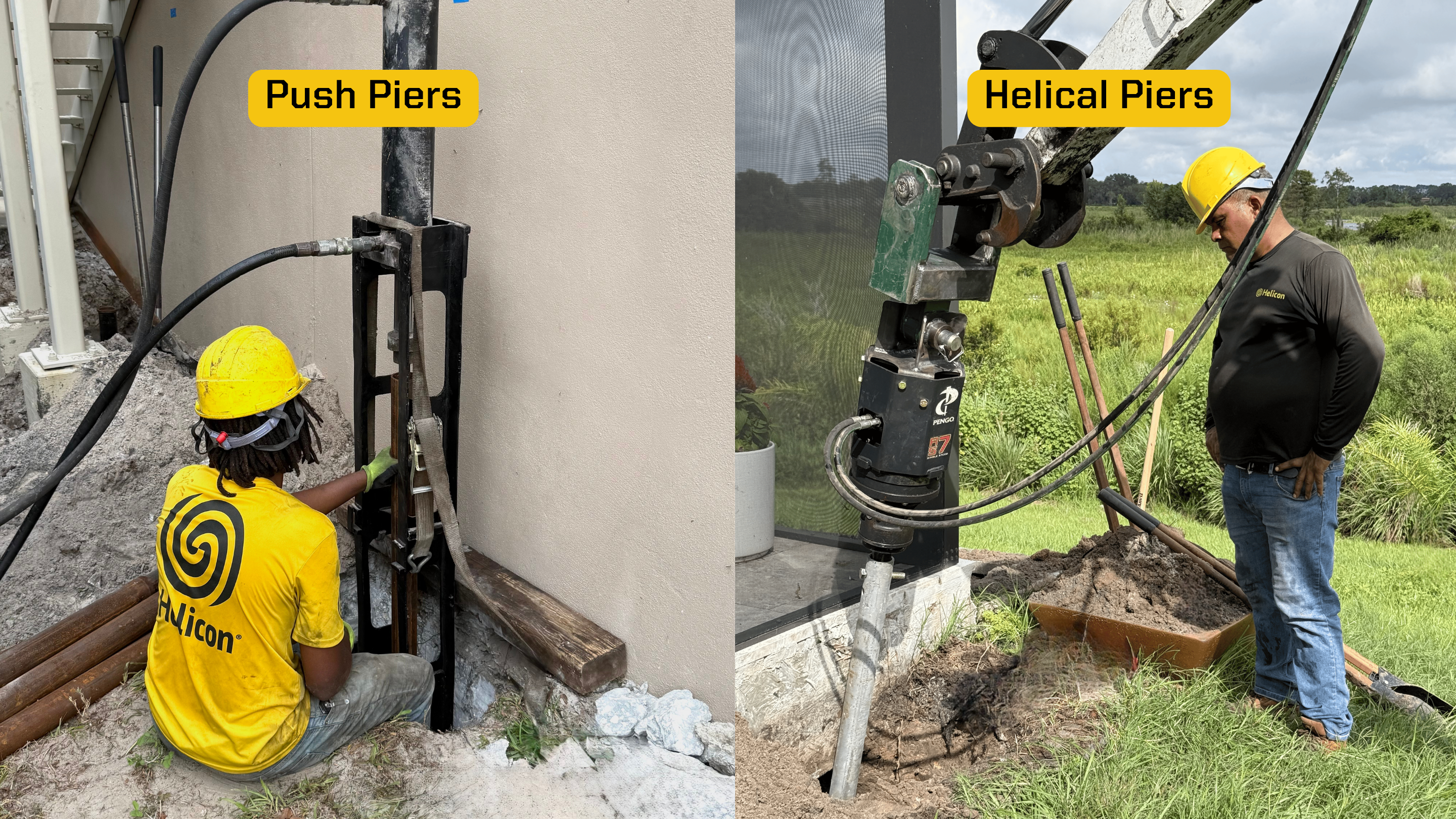
When controlled foundation lifting is needed, underpinning with push piers, helical piers, or another appropriate foundation-support system generally provides better control.
Beneath an Interior Slab
A settled interior slab may require two treatment zones:
- Soil injections to improve weak ground beneath the slab
- Slab injections directly beneath the concrete to fill voids, restore contact, and, when appropriate, lift the slab
Unlike perimeter foundation stabilization, interior concrete slabs can often be lifted using polyurethane injection.
Polyurethane injection under a home is not simply “pumping foam beneath the house.” Where the material is placed—and what the repair is intended to accomplish—changes the repair.
Read more: What Is Soil Stabilization and How Does It Work?
Where Is Polyurethane Actually Injected Under a Home?
The easiest way to understand polyurethane injection is by looking at the treatment zone.
| Injection Location | Primary Objective | Typical Approach |
| Soil beneath perimeter footing | Improve shallow foundation support | Angled injection rods into targeted soil zone |
| Deeper soil beneath interior slab | Improve weak or loose soil | Injection rods through planned grid |
| Immediately beneath interior slab | Fill voids and restore contact | Small injection ports through slab |
| Beneath settled interior slab requiring lift | Restore support and attempt elevation recovery | Controlled slab injections |
| Localized void beneath concrete | Fill unsupported space | Targeted void-fill injection |
Some projects require more than one treatment.
For example, a settled interior slab may need both deeper soil stabilization and direct slab injection.
The repair should match where support has been lost and what needs to be accomplished.
Why Would a Home Need Polyurethane Injection?
A home depends on the ground beneath it for support.
If supporting soils become loose, poorly compacted, eroded, or partially missing, the foundation or slab above can begin to move.
Possible contributors include:
- Poor compaction during construction
- Loose fill
- Plumbing or irrigation leaks
- Erosion or washout
- Voids
- Buried organic material
- Disturbed soils
- Drainage problems
Florida’s sandy soils are not automatically poor foundation soils.
Dense, properly compacted sand can provide good support.
Concern develops when the soil is loose, voided, poorly compacted, eroding, or no longer providing uniform support.
Read more: How Florida Soil Conditions Affect Your Home Foundation
How Polyurethane Injection Works Around the Foundation Perimeter
When a foundation problem involves an appropriate shallow-soil condition, polyurethane can be injected into the soil influencing the footing.
The process generally follows four steps.
Step 1: Identify the Affected Foundation Area
Before injecting material, the contractor should determine what appears to be moving and where support may have been lost.
An evaluation may consider:
- Crack patterns
- Doors and windows
- Gaps
- Relative floor elevations
- Exterior settlement
- Drainage and erosion
- Shallow soil conditions
- Property and repair history
At Helicon, a Zip Level may be used when appropriate to evaluate relative floor-elevation patterns.
Soil probing may also provide useful field information about apparent loose or weak shallow zones.
The objective is not simply to find a crack and inject beside it.
It is to identify which foundation areas appear to need improved support.
Step 2: Lay Out the Injection Locations
On many residential projects, injection locations may be spaced approximately:
5 feet apart along the affected foundation perimeter.
Spacing can vary based on:
- Foundation configuration
- Soil conditions
- Treatment area
- Access
- Material
- Repair design
The goal is adequate treatment coverage—not simply a predetermined number of injection points.
Step 3: Install the Injection Rods
Small-diameter rods are advanced into the soil beside the foundation.
They are commonly installed at an angle so the injection point reaches the targeted soil beneath or immediately adjacent to the footing.
On many Helicon residential applications, treatment may extend approximately:
6 to 10 feet below grade.
These are typical treatment depths, not universal requirements.
The actual treatment zone depends on the structure, soil conditions, and repair plan.
Step 4: Inject Structural Polyurethane
Structural polyurethane is pumped through each rod into the targeted soil zone.
On some typical residential perimeter plans, approximately 20 pounds of polyurethane may be used at an individual injection location.
That is not a fixed quantity.
Actual material use depends on:
- Soil density
- Voids
- Material take
- Treatment depth
- Soil response
- Repair objective
The objective is not to inject the most material possible. It is to improve the soil zone supporting the affected foundation.
What Happens to the Polyurethane Underground?
Depending on the polyurethane formulation and soil conditions, the material may:
- Enter loose or lower-resistance zones
- Expand into available voids
- Exert pressure against loose soils
- Compact or densify surrounding soil
- Bind portions of granular soil
- Improve contact within the soil mass
- Improve support within the treated zone
The two-part structural polyurethane used for many foundation applications is lightweight compared with cementitious grout but develops substantial strength after reacting and curing.
Certain formulations cure into a dense, closed-cell structural foam.
This allows the material to improve support without placing a large amount of additional weight on soils that may already be weak.
Does the Foam Create One Giant Block Under the House?
Usually, no.
Polyurethane does not normally form one perfectly shaped layer beneath the entire house.
Soils contain varying densities, layers, voids, moisture, roots, disturbed areas, and other pathways.
The material responds to those conditions.
Around an injection location, polyurethane may:
- Fill a void
- Expand into a loose zone
- Compact nearby soil
- Bind soil particles
- Overlap with adjacent treated areas
That is also one reason multiple injection locations are used.
The objective is to improve the targeted soil mass, not create one giant block of foam beneath the home.
Why Are Shallow Soils Important to a Foundation?
Most Florida homes use relatively shallow foundation systems.
The soils immediately beneath and surrounding the footing therefore have an important influence on foundation support.
If this shallow zone becomes loose or loses density, foundation settlement can occur.
Polyurethane may be appropriate when the support problem is concentrated within a treatable shallow soil zone and the goal is to improve support and help reduce additional settlement.
But there are important limits.
If the support problem extends significantly deeper, deeper ground improvement or foundation piers may be more appropriate.
And if the structural foundation needs to be lifted with precision, underpinning is generally the better tool.
Push piers, helical piers, or another underpinning system allow the foundation to be supported and adjusted at specific locations. That can be especially useful when controlled elevation recovery is needed to help reduce or close larger foundation, block, or stucco cracks associated with settlement.
Polyurethane soil injection can produce some foundation movement, but precision lifting is not its primary purpose around the perimeter.
The question is not simply whether the soil is weak. It is where the support problem is located—and whether the objective is soil stabilization, deeper structural support, or controlled foundation lifting.
Read more: Helical Piers vs. Push Piers: What’s the Difference?
How Polyurethane Injection Works Beneath an Interior Floor
Interior slab settlement is different from perimeter foundation settlement.
A settled interior floor may have two separate support problems:
- Weak or loose soil beneath the slab
- A void between the concrete slab and the supporting soil
When both conditions exist, some Helicon projects use a two-stage injection process.
Stage 1: Stabilize the Soil Beneath the Interior Slab
When weak shallow soils appear to be contributing to settlement, injection points may be installed through the slab in a grid pattern.
On many projects, spacing may be approximately:
5 feet by 5 feet
depending on the treatment area and repair design.
Rods are advanced into the targeted soil, which may extend approximately 6 to 10 feet below grade when that is the soil zone influencing the settlement.
Structural polyurethane is then injected to improve the supporting ground.
At this stage, the objective is soil stabilization—not lifting the slab.
Stage 2: Inject Directly Beneath the Slab
After the deeper soil has been treated when necessary, polyurethane can be injected immediately beneath the concrete.
If settlement has created a gap between the slab and the supporting soil, these injections can:
- Fill the void
- Restore slab-to-soil contact
- Support previously unsupported concrete
- Reduce unwanted slab movement
- Begin controlled lifting when appropriate
Deeper soil injection improves the ground. Slab injection restores support directly beneath the concrete and can be used to lift the slab when appropriate.
Why Stabilize the Soil Before Lifting the Slab?
Lifting a slab without addressing weak supporting soil may raise the concrete without correcting the condition that contributed to the settlement.
When weak soil is part of the problem, the sequence may therefore be:
1. Improve the weak soil
2. Fill the remaining slab void
3. Attempt controlled elevation recovery when appropriate
Not every interior slab requires all three steps.
A slab may need only void filling, only lifting, or a combination of soil treatment and slab injection.
The condition should determine the sequence.
Soil Stabilization vs. Void Filling vs. Slab Lifting
| Repair Objective | Where Material Is Injected | What the Repair Is Trying to Do |
| Soil stabilization | Into weak soil below the structure | Improve ground support |
| Void filling | Into empty space beneath slab | Restore contact |
| Slab stabilization | Beneath unsupported slab | Restore support and reduce movement |
| Concrete lifting | Beneath settled slab | Restore support while attempting elevation recovery |
One project can involve several objectives.
The material may be similar. The repair objective is what changes.
Read more: Voids Under Concrete Slabs: What Causes Them and How to Fix Them
How Does Polyurethane Actually Lift a Slab?
Once underlying voids are filled and the polyurethane becomes confined beneath the slab, continued controlled injection can create upward pressure.
That pressure can begin moving the concrete.
The key word is controlled.
Technicians inject measured amounts while monitoring the slab and surrounding structure.
They may watch:
- Relative elevations
- Door thresholds
- Cracks
- Tile or flooring
- Adjacent walls
- Plumbing
- Nearby slabs
The goal is not to keep pumping until the slab reaches a predetermined elevation.
It is to recover elevation only as far as conditions safely allow.
Sometimes substantial recovery is possible.
Sometimes only limited movement should be attempted.
And sometimes stabilization without meaningful lifting is the right result.
Will Polyurethane Lift the Foundation Around the Exterior Too?
It can produce some movement, but precise lifting of the perimeter foundation is generally better accomplished with underpinning.
Perimeter polyurethane injection is primarily a foundation soil stabilization method intended to:
- Improve weak shallow soils
- Increase support beneath the footing
- Help reduce the potential for additional settlement
When the structural foundation itself needs controlled elevation recovery, underpinning provides greater control over how specific foundation areas are supported and moved.
A simple way to think about it is: polyurethane improves the ground supporting the foundation; underpinning gives us direct control of the foundation itself.
That may be especially important when attempting to reduce larger:
- Foundation cracks
- Block cracks
- Stucco cracks
- Settlement-related gaps
Trying to force significant foundation lift through soil injection can also create unwanted movement elsewhere.
Improved support can be a successful outcome even when little or no foundation lifting occurs.
This is an important difference between foundation soil stabilization and intentionally lifting a settled concrete slab.
How Do Technicians Know When to Stop Injecting?
Polyurethane injection is not simply based on pumping for a predetermined amount of time.
Technicians may monitor:
- Planned material quantities
- Material take
- Injection response
- Resistance or pressure
- Surface or slab movement
- Relative elevations
- Material appearing at another location
- Material reaching the surface
- Changes in nearby cracks or joints
If material begins migrating to the surface, that may indicate it has reached a less-confined zone and pumping at that location should stop.
If a slab begins moving, the injection rate or location can be adjusted.
More polyurethane does not automatically mean a better repair.
The goal is controlled treatment of the intended support zone.
Why Does Injection Spacing Matter?
Polyurethane does not spread uniformly in every soil condition.
Because the ground can contain variable densities, layers, voids, and preferential pathways, several injection locations are typically used to treat an area more effectively.
Approximate 5-foot spacing can be a practical pattern on many Helicon residential projects, but spacing should be adjusted when conditions require it.
The objective is appropriate treatment coverage—not simply hitting a predetermined number of holes.
What Causes Interior Slabs to Settle?
Common causes include:
Poor Compaction
Fill beneath the slab may not have been compacted uniformly during construction.
Plumbing Leaks
A leaking water or drain line can disturb or wash away supporting soil.
Erosion or Soil Loss
Water movement can create voids beneath the slab.
Buried Organic Material
Roots or other organic material can decompose and leave empty space.
Variable Fill or Soil Conditions
Different parts of the home may sit over different soil or construction conditions.
The visible low floor is the symptom.
The important question is:
Why did the slab lose support?
Read more: Interior Slab Settlement: Causes, Signs & Repair Options
What If a Plumbing Leak Caused the Settlement?
The leak should generally be corrected as part of the overall repair plan.
Otherwise, continued water loss may keep affecting the supporting soils.
When plumbing beneath an interior slab requires repair, stabilization may need to be coordinated around that work so the source is corrected before finished flooring and other cosmetic repairs are restored.
Repairing the finishes without addressing ongoing support loss does not solve the underlying problem.
Is Polyurethane Injection the Same as Foundation Piers?
No.
They solve different problems.
Polyurethane Soil Injection
Objective: Improve an appropriate shallow soil zone.
Around a home’s perimeter, polyurethane is generally intended to improve support and help reduce additional settlement.
Push or Helical Piers
Objective: Transfer structural loads to deeper competent bearing soils or other suitable bearing material.
Piers are also generally better suited when the structural foundation needs precise, controlled lifting or elevation recovery.
Individual pier locations allow the foundation to be supported and adjusted more precisely, which may be important when settlement has created significant foundation, block, or stucco cracking.
If weak shallow soil is the primary problem and lifting is not the main objective, polyurethane may be appropriate.
If dependable deeper support or controlled foundation lifting is needed, underpinning may make more sense.
The repair method should follow both the location of the support problem and the repair objective.
Is Polyurethane Injection the Same as Compaction Grouting?
No.
Polyurethane generally uses a lightweight chemical grout to improve appropriate shallow soils, fill voids, or support and lift slabs.
Compaction grouting uses a thick, high-strength cementitious grout that forms dense grout bulbs and compacts surrounding soils.
It is commonly used for deeper ground improvement and engineered sinkhole remediation.
Read more: What Causes Sinkholes in Florida—and Should You Worry?
When Does Polyurethane Injection Make Sense Under a Home?
Polyurethane may be worth considering when the condition involves:
- Weak or loose shallow soil
- Poorly compacted fill
- Localized soil loss
- Voids beneath concrete
- Interior slab settlement
- Loss of shallow support beneath a footing
- Washout
- A settled but repairable concrete slab
For perimeter foundation work, polyurethane is best suited when improving the shallow supporting soil is the primary objective.
For interior slabs, it can also fill voids and provide controlled lifting.
When Is Polyurethane NOT the Right Repair?
Another repair may be more appropriate when:
Deeper Structural Support Is Needed
Foundation piers may be the better solution.
The Structural Foundation Needs Precise Lifting
Underpinning generally provides better control when elevation recovery of the foundation is an important repair objective.
Deeper Ground Improvement Is Needed
Compaction grouting or another geotechnical method may be appropriate.
The Concrete Is Too Deteriorated
Replacement may be more appropriate than lifting.
An Active Leak Is Still Removing Soil
The source should also be corrected.
The Cause Is Unclear
More evaluation may be necessary before choosing a repair.
The fact that polyurethane can be injected beneath a home does not mean polyurethane should be the repair.
Is Polyurethane Injection Disruptive?
Polyurethane can often be installed through relatively small access points.
Depending on the project, that can mean:
- Limited excavation
- Small injection rods
- Small drilled ports through concrete
- Compact equipment
- Rapid curing
- Less demolition than some alternatives
Interior slab injection holes can usually be repaired after treatment.
But reduced disruption should not determine the repair method by itself.
The goal is the least invasive repair that properly addresses the movement.
How Long Does the Polyurethane Take to Cure?
Structural polyurethane reacts and cures rapidly.
For the structural polyurethane systems Helicon commonly uses in these applications, the material typically reacts and cures in about 15 minutes, although exact cure characteristics vary by formulation and site conditions.
Rapid curing allows the treated soil or slab to develop support quickly and helps technicians observe the response during installation.
It is also one reason polyurethane works well for controlled slab lifting.
How Long Does Polyurethane Injection Last?
There is no responsible universal lifespan for every project.
Long-term performance depends on:
- Correct diagnosis
- Correct treatment depth
- Soil conditions
- Treatment coverage
- Material selection
- Installation quality
- Structural loading
- Drainage
- Future leaks or erosion
- Conditions outside the treated area
Once cured, structural polyurethane is intended to remain within the treated soil or beneath the slab.
The more useful question is:
Was the correct support zone treated, and was the reason it lost support properly addressed?
What Does Polyurethane Injection Cost?
Cost varies substantially because projects can involve very different treatment areas and objectives.
Factors can include:
- Perimeter treatment length
- Interior treatment area
- Number of injection points
- Treatment depth
- Material quantity
- Soil and void conditions
- Interior access
- Flooring
- Whether slab lifting is attempted
- Engineering requirements
A few localized slab injections are very different from stabilizing soil around a substantial portion of a home’s foundation.
Compare the diagnosis, treatment zone, and repair objective before comparing price.
Read more: Why Is One Foundation Repair Quote Much Higher Than Another?
Checklist: Questions to Ask Before Polyurethane Is Injected Under Your Home
Diagnosis
- What is moving—the foundation, interior slab, or both?
- What evidence indicates support has been lost?
- What appears to have caused the settlement?
- Could plumbing, drainage, or erosion be contributing?
- Does the support problem appear shallow or deeper?
Treatment Zone
- Where will the polyurethane actually be injected?
- What depths will be treated?
- Why were those depths selected?
- How far apart will injection locations be?
- Will the perimeter and interior be treated differently?
Repair Objective
- Is the objective foundation soil stabilization?
- Is void filling needed?
- Will an interior slab be lifted?
- Does the structural foundation need precise lifting?
- If so, was underpinning considered?
- What elevation recovery is realistic?
Installation
- What polyurethane formulation will be used?
- Why is it appropriate?
- How will the injection response be monitored?
- What determines when pumping stops?
- What happens if material migrates unexpectedly?
Alternatives
- Were foundation piers considered?
- Would compaction grouting be more appropriate?
- Does the slab need replacement?
- Could monitoring be reasonable?
- Does another contributing condition need correction first?
A contractor should be able to explain where the material is going, why it is going there, and what that injection is intended to accomplish.
How Helicon Approaches Polyurethane Injection Under a Home
Helicon has worked with Florida foundations and soils since 2004.
Our experience includes:
- Perimeter foundation soil stabilization
- Interior soil injection
- Structural slab void filling
- Concrete lifting
- Polyurethane chemical grouting
- Foundation underpinning
- Compaction grouting
- Sinkhole remediation
That breadth matters because polyurethane is only one repair tool.
We First Determine What Has Lost Support
An evaluation may consider:
- Crack and symptom patterns
- Relative floor elevations using a ZipLevel when appropriate
- Interior slab conditions
- Exterior foundation movement
- Drainage and plumbing history
- Soil loss or erosion
- Shallow soil conditions
Then we ask:
- Is the exterior foundation settling?
- Is an interior slab settling?
- Are both involved?
- Is weak shallow soil contributing?
- Is a void present beneath the slab?
- Does an interior slab need lifting?
- Does the structural foundation need controlled lifting or deeper support?
Those answers determine where polyurethane should be placed—or whether a different method should be used.
The value of polyurethane injection is not that it can be pumped beneath a house. It is that it can be placed in the specific soil or slab zone that has lost support.
Schedule a Foundation Inspection
If you are seeing cracks, uneven floors, sticking doors, gaps, or other signs of settlement, you do not need to decide whether polyurethane is the right solution before the home is evaluated.
First determine:
- What has moved
- Why
- Where support has been lost
- Whether the condition is shallow or deeper
- Whether the objective is stabilization or lifting
- Whether the soil, slab, foundation—or a combination—needs repair
The injection plan—or underpinning plan—should follow the diagnosis and repair objective, not the other way around.
Read more: Foundation Repair
FAQ
What does polyurethane injection do under a house?
It can improve weak shallow soils, fill voids, restore support beneath concrete, and lift settled interior slabs in appropriate conditions.
Where is polyurethane injected around a foundation?
Rods are commonly installed beside the foundation and angled toward the soil beneath or adjacent to the footing.
How far apart are polyurethane injection points?
On many Helicon residential projects, locations may be approximately 5 feet apart, although actual spacing depends on the site and repair plan.
How deep is polyurethane injected beneath a foundation?
On some residential Helicon projects, the shallow-soil treatment zone may extend approximately 6 to 10 feet below grade. Actual depths vary.
How much polyurethane is injected at each point?
Approximately 20 pounds may be used at an individual location on some typical perimeter plans, but actual quantities depend on soil conditions, depth, material take, and the repair objective.
How does polyurethane improve soil?
Depending on the formulation and soil condition, it can expand into loose zones and voids, compact surrounding soils, bind portions of granular soil, and improve support.
Is polyurethane injected directly beneath an interior floor?
Yes, when appropriate. A project may involve deeper soil injections plus separate injections immediately beneath the slab.
Why inject the soil and then the slab?
The soil injection improves weak ground. The direct slab injection fills remaining voids, restores contact, and can allow controlled slab lifting.
Can polyurethane lift an interior floor?
Yes, in appropriate conditions. Once support is established beneath the slab, controlled injections can raise settled concrete.
Can polyurethane precisely lift my home’s foundation?
That is generally better accomplished with underpinning. Perimeter polyurethane is primarily a foundation soil stabilization method, although some movement may occur during treatment.
Why use piers if my foundation needs lifting?
Piers allow specific foundation locations to be supported and adjusted with greater control when precise elevation recovery is needed.
Can foundation lifting help close cracks?
Sometimes. Controlled elevation recovery may reduce or close some larger foundation, block, or stucco cracks caused by settlement, although complete cosmetic recovery is not guaranteed.
Does polyurethane fill every void beneath the house?
Not necessarily. Treatment is targeted to the soil zones and areas identified in the repair plan.
Is polyurethane better than foundation piers?
Neither is universally better. Polyurethane improves appropriate shallow soils and voids. Piers provide deeper structural support and greater control when the foundation needs precise lifting.
What if a plumbing leak caused the settlement?
The leak should generally be corrected as part of the repair plan so continued water loss does not keep affecting the supporting soils.
Does polyurethane injection require major excavation?
Usually not. It can generally be installed through relatively small injection rods or ports.
How quickly does polyurethane cure?
For the structural polyurethane systems Helicon commonly uses in these applications, the material typically reacts and cures in about 15 minutes, although exact cure characteristics vary by formulation and site conditions.
How do technicians know when enough polyurethane has been injected?
They may monitor material take, injection response, resistance, movement, relative elevations, surface observations, and other project-specific indicators.
How long does polyurethane last under a house?
There is no universal lifespan. Performance depends on diagnosis, treatment coverage, material, installation, soil conditions, drainage, and future site conditions.
Can polyurethane fix every type of foundation settlement?
No. Deeper foundation problems or foundations requiring precise lifting may be better addressed with underpinning, compaction grouting, or another method.
How do I know whether my house needs soil injection, slab injection, or piers?
It depends on where support has been lost and what the repair needs to accomplish. Weak shallow soil may call for soil stabilization, a slab void may require direct slab injection, and a structural foundation needing deeper support or precise lifting may require underpinning.