Some foundation problems begin long before a crack appears.
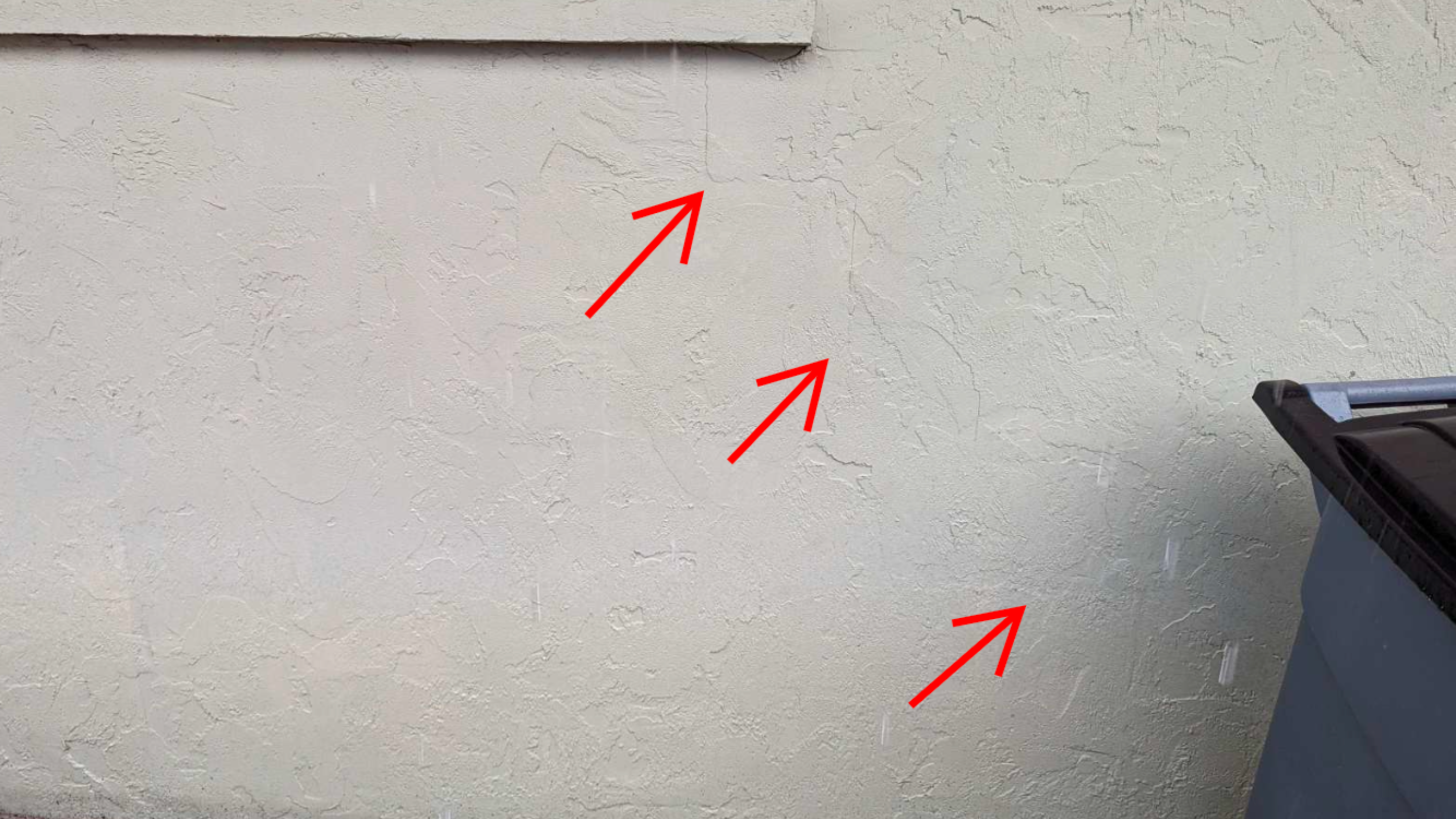
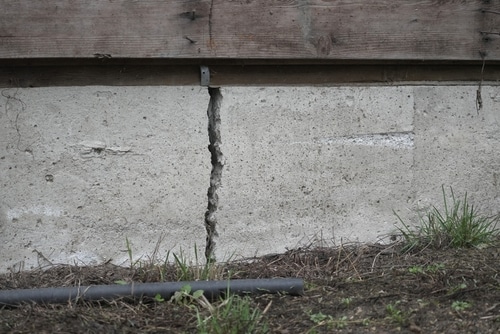
They begin below the surface, in weak or loose soil zones that cannot reliably support the structure planned above them. By the time settlement, slab movement, or foundation cracking becomes visible, the building may already be reacting to a subsurface condition that should have been addressed earlier.
That is why pre-construction soil stabilization matters.
For a new building planned at the World Equestrian Center in Ocala, Florida, the goal was not to repair damage after construction. The goal was to reduce risk before construction began.
On a property of that size, visibility, and operational importance, a “wait and see” approach was not the right strategy. Every structure added to the campus needed to support long-term performance, reliability, and the high standards associated with one of Florida’s most recognizable equestrian and hospitality destinations.
The ownership team understood that if weak soils remained in place beneath the future building, the project could become vulnerable to settlement, slab movement, foundation cracking, uneven support conditions, and more expensive corrective work later.
Helicon performed a commercial compaction grouting program designed to improve the ground beneath the future building footprint before the structure was built.
A High-Profile Ocala Property with No Room for Guesswork
The World Equestrian Center is one of the most recognizable large-scale properties in Ocala and across Florida’s equestrian, event, and hospitality landscape.
Projects at that level are not built with a “fix it later” mentality.
A future foundation issue on a major destination property can create more than repair costs. It can affect operations, maintenance budgets, construction schedules, owner confidence, and the reputation of the expansion work itself.
For this project, a new building was planned as an addition to the existing property. Before construction moved forward, the team wanted a reliable way to improve the ground beneath the future structure.
Weak soils beneath new construction can increase the risk of:
- Post-construction settlement
- Slab movement
- Foundation cracking
- Uneven support beneath structural elements
- Long-term maintenance concerns
- Disruptive corrective work after the building is complete
Instead of waiting to find out whether those risks would appear later, the project team chose to address the soil conditions first.
That decision created an opportunity to perform the work under better conditions, with more control, and at a much lower long-term risk than a post-construction repair would likely involve.
Why Pre-Construction Soil Stabilization Matters
Many commercial foundation repair projects begin after a structure is already showing distress.
A slab settles. A wall cracks. Doors no longer align. Equipment pads move. Interior finishes separate. A column or footing begins to respond differently than the rest of the structure.
The work was proactive. The building had not yet been constructed, which allowed the project team to improve subsurface conditions before structural loads were introduced.
That is one of the biggest advantages of pre-construction ground improvement.
Before a building is erected, crews usually have better access, fewer finished surfaces to protect, fewer operational conflicts, and more flexibility in drilling layout and treatment sequencing. Once a building is complete, any corrective work has to be performed around finished floors, walls, utilities, landscaping, operations, occupants, and business disruption.
Pre-construction stabilization is often:
- Easier to coordinate
- Less disruptive
- More efficient to perform
- Better aligned with construction planning
- More cost-effective over the life of the building
- Stronger as a settlement risk-reduction strategy
The best time to address weak soils is before they cause structural problems.
Depth, Precision, and Production
This was not a small or shallow stabilization effort.
The project required 757 linear feet of drilling and casing to reach the subsurface zones targeted for improvement. That drilling and casing scope mattered because the goal was not simply to treat the upper soils. The compaction grouting program needed to reach the areas beneath the future building footprint where weak or loose soils could affect long-term support.
The work also included approximately 500 cubic yards of compaction grout, making this a substantial commercial ground improvement project.
In compaction grouting, there is very little value in moving quickly if the material is not being delivered where it can improve soil performance. Drilling locations, casing placement, treatment depths, grout sequencing, and full coverage of the treatment zone all matter.
If treatment is too shallow, it may improve upper soils while missing deeper weak zones. If grout is not placed in the correct locations, the soil improvement may not match the needs of the future structure.
On a high-profile commercial campus, that level of accuracy is essential. Speed matters on construction sites, but accuracy matters more.
Engineering-Guided Ground Improvement
Geotechnical and engineering recommendations supported this project before Helicon performed the work.
Commercial soil stabilization should not be treated like a one-size-fits-all service. The correct approach depends on subsurface conditions, building requirements, soil behavior, anticipated loads, access, construction timing, and the depth of weak zones.
For this new building addition, the stabilization plan focused on improving the ground before construction began.
By following an engineering-informed approach, the project team could target the areas where ground improvement would provide the greatest long-term value.
Reactive foundation repair responds to damage. Pre-construction stabilization reduces the risk before damage has a chance to begin.
That difference matters for commercial owners, developers, contractors, and construction managers who are trying to protect project schedules, budgets, and long-term building performance.
What Compaction Grouting Does
Compaction grouting is a ground improvement method used to densify loose soils and improve support conditions beneath existing or future structures.
Instead of excavating and replacing large volumes of soil, a low-mobility grout is injected below the surface through drilled casings. As grout is placed, it forms controlled grout masses that displace and compact surrounding soils. The purpose is to improve soil density, reduce weak zones, and create a stronger support condition below the planned structure.
For commercial construction, compaction grouting can help:
- Densify weak or loose soils
- Improve load-bearing characteristics
- Reduce settlement risk beneath new structures
- Strengthen the construction platform
- Improve support beneath future slabs, footings, or structural elements
- Reduce the likelihood of foundation-related distress after construction
This makes compaction grouting especially valuable when a commercial project has known subsurface concerns before construction begins.
In this case, compaction grouting was selected because it could target the subsurface zones of concern and improve the ground beneath the future building footprint before the structure was built.
How the Work Was Performed
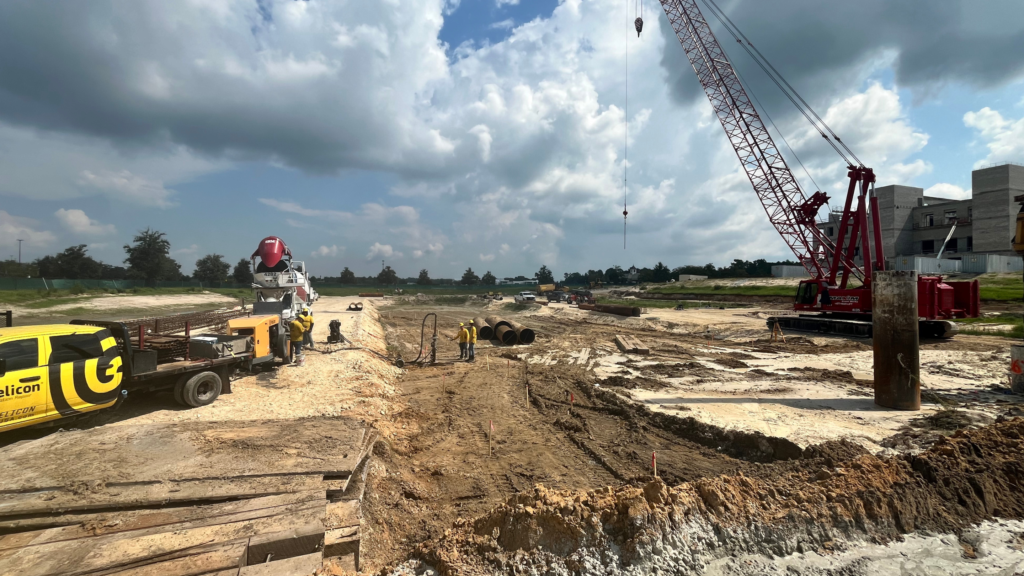
Helicon’s work followed a structured process built around drilling access, casing installation, and controlled grout placement.
Step 1: Drilling and Casing Installation
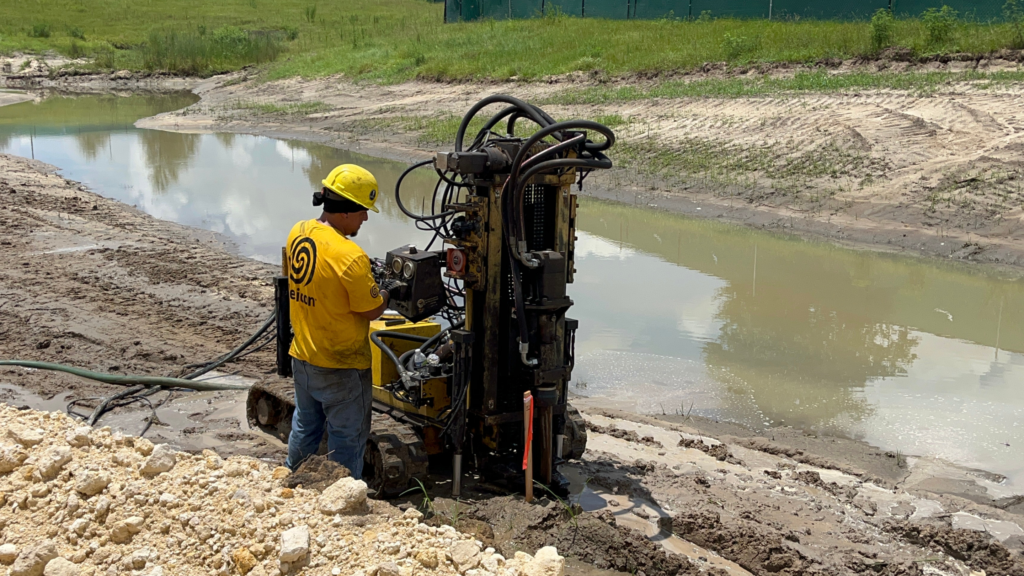
Helicon’s crew drilled and installed 757 linear feet of steel casing at selected locations across the treatment area.
These casings created access to the subsurface zones targeted for improvement. Proper casing placement was critical because compaction grout must be delivered at the correct depths to improve the soil conditions that matter most to the future structure.
On commercial ground improvement projects, layout, depth, and casing control are not minor details. They are central to the success of the work.
Step 2: Insertion of Compaction Grout
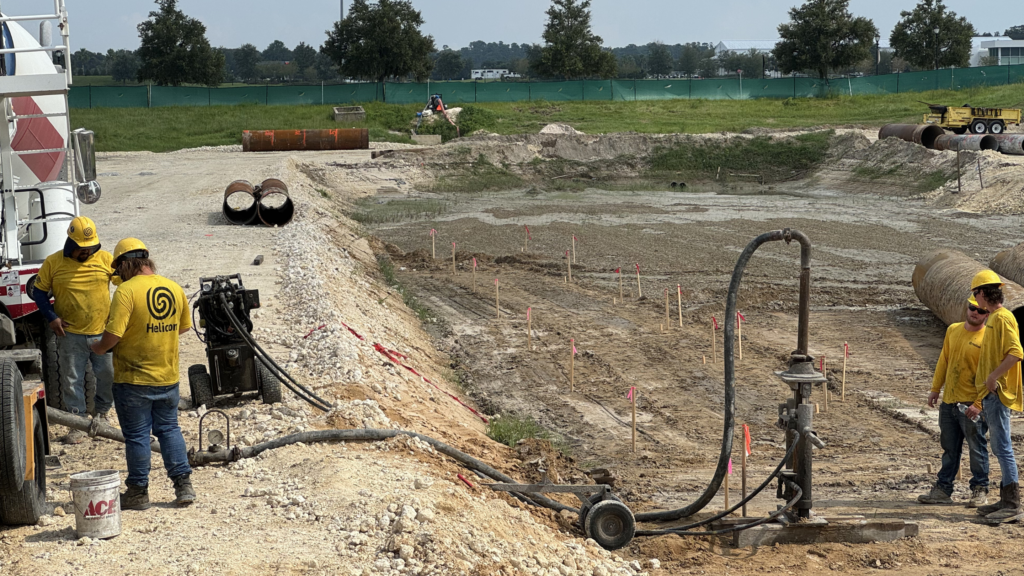
After casing installation, Helicon inserted approximately 500 cubic yards of compaction grout beneath the future building footprint.
As grout was injected, it helped densify and reinforce weak or loose soil zones. The goal was to improve support conditions before the future structure was built, reducing the risk of settlement-related problems after construction.
Step 3: Treatment of Weak Soil Zones
As the compaction grouting progressed, weak or loose zones within the treatment area were improved.
This created a stronger and more dependable subsurface condition beneath the future structure. The result was a better foundation support environment before the building loads were introduced.
Step 4: Coordination on an Active Campus
The project was completed while the World Equestrian Center remained an active property.
That added an important layer of coordination. Large-scale ground improvement work must be performed safely, efficiently, and with awareness of surrounding operations.
On active commercial campuses, experience matters. The work has to support the construction schedule without creating unnecessary disruption to the larger property.
Why This Was Especially Important at the World Equestrian Center
The World Equestrian Center is not an ordinary property.
It is a major Ocala destination with large-scale operations, hospitality facilities, equestrian venues, event spaces, and ongoing development needs. New construction on a campus like this must support more than a building. It must support guest experience, operations, brand reputation, long-term expansion, and owner confidence.
If a new commercial structure experiences foundation movement after construction, the consequences can be significant.
Settlement-related issues can lead to:
- Cracking in slabs or walls
- Uneven floors
- Maintenance costs
- Operational disruption
- Repairs around finished spaces
- Scheduling complications
- Loss of confidence in building performance
For high-standard commercial properties, preventing these problems is often far more valuable than correcting them later.
That is why the decision to stabilize the soil before construction was so important. It reflected a long-term mindset: invest in the ground now to protect the structure later.
Pre-Construction Stabilization vs. Post-Construction Repair
There is a major difference between improving soils before construction and repairing settlement after a building is complete.
Post-construction repairs can be effective, but they are often more complicated. Crews may need to work around finished flooring, walls, landscaping, utilities, tenants, employees, customers, guests, equipment, and active operations.
Access may be limited. Scheduling may be harder. Costs may rise because the repair must be performed around an existing structure.
Pre-construction work gives the project team more control.
Before the building is built, crews can access the treatment area more efficiently. Drilling layouts can be completed with fewer restrictions. Ground improvement can be performed before finishes, occupants, and operations are in the way.
That is why pre-construction soil stabilization is often the smarter path when weak soils are identified early.
It allows owners and builders to solve a subsurface problem before it becomes a structural problem.
A Stronger Support Condition Before Construction
Once the drilling, casing, and compaction grouting work were complete, the future building site had an improved support condition before construction began.
This is exactly why pre-construction ground improvement is so valuable.
It allows owners, developers, and builders to address subsurface risk before the building is in place, before finishes are installed, and before operations depend on the structure.
Why Execution Quality Matters in Compaction Grouting
Compaction grouting is not simply about drilling holes and pumping grout.
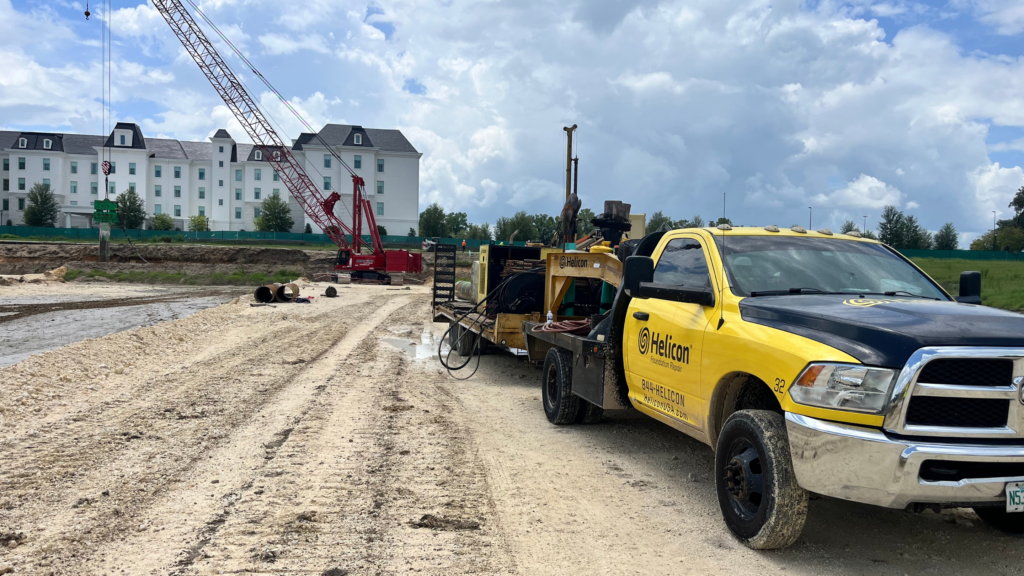
It is a controlled ground improvement process. The success of the work depends heavily on the crew’s ability to drill accurately, manage casing placement, control grout installation, and respond to field conditions.
The same material can produce very different results depending on how well the work is executed.
On this project, depth was difficult but necessary. The crew had to reach low enough beneath the ground to treat the critical soil zones. That required persistence, skill, and discipline in the field.
A meaningful compaction grouting program requires:
- Experienced crews
- Proper equipment
- Accurate drilling
- Controlled grout placement
- Understanding of subsurface behavior
- Coordination with project requirements
- Commitment to doing the work correctly
When the future performance of a building depends on the ground below it, execution quality matters from the first casing to the final yard of grout.
What Commercial Owners and Developers Can Learn From This Project
This Ocala project offers a valuable lesson for commercial property owners, developers, builders, general contractors, engineers, and construction managers across Florida.
Foundation performance begins below the foundation.
If the soil is weak, loose, inconsistent, or vulnerable to settlement, the structure above it may eventually reflect those problems. A well-designed building still depends on the quality of the ground supporting it.
Pre-construction soil stabilization should be considered when a project involves:
- Known weak or loose soils
- Fill soils or variable subsurface conditions
- Settlement-sensitive structures
- Large slabs or structural loads
- Expansions to existing commercial properties
- Active campuses where future disruption would be costly
- Projects where long-term performance is critical
For projects in Ocala, Marion County, Gainesville, Orlando, Tampa, Lakeland, Sarasota, Fort Myers, Naples, and throughout Florida, soil conditions can vary significantly. Early evaluation and stabilization planning can help reduce the risk of future foundation problems.
Commercial Soil Stabilization in Ocala and Across Florida
Helicon provides commercial foundation repair, compaction grouting, soil stabilization, sinkhole remediation, helical pier installation, deep foundation support, and structural repair solutions throughout Florida.
Our team has experience with complex commercial, municipal, DOT, residential, and large-scale stabilization projects. That background matters because commercial ground improvement often demands more than a standard repair approach. It requires planning, production capability, technical understanding, specialized equipment, and field crews that can execute in demanding conditions.
For developers and commercial property owners, the right ground improvement partner can help reduce risk before it becomes expensive.
Whether the project involves a new building, an expansion, a structural addition, or an existing facility showing signs of movement, the right stabilization plan starts with understanding the soil.
Protect the Building Before It Has a Chance to Settle
The World Equestrian Center project is a strong example of smart pre-construction planning.
Instead of waiting for settlement, cracking, or slab movement to appear later, the project team addressed weak soil risk before construction began. Helicon’s compaction grouting program helped improve the ground beneath the future building footprint and created a stronger support condition for long-term performance.
If you are planning a commercial building, expansion, or structural addition in Ocala, Marion County, or anywhere in Florida, Helicon can help evaluate whether soil stabilization or compaction grouting should be part of your foundation protection strategy.
Call 844-Helicon today for a free inspection or fill out the form on our site.