Direct Answer
Soil stabilization is the process of improving weak, loose, eroded, or poorly compacted ground so it can provide better support for a foundation, slab, or other structure.
For many Florida residential foundation and slab problems, one approach is to inject structural polyurethane into weak shallow soils.
Depending on the material, soil, and repair objective, polyurethane can:
- Fill underground voids
- Densify or reinforce loose soil zones
- Bind portions of loose granular soil
- Restore support beneath foundations or slabs
- Help reduce the potential for additional settlement in the treated area
- Be installed through relatively small injection locations
But soil stabilization is an objective—not one specific product or repair method.
Other ground-improvement methods may include compaction grouting, permeation or chemical grouting, and other geotechnical techniques.
And soil stabilization is not automatically the right answer for every sinking foundation.
If deeper foundation support is needed, piers may make more sense. If a slab only has a void beneath it, void filling may be sufficient. If settled concrete needs to be raised, concrete lifting has a different objective.
The purpose of soil stabilization is not simply to inject material into the ground. It is to improve the soil condition that is contributing to the loss of support.
Read more: How Florida Soil Conditions Affect Your Home Foundation
What Does “Soil Stabilization” Actually Mean?
Homeowners often hear terms such as:
- Soil stabilization
- Polyurethane injection
- Chemical grouting
- Foam injection
- Void filling
- Concrete lifting
- Compaction grouting
- Foundation repair
They are related, but they are not interchangeable.
Soil stabilization describes the objective: improve the ground.
The appropriate method depends on:
- What is wrong with the soil
- How deep the problem is
- What is being supported
- Whether voids are present
- Whether lifting is needed
- Whether water or erosion is contributing
For loose shallow soils, polyurethane may be appropriate.
For deeper weak soils, compaction grouting may be considered.
For a foundation requiring deeper structural support, piers may be the better approach.
The repair should follow the condition.
Soil Stabilization vs. Other Foundation and Slab Repairs
| Condition | Repair Objective | Possible Approach When Appropriate |
| Weak or loose shallow soils | Improve soil support | Polyurethane soil stabilization |
| Void beneath a slab | Restore contact/support | Structural polyurethane void filling |
| Settled but repairable slab | Restore support and elevation | Concrete lifting |
| Foundation requiring deeper support | Transfer structural loads deeper | Push, helical, drilled, or other pier system |
| Deeper loose or weak soils | Densify or improve deeper ground | Compaction grouting |
| Active erosion or leak | Stop continuing soil loss | Drainage or plumbing correction plus appropriate repair |
| Severely deteriorated slab | Replace unsuitable concrete | Concrete replacement |
| Minor or uncertain movement | Determine whether it is progressing | Monitoring |
Sometimes a property has more than one problem.
A foundation may need deeper pier support while an adjacent slab has shallow voids requiring polyurethane.
One method does not have to solve every condition on the property.
Why Does Soil Need Stabilization?
Soil supports everything built above it.
When supporting soils become loose, weak, or partially missing, the structure above may lose uniform support.
Common Florida contributors include:
- Poorly compacted fill
- Loose sandy soils
- Erosion or washout
- Plumbing or irrigation leaks
- Drainage problems
- Voids
- Disturbed soil
- Compressible organic material
- Variable soil layers
Importantly, Florida sand itself is not automatically a problem.
Dense, properly compacted sand can provide good support. Concern increases when the soil is loose, poorly compacted, eroding, voided, or behaving differently from the surrounding ground.
How Polyurethane Soil Stabilization Works
The installation varies by property, material, depth, and repair design, but the basic process generally follows six steps.
Step 1: Identify the Area That Has Lost Support
Before injecting material, the contractor should determine what appears to be moving and what condition is being treated.
An evaluation may consider:
- Crack patterns
- Doors and windows
- Gaps
- Relative floor elevations
- Exterior settlement
- Drainage or erosion
- Voids
- Shallow soil conditions
- Property history
At Helicon, a Zip Level may be used when appropriate to help identify relative floor-elevation patterns.
Shallow soil probing may also provide useful field information about apparent loose or weak zones.
Neither measurement alone determines the cause. They are pieces of evidence used to develop the repair plan.
Step 2: Plan the Injection Pattern
Injection locations are positioned around or beneath the treatment area.
Spacing and depth depend on:
- Soil conditions
- Treatment area
- Foundation or slab configuration
- Access
- Material
- Repair objective
Injection rods may be installed at an angle when appropriate to reach soil beneath or adjacent to the structure.
The objective is not to create the most injection points.
It is to place the material where ground improvement is needed.
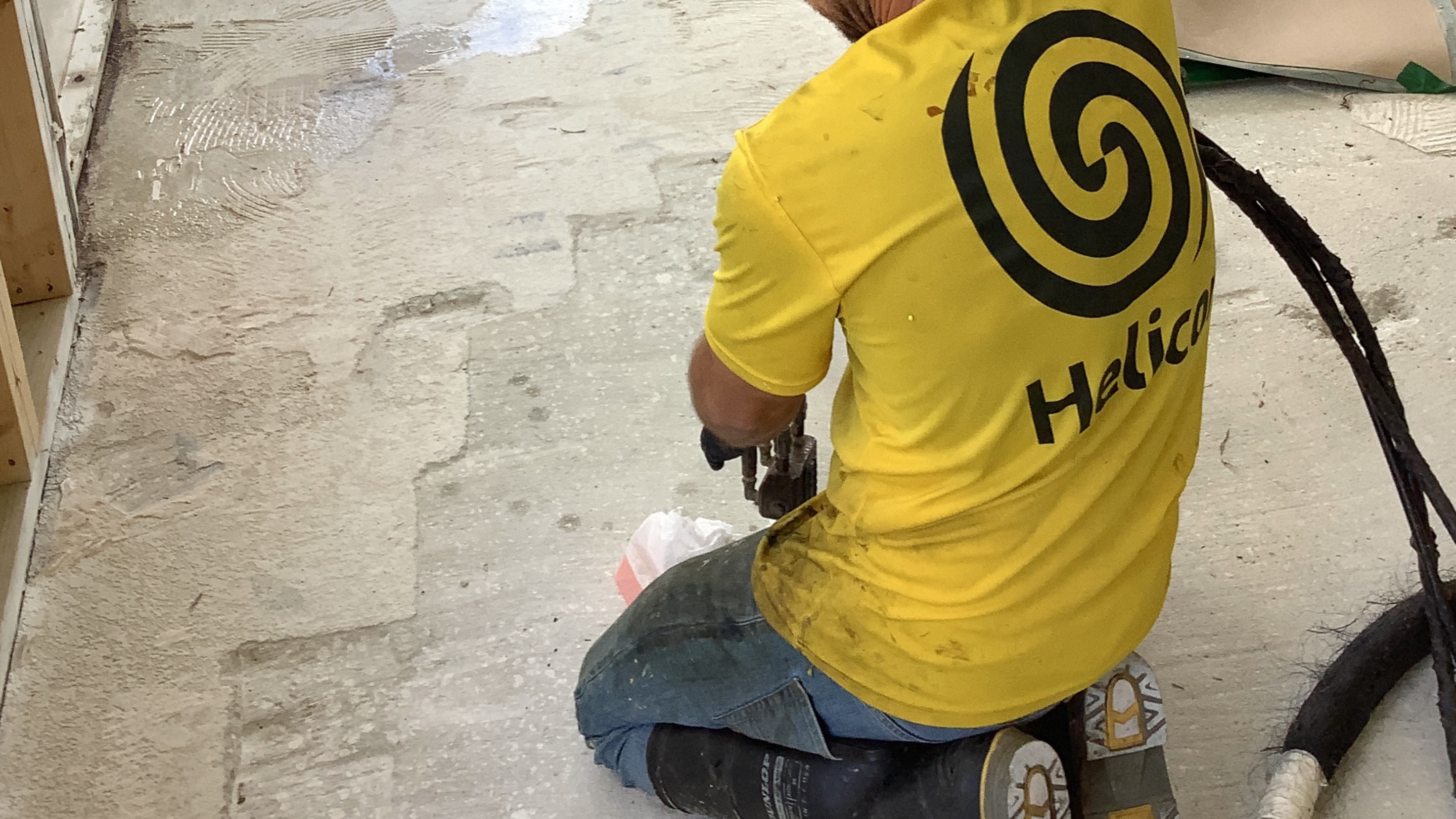
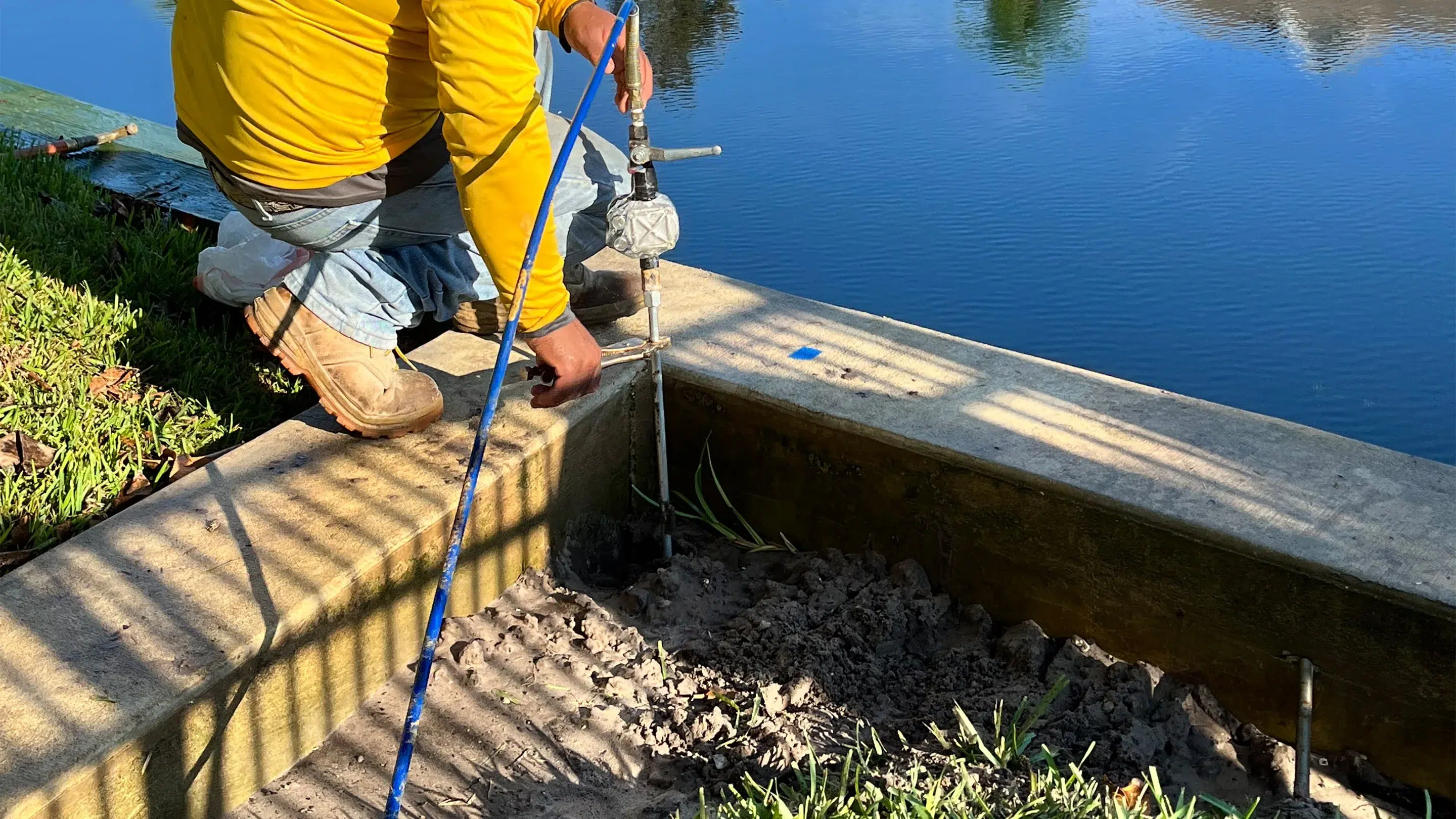
Step 3: Install Injection Rods
Small-diameter rods are advanced into the targeted soil zone.
This allows material to be delivered underground with relatively limited excavation.
Rod depth depends on the condition being treated.
A shallow stabilization project should not be confused with deeper ground improvement or underpinning simply because each involves work below grade.
Step 4: Inject the Polyurethane
Polyurethane is introduced through the rods in controlled amounts.
Depending on the formulation and soil conditions, the material can enter loose zones and voids and then react or expand.
This can help:
- Fill empty space
- Densify surrounding loose soil
- Bind portions of loose granular soil
- Restore contact
- Improve support in the treated zone
The objective is controlled ground improvement—not uncontrolled expansion.
Step 5: Monitor the Response
More material is not automatically better.
During injection, the crew may monitor:
- Material take
- Injection response
- Pressure or resistance
- Surface or structural movement
- Relative elevations
- Nearby slabs or structures
Injection can be adjusted as the soil and structure respond.
This is particularly important when stabilization—not significant lifting—is the objective.
Step 6: Complete the Treatment Zone
Injection continues through the planned locations until the intended stabilization scope has been addressed.
The rods are removed and access locations restored.
The goal is not necessarily to create one continuous mass beneath the property.
It is to improve the targeted weak or voided zones identified in the repair plan.
What Is Actually Happening Underground?
Depending on the polyurethane formulation and soil conditions, the material may expand into voids, exert pressure against loose soils, permeate portions of granular soil, or bind soil particles together.
1. Voids Are Filled
Where soil has been lost or contact has been reduced, polyurethane can enter available void space and help restore support.
2. Loose Soil Is Improved
Expansion can exert pressure against loose granular soils, helping densify the surrounding ground.
Some polyurethane formulations can also penetrate portions of loose soil and bind particles together.
3. Support Is Improved in the Treated Zone
Filling voids, improving loose zones, and restoring contact can create better support for the structure above.
Exactly how the material behaves depends on factors such as:
- Polyurethane formulation
- Soil density and particle size
- Moisture
- Void conditions
- Injection pressure
- Treatment depth
- Installation technique
That is why polyurethane should not be treated as one universal repair installed the same way on every project.
Is Soil Stabilization the Same as Concrete Lifting?
No.
The distinction comes down to repair objective.
Soil Stabilization
Improve weak or loose soil.
Void Filling
Restore support where a gap exists beneath a slab or structure.
Concrete Lifting
Raise settled concrete while restoring support.
One polyurethane project can involve more than one objective.
A foundation may need shallow-soil stabilization without significant lifting.
An interior slab may need support restored without changing elevation.
A driveway may need both void filling and controlled lifting.
The material may be similar. The repair objective is what changes.
Read more: Voids Under Concrete Slabs: What Causes Them and How to Fix Them
Read more: Concrete Lifting
Will Soil Stabilization Lift My Foundation?
Sometimes some movement occurs during injection.
But lifting should not automatically be the objective of soil stabilization.
On certain projects, the appropriate approach may be:
Stabilize first. Do not chase elevation.
Additional lifting can sometimes increase the risk of:
- Cracking
- Door or window changes
- Plumbing stress
- Finish damage
- Unwanted movement elsewhere
On other projects, controlled recovery may be appropriate.
Before work begins, homeowners should understand:
- Is stabilization the primary objective?
- Will lifting be attempted?
- What recovery is realistic?
- What would cause the crew to stop?
Improved support can be a successful outcome even when little or no lifting occurs.
When Does Polyurethane Soil Stabilization Make Sense?
Polyurethane may be worth considering when the primary problem involves certain shallow weak, loose, or voided soil conditions.
Examples may include:
- Loose sandy soils
- Poorly compacted shallow fill
- Localized weak zones
- Soil loss near a foundation
- Voids
- Washout
- Loss of shallow slab support
- Soil behind some seawalls or retaining structures
- Certain pre-construction ground-improvement applications
The structure and loading also matter.
A method appropriate beneath an exterior slab is not automatically appropriate for a home foundation.
When Is Soil Stabilization NOT the Right Answer?
Polyurethane should not become the default solution to every settlement problem.
When the Foundation Needs Deeper Support
If appropriate support lies beyond the treatment zone, foundation piers or another deep-foundation method may make more sense.
When the Concrete Is Not Worth Saving
Badly fragmented, deteriorated, or poorly constructed concrete may be better replaced.
When Water Is Still Removing Soil
If an active leak, drainage problem, or other water source continues to wash soil away, that condition may also need correction.
When the Problem Is More Geologically Complex
Suspected sinkhole-related or other deeper subsurface conditions may require engineering, geologic investigation, compaction grouting, or another approach.
When the Problem Has Not Been Diagnosed
A crack, low floor, or visible void does not by itself prove that polyurethane stabilization is appropriate.
The fact that soil can be injected does not mean it should be.
Soil Stabilization vs. Foundation Piers
These methods solve different support problems.
| Polyurethane Soil Stabilization | Foundation Piers |
| Treats appropriate shallow soil conditions | Provides deeper structural support |
| Improves targeted ground | Transfers foundation loads deeper |
| Typically uses small injection locations | Requires connection to the foundation |
| Can address loose shallow soils and voids | Bypasses unsuitable shallower soils |
| Often requires limited excavation | Usually requires localized excavation/access |
| Appropriate when shallow support is the problem | Appropriate when deeper support is required |
In some cases, both methods can be used on the same property for different objectives.
The useful question is not:
“Which system is better?”
It is:
“Where is the support problem?”
Read more: Can Foundation Problems Be Fixed Without Tearing Everything Out?
Soil Stabilization vs. Compaction Grouting
Both are ground-improvement techniques, but they work differently.
Polyurethane Soil Stabilization
Typically uses a lightweight chemical grout that may:
- Fill voids
- Expand within loose zones
- Bind or densify soils
- Cure rapidly
- Be installed through relatively small access points
It is commonly useful for appropriate shallow soil and slab-support applications.
Compaction Grouting
A high-strength cementitious grout is injected deep into weak or loose soils.
As the grout is pumped under pressure, it forms dense grout bulbs that compact surrounding soils, improve ground support, and help reduce the risk of future settlement beneath foundations, slabs, and other structures.
Compaction grouting may be appropriate for deeper ground improvement and certain sinkhole-related conditions.
Neither method is universally better.
The soil condition, depth, structure, and repair objective determine which approach fits.
Read more: Compaction Grouting
Why Polyurethane Formulation Matters
Usually, homeowners do not need to select the chemistry themselves.
Polyurethane systems can vary in:
- Viscosity
- Expansion
- Reaction time
- Strength
- Water response
- Permeation characteristics
Different formulations may be selected for soil stabilization, void filling, slab lifting, seawall soil stabilization, water control, or other specialized applications.
The important homeowner question is:
“Why is this material appropriate for my soil condition and repair objective?”
The contractor should be able to explain that.
How Do Contractors Know the Soil Has Been Stabilized?
Because the work occurs underground, installation control matters.
Depending on the project, crews may consider:
- Planned injection locations and depths
- Material quantities
- Injection pressure or resistance
- Material take
- Soil or surface response
- Structure or slab movement
- Elevation monitoring
- Engineering specifications
- Additional testing when required
No single indicator tells the entire story.
The appropriate indicators also depend on the repair design and the material being installed.
Injecting more material does not automatically create a better repair.
The objective is to achieve the treatment required for the condition.
Can Soil Stabilization Stop Future Settlement?
Proper stabilization is intended to improve support and reduce the potential for additional movement in the treated area.
It does not make the entire property immune to future movement.
Future issues could occur because of:
- Movement outside the treated area
- New leaks
- Drainage changes
- New erosion
- Deeper soil conditions
- Structural changes
- Unrelated slab settlement
Every stabilization project has a defined treatment area and objective.
Read more: What Most Companies Won’t Tell You About Foundation Repair
What About Water and Drainage?
Soil stabilization and water management solve different parts of a problem.
If water is actively washing soil away, leaking from a pipe, or concentrating beside a structure, the source should be considered.
Soil stabilization may address weakened ground.
Drainage or plumbing work may address why the ground became weakened.
Correcting drainage alone also does not necessarily restore support already lost.
Sometimes both need attention.
Read more: Drainage Problems and Foundation Settlement in Florida
Is Polyurethane Soil Stabilization Disruptive?
Compared with major excavation or some structural repairs, polyurethane injection can often be performed with relatively limited disturbance.
Potential advantages include:
- Small injection locations
- Limited excavation
- Lightweight material
- Rapid reaction and curing
- Targeted treatment
- Access to some difficult locations
But lower disruption should never become the reason to choose the wrong repair.
If deeper structural support is required, piers may still be appropriate.
The goal is the least invasive repair that properly addresses the movement.
How Long Does Polyurethane Soil Stabilization Last?
There is no responsible universal lifespan for every project.
Long-term performance depends on:
- Correct diagnosis
- Soil conditions
- Treatment depth and coverage
- Material selection
- Installation
- Structural loading
- Drainage
- Future erosion
- Conditions outside the treated zone
Once cured, structural polyurethane is designed to remain in the treated ground.
But durability depends on more than the material itself.
The more useful question is:
“Was the correct soil zone treated, and was the cause of the support problem properly addressed?”
What Does Soil Stabilization Cost?
Cost can vary significantly because soil stabilization projects differ in size, depth, access, and objective.
Pricing may depend on:
- Treatment area
- Treatment depth
- Injection locations
- Material quantity
- Interior or exterior access
- Soil conditions
- Voids
- Foundation configuration
- Whether lifting is attempted
- Whether slab support is also needed
- Engineering requirements
A localized slab-support repair is very different from treating weak soils around a substantial portion of a home.
Compare diagnosis and scope before price.
Read more: How Much Does Foundation Repair Cost in Florida?
What Signs Might Suggest a Shallow Soil-Support Problem?
Possible signs include:
- Soil loss beside a foundation
- Small depressions near the structure
- Voids beneath concrete
- Settled sidewalks or patios
- Interior or garage slab settlement
- Pool deck movement
- Repeated cracking in one area
- Gaps between slabs and the foundation
- Evidence of washout
These signs do not prove polyurethane stabilization is needed.
They identify conditions worth investigating.
The symptom identifies where to investigate—not which product to install.
Checklist: Questions to Ask Before Approving Soil Stabilization
Diagnosis
- What exactly is moving?
- What evidence indicates weak or loose soil?
- Does the problem appear shallow or deeper?
- Are voids present?
- Is the structural foundation settling?
Cause
- Why did the soil lose support?
- Could poor compaction be involved?
- Is erosion or washout involved?
- Are plumbing or irrigation leaks relevant?
- Is drainage contributing?
Treatment
- What soil zone will be treated?
- Approximately how deep will treatment extend?
- How are injection locations selected?
- Why is polyurethane appropriate?
- Is the objective stabilization, void filling, lifting, or a combination?
Alternatives
- Were piers considered?
- Would compaction grouting be more appropriate?
- Does the concrete need replacement?
- Could monitoring be reasonable?
- Does another contributing condition need correction?
Expectations
- Is lifting expected?
- What recovery is realistic?
- What areas are not included?
- What cosmetic damage may remain?
- What does the warranty cover?
If those questions cannot be answered clearly, more information may be needed before approving the repair.
How Helicon Approaches Soil Stabilization
Helicon has worked with Florida foundations and soils since 2004.
Our experience includes:
- Polyurethane soil stabilization
- Structural void filling
- Concrete lifting
- Foundation underpinning
- Compaction grouting
- Sinkhole repair
- Seawall soil stabilization
- Deep foundations
That breadth matters because not every weak-ground problem should receive the same treatment.
We Start With the Repair Objective
We want to understand:
- What is moving?
- What appears to have caused the support loss?
- Is the condition shallow or deeper?
- Is the problem soil, a void, a slab, the foundation, or a combination?
- Is water contributing?
- Does anything need repair?
- What is the least invasive repair that properly addresses the movement?
Sometimes polyurethane stabilization is appropriate.
Sometimes deeper foundation support is needed.
Sometimes only a slab or contributing water condition requires attention.
And sometimes monitoring is appropriate.
The value of having multiple repair capabilities is not finding more things to sell. It is being able to choose the method that fits the problem.
Read more: About Helicon
Schedule a Free Soil Stabilization Inspection
If you are seeing soil loss, voids, foundation symptoms, sinking slabs, or other signs of possible ground movement, you do not need to choose the repair method yourself.
Helicon can evaluate the visible condition, relative elevations when appropriate, drainage, shallow soils, slab behavior, foundation symptoms, and other relevant site factors.
The goal is to determine:
- What has lost support
- Why
- Whether the problem appears shallow or deeper
- Whether soil stabilization is appropriate
- Whether another repair makes more sense
Good soil stabilization starts with understanding why the ground is weak—not simply deciding to inject it.
Read more: Polyurethane Soil Stabilization
FAQ
What is soil stabilization?
Soil stabilization improves weak, loose, eroded, or poorly compacted ground so it can provide better support for a structure or slab.
How does polyurethane soil stabilization work?
Structural polyurethane is injected into targeted weak or voided soil zones where it can fill voids, improve loose soil, and restore support in the treated area.
Is soil stabilization the same as foundation repair?
It can be part of foundation repair, but foundation repair may also involve piers or other structural support methods.
Is soil stabilization the same as concrete lifting?
No. Soil stabilization improves the ground. Concrete lifting is intended to raise settled concrete while restoring support.
Is soil stabilization the same as void filling?
No. Void filling restores contact where empty space exists. Soil stabilization improves weak or loose ground. Some projects involve both.
Can polyurethane lift a house?
Some movement can occur, and controlled lifting may be appropriate on certain projects. On others, stabilization rather than elevation recovery is the objective.
How deep can polyurethane soil stabilization go?
Treatment depth depends on the soil, material, equipment, access, and repair design. It is commonly used for appropriate shallow-soil conditions rather than as a universal substitute for deeper support.
When are foundation piers better than soil stabilization?
Piers may be more appropriate when affected foundation areas require dependable support at greater depth.
What is the difference between polyurethane and compaction grouting?
Polyurethane is a lightweight chemical grout often used for appropriate shallow soil, void, and slab-support applications. Compaction grouting uses a thick cementitious grout to compact surrounding soils and is often used for deeper ground improvement.
Can soil stabilization fix drainage problems?
No. Stabilization can improve weakened ground, but an active drainage or plumbing source may also need correction.
Does polyurethane soil stabilization require excavation?
Usually only limited access is needed compared with major excavation. Material is typically delivered through small-diameter injection rods or ports.
How do contractors know where to inject polyurethane?
Locations are planned based on the structure, symptom pattern, soil condition, treatment depth, access, and repair objective.
How long does soil stabilization last?
There is no universal lifespan. Performance depends on diagnosis, soil conditions, treatment coverage, material, installation, drainage, and future conditions.
Can soil stabilization fix a sinkhole?
Polyurethane stabilization should not automatically be treated as sinkhole remediation. Sinkhole-related conditions may require engineering or geologic evaluation and other repair methods such as compaction grouting.
How do I know whether my home needs soil stabilization?
First determine what is moving and whether the problem involves shallow soil, voids, a slab, deeper foundation support, or another condition. The visible symptom alone usually cannot answer that question.