Your floors feel uneven underfoot, a door that used to swing freely now sticks, and you notice a crack running diagonally from the corner of a window. These are not cosmetic quirks. They are often early signs that the soil beneath your home is shifting, and that your foundation piers, or lack of proper support, may be the reason your structure is losing stability.
When a foundation loses support, the structure above it moves with it, and that movement creates problems that grow more expensive the longer they go unaddressed. Getting the right information early gives you options. Catching settlement at the stair-step crack stage is far less involved than waiting until beams separate or slabs fracture.
This guide walks you through why Florida homes lose support, how pier systems restore it, what warning signs to watch for, and what the repair process actually looks like from inspection to completion. The guidance here draws on engineered repair experience, including the approach used by Helicon, to give you a clear, practical picture of your next steps.
Why Homes Lose Support
Soil failure is rarely dramatic at first, which is why most homeowners are surprised when a structural engineer tells them the problem has been building for years. The specific soil conditions found in Florida create settlement risks that differ significantly from what homeowners in other states face.
How Soil Movement Affects Structural Stability
Soil carries your home’s weight constantly. When that soil compresses, washes away, or shifts laterally, the foundation above it loses its bearing surface, and that loss translates directly into structural movement.
Sandy soils compact under repeated loading. Clay soils expand when wet and shrink when dry, creating a cycle of upward and downward pressure that stresses the slab repeatedly. Organic material in the soil decomposes over time, leaving voids that cause the ground to collapse inward. Each of these mechanisms produces uneven support, which is why one side of a room may drop faster than the other.
The result is differential settlement, where one section of the foundation moves more than an adjacent section. That differential creates stress concentrations, and those concentrations show up as diagonal cracks, sloped floors, and gaps where walls meet ceilings.
Common Triggers In Florida Properties
Florida’s geology creates a specific set of risk factors that make foundation movement more common here than in states with dense, stable subsoil:
- High water tables soften the soil around and beneath slabs, reducing the soil’s load-bearing capacity during and after heavy rain events.
- Sandy and silty soils drain quickly but also shift easily, offering little cohesion to resist lateral movement.
- Karst topography, where limestone bedrock dissolves over time, creates underground voids that can collapse suddenly, producing sinkholes and severe localized settlement.
- Coastal erosion and storm-related washouts further destabilize the soil profile around seawalls and areas requiring helical piers for pool sites or any structure near the waterline.
- Poor drainage around the perimeter of a home concentrates water near the foundation, accelerating soil softening in precisely the areas where the load is highest.
How Pier Systems Restore Stability
Pier systems work by bypassing weak, unreliable near-surface soils and transferring your home’s weight to deeper ground that can actually carry the load. When considering repair methods, weighing foundation piering vs underpinning helps determine which underpinning technique best fits your soil profile and the type of movement that has already occurred.
What These Systems Actually Do
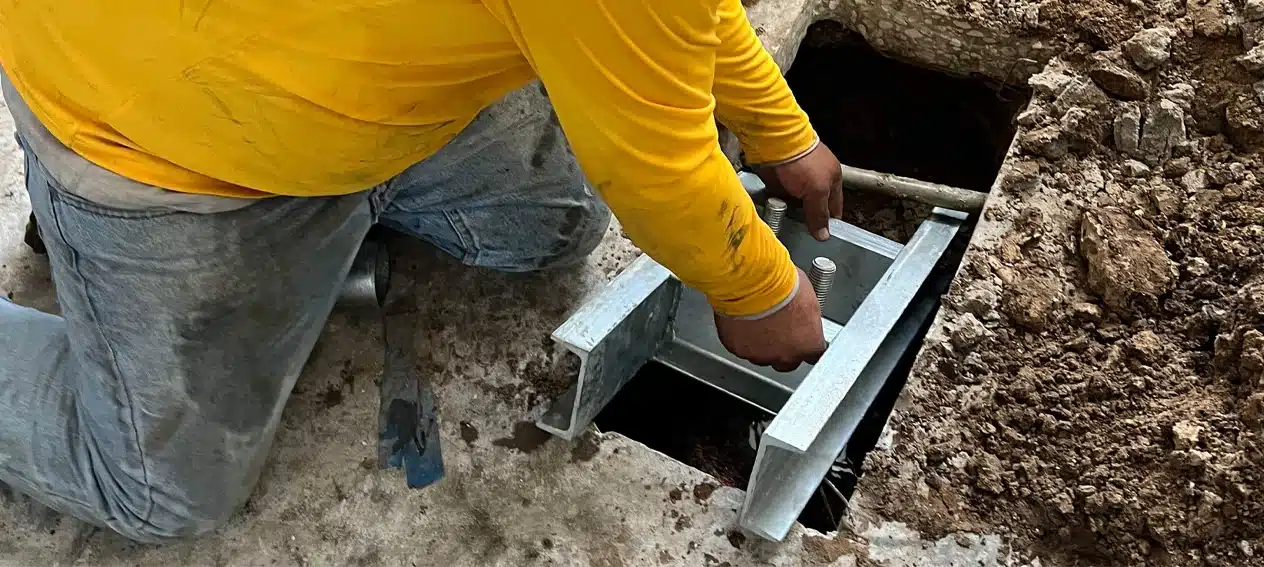
A pier is a vertical structural column installed into the ground beneath the foundation. Its job is to act as a bridge between your home’s slab or footing and the deeper, stable soil or bedrock below it. Once installed, the pier carries the structure’s load past the problematic zone entirely.
After the piers are set, hydraulic equipment applies controlled, measured lifting force to the foundation brackets. This lifts the settled section back toward its original elevation. The degree of lift depends on how much settlement has occurred and whether the structure can tolerate the movement safely.
Once the piers are locked into position, the foundation sits on a new, engineered support system rather than on the soil that failed. The process does not repair the soil. It makes the soil irrelevant to your home’s structural performance.
Where Helical And Push Options Differ
Helical piers are screwed into the ground using rotational torque, much like a large screw being driven into dense material. When evaluating push piers vs helical piers, remember that helicals generate their own installation force rather than relying on the structure’s weight, making them ideal for lighter residential applications and tight access areas. Torque readings during installation confirm when the pier has reached competent bearing material.
Push piers are hydraulically driven into the ground using the weight of the existing structure as resistance. That means the home itself provides the downward force that seats each pier. Push piers are well suited to heavier structures where existing settlement has already occurred, because the installation process also allows for controlled lifting once the piers are fully driven.
The right choice depends on your soil depth, your home’s weight distribution, and the locations where support is most needed. The benefits of helical piers in Florida are evident in coastal and sandy environments, which is why helical piers outperform timber piles for long-term structural reliability.
Signs A Structural Evaluation Makes Sense
Most homeowners notice interior symptoms before they ever spot exterior changes, but both matter. Combining what you see inside and outside gives the clearest picture of how far a problem has progressed.
Interior Clues Homeowners Often Notice First
The most telling interior signs tend to cluster around doors, windows, and floor transitions. Doors and windows that stick or no longer latch properly often indicate that the frame has racked, meaning the opening is no longer square.
That racking follows foundation movement directly. Diagonal cracks running from the corners of door frames or window frames at roughly 45-degree angles are a specific pattern tied to differential settlement, not normal house movement.
Uneven floors that cause furniture to wobble or that you can feel as a slope when walking barefoot across a room point to the foundation dropping unevenly. Gaps appearing between walls and floors, or between walls and ceiling trim, signal that the structure has moved enough to separate finish materials from their substrate.
Creaking sounds that increase over time, especially when walking across a specific area, can indicate that joists or beams are under abnormal stress.
Exterior Changes Around The Slab And Yard
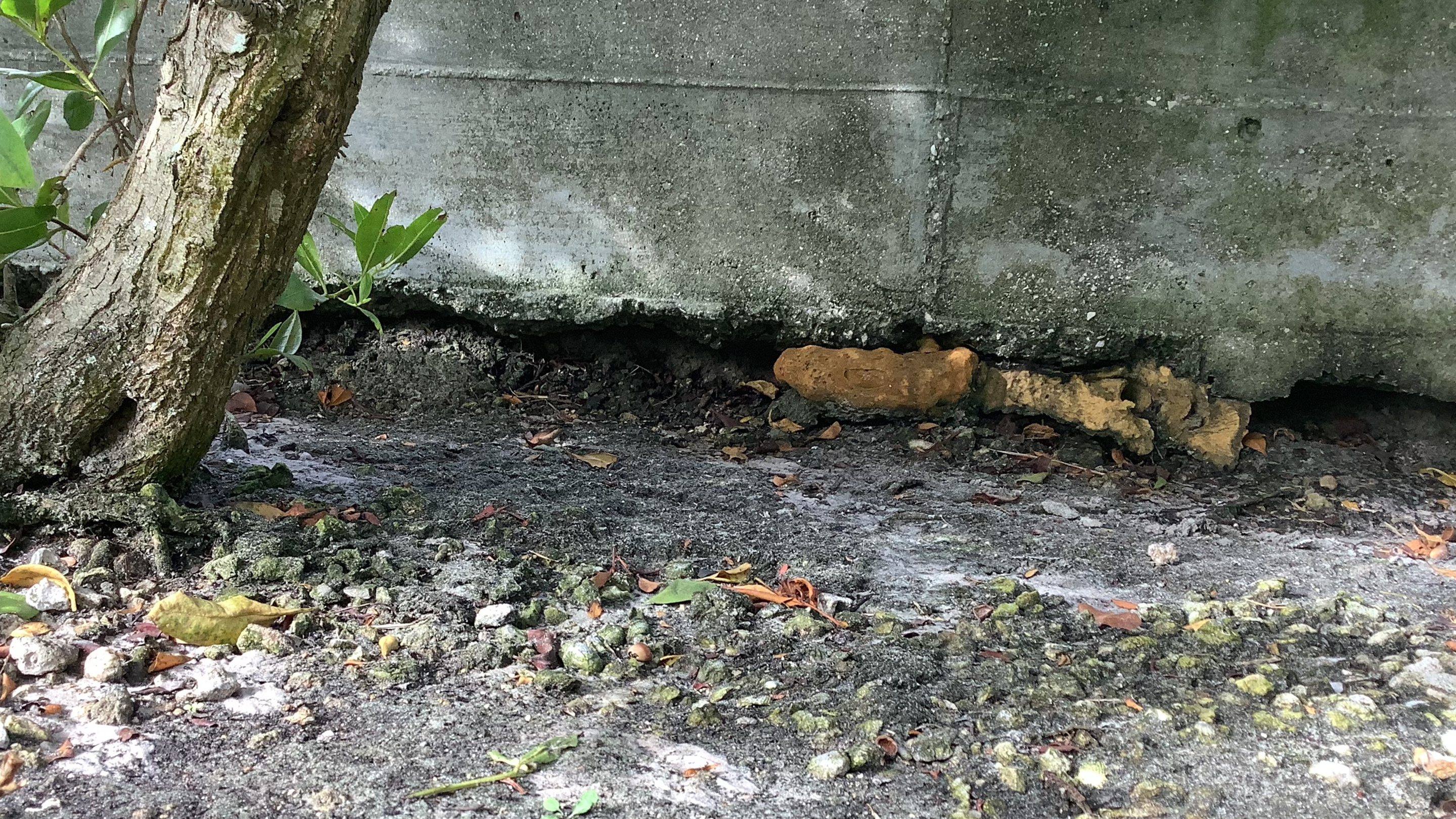
Outside your home, settlement leaves different but equally readable evidence. Depressions in the yard, especially those that appear gradually or after heavy rain, often indicate voids forming beneath the surface. These voids remove the soil support that keeps slabs and foundations level.
Cracks in the slab itself, particularly those that are wide enough to insert a credit card into, or that show vertical displacement where one edge is higher than the other, indicate significant movement. Water pooling consistently near the foundation perimeter suggests drainage problems that are actively feeding the soil saturation cycle that leads to settlement.
Cracks in exterior brick or stucco that follow a stair-step pattern along mortar joints are another reliable sign that the foundation beneath has shifted unevenly.
What Installation Usually Looks Like
Most homeowners are surprised by how contained the process is. Pier installation typically does not require you to vacate the home, and the disruption to your yard is far more limited than most people expect.
Inspection, Engineering, And Load Planning
Before any equipment arrives, a structural evaluation determines exactly where piers are needed and how many.
The inspector examines visible symptoms inside and outside the structure, documents crack locations and patterns, and assesses the floor profile. Soil conditions inform the pier type and installation depth required to reach stable bearing material.
Engineering calculations establish the load that each pier must carry, which determines pier spacing and bracket placement along the foundation. This planning phase is not a formality. Placing too few piers or spacing them incorrectly produces uneven lift that can stress the structure rather than relieve it.
Installation Lifting And Final Verification
On installation day, the crew excavates small access pits at each marked pier location, typically 18 to 24 inches wide, just large enough to seat the bracket and drive equipment. Steel brackets are attached directly to the footing, and pier sections are driven or screwed to depth in segments.
Once all piers reach their target depth, hydraulic jacks apply simultaneous lift across the pier line. Elevation readings guide how much lift each section receives, ensuring the foundation rises evenly rather than creating new stress points.
After the lift is complete and the structure is locked at its new elevation, backfill closes the access pits, and the site is restored. Most residential installations take two to four days depending on the number of piers and site access.
Costs Longevity And Repair Planning
Pier projects range considerably in price, but most of that variation comes down to a small number of predictable factors rather than random market differences. Understanding what drives cost helps you compare quotes accurately and set realistic expectations before you approve any work.
What Affects Price And Project Scope
The single largest driver of total project cost is pier count. Each pier typically falls in the range of $1,000 to $3,500 depending on type, depth, and materials. A home requiring eight piers costs roughly twice what a home requiring four piers costs, before any additional work is factored in.
Pier type affects both unit cost and installation time. Helical piers require a torque motor and trained operators, which adds equipment cost. Push piers require hydraulic driving equipment and simultaneous lifting rigs.
Steel piers in soft Florida soils often need to reach greater depths to find competent bearing material, which increases both material length and labor hours. Access conditions matter too.
Piers installed in a crawl space under a low-clearance area take longer to set than those installed from an open exterior perimeter. Permitting requirements and engineered drawings also add to the project total, especially in coastal or sinkhole-prone zones.
How Long Results Typically Last
When piers are designed and installed correctly, the results are intended to be permanent. The pier itself does not degrade in the way that soil does. Steel pipe sections driven to bedrock or dense bearing strata will not settle further as long as the bearing material itself remains stable.
Corrosion protection on steel piers extends service life significantly in Florida’s humid, high-water-table conditions. What changes over time is the surrounding soil, not the pier. If erosion or void formation continues elsewhere under the slab, new areas may require treatment, but properly piered sections hold their position.
For that reason, pairing pier installation with soil stabilization where conditions warrant it gives the most complete long-term outcome.
Choosing The Right Next Step
Making a confident decision about foundation repair starts with asking the right questions before you agree to anything. The questions you ask a contractor reveal the quality of the repair as much as the proposal itself does.
Questions To Ask Before Approving Repairs
Before signing any contract, get clear answers to these specific questions:
- What engineering basis did you use to determine pier count and spacing? A legitimate answer references load calculations and soil conditions, not a general rule of thumb.
- What pier type are you recommending, and why does it fit my specific soil profile? The answer should reference your site, not a default product.
- How deep will each pier need to go to reach competent bearing material? Depth varies by location in Florida and should be estimated from soil data, not assumed.
- Will the work include a controlled lift, and how will you verify elevation during the process? Documented lift monitoring protects you from uneven raising that creates new cracks.
- What does the warranty cover, and for how long? Understand whether it covers the pier itself, the lift, or both.
- Do I need a permit for this work, and will you pull it? In Florida, structural repairs to a foundation typically require a permit.
Frequently Asked Questions
Answers to common questions about pier costs, types, and installation can make the difference between an informed repair decision and an expensive misstep.
How much does it typically cost to install piers under a house?
Most homeowners pay between $1,000 and $3,500 per pier, depending on the pier type, required depth, and local soil conditions. Total project costs vary based on how many piers are needed, with smaller jobs running $8,000 to $15,000 and more extensive repairs exceeding $20,000 or more. Getting a site-specific evaluation is the only reliable way to estimate your actual project cost.
What are the main types of piers used for residential foundation repair?
The most common types used in residential repair are helical piers, push piers, and concrete piers. Helical piers are screwed into the ground using rotational torque, push piers are hydraulically driven using the structure’s own weight, and concrete piers are cast in drilled shafts. Each type suits different soil conditions, load requirements, and access situations.
When should you choose steel push piers instead of concrete alternatives?
Steel push piers work best when the structure is heavy enough to provide sufficient driving resistance and when competent bearing material exists at a reachable depth. They are particularly effective for existing homes experiencing active settlement where controlled lifting is needed. Concrete alternatives may be preferred in new construction or when a drilled shaft can be filled and cured to meet specific load requirements.
How many piers are usually needed to stabilize a settling foundation?
The number depends on the size of the settled area, the home’s weight, and how far apart each pier can be spaced while still carrying its share of the load. A small localized settlement may require as few as four to six piers, while a home with widespread settlement across a full perimeter can require twelve or more. Spacing is determined by structural engineering calculations, not by a fixed rule.
Can piers be installed on an existing home without major disruption?
Yes. Pier installation on an existing structure typically requires only small access pits, usually 18 to 24 inches wide, at each bracket location. The work does not require full excavation around the foundation perimeter or removal of interior flooring in most cases. Most homeowners can remain in the home during installation, though your contractor should advise you based on the specific scope of your project.
What factors most affect the total price of a piering project?
Pier count has the largest effect on total cost, since each pier carries its own materials and labor cost. Depth to competent bearing material drives per-pier cost significantly, especially in Florida where stable layers can sit well below the surface. Access conditions, permit requirements, and whether soil stabilization is needed alongside the pier work also affect the final total.
When To Schedule A Professional Inspection
You do not need to wait until the problem is obvious from the street. Earlier evaluations consistently lead to simpler, less expensive repairs.
Schedule a structural inspection if you notice doors or windows sticking that were previously easy to operate. Any new or growing diagonal crack at a door or window corner warrants a professional inspection. Helicon Foundation Experts offers free, no-obligation inspections across Florida, removing the cost barrier to getting reliable information early. The inspection documents your current condition and gives you a clear, specific repair recommendation rather than a general estimate.