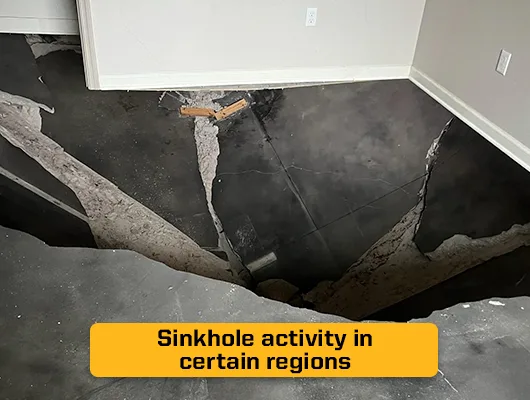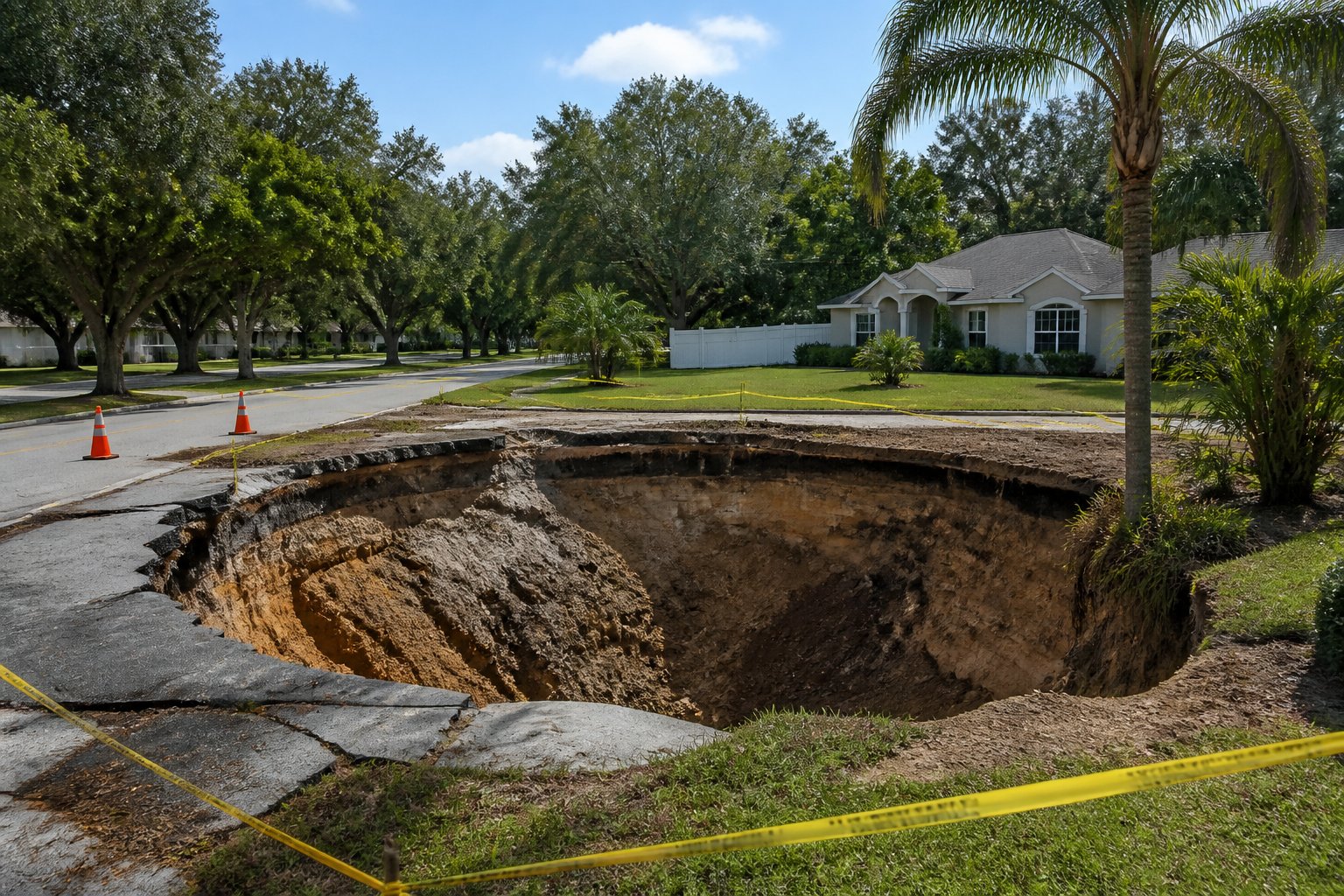
You just opened a 50-page document full of terms like “differential settlement,” “SPT boring log,” and “void not confirmed,” and none of it explains what it means for your house. Maybe your insurance company ordered this evaluation before renewing your policy. Maybe you filed a claim after noticing cracks or a dip in the yard, and now you’re holding the engineer’s response with no idea how to read it.
Sandy fill soils, karst limestone, and heavy seasonal rain make Florida one of the few places in the country where a sinkhole inspection report is routine for homeownership, not a rare emergency document.
This guide walks through every major section of a typical report, from site history to the engineer’s final conclusion, to help you understand the document in front of you.
Where Should You Start in the Report?
Start at the front of the report, not the technical pages in the middle. The property details, scope of work, and engineer’s conclusion give you the frame you need before any of the data makes sense.
A sinkhole assessment is built in layers, and skipping to the boring logs first is how most homeowners end up more confused, not less. The opening pages tell you who ordered the report, what address and structure were evaluated, and what triggered the investigation.
That context matters because a report requested after a visible crack reads differently in structure than one requested for a routine insurance renewal.
Find the Property Details, Scope, and Engineer’s Conclusion
Check that the address, parcel details, and inspection date match your property exactly. Then look for the scope of work section, which spells out what the geotechnical engineer was asked to evaluate, whether that’s the full lot, just the structure’s footprint, or a specific area of concern like a patio or driveway.
The engineer’s conclusion usually sits near the front as a short summary, even though the supporting data appears later. Reading that summary first gives you a preview of what the rest of the pages are trying to prove or rule out.
Separate Observations, Test Results, and Recommendations
Reports mix three different kinds of information, and separating them helps you read with more clarity:
- Observations describe what the field team saw or measured, like cracks, floor tilt, or soil samples.
- Test results are the numeric data from borings, penetration tests, or radar scans.
- Recommendations are the engineer’s professional judgment about what, if anything, should happen next.
Once you know which category you’re reading, the next logical step is to look at how the report frames your property’s history and what the field team actually observed on site.
What Do the Site History and Visual Findings Show?
The site history section documents anything on record about your property or the surrounding area, while the visual findings describe what the inspector physically observed during the site visit. Together, they set the stage for why subsurface testing was or wasn’t recommended.
Florida’s geotechnical investigation process almost always starts by checking for prior sinkhole activity or subsidence incidents tied to the address or neighborhood. This isn’t a guess about your specific risk. It’s a records check against known reporting databases.
Review Past Damage, Repairs, and Reported Subsidence
This part of the report lists any previously documented sinkhole damage, prior repairs, or subsidence incident reports connected to the property or nearby parcels. If your home has had grouting, underpinning, or other stabilization work done in the past, the engineer will typically note it here as background, not as a current finding.
A subsidence incident report is different from a confirmed sinkhole. Many reported incidents on Florida properties are logged simply because a resident called it in, not because a licensed geologist verified karst activity, according to the Florida Geological Survey’s sinkhole FAQ.
Read Cracks, Floor Elevations, and Yard Depressions as Observations
The visual inspection section records physical conditions such as interior or exterior cracks, uneven floors, yard depressions, or misaligned doors and windows. These are logged as observations, meaning the engineer documents what exists, not what caused it.
Floor elevation surveys are part of this step. They measure height differences across the slab, since a foundation tilt can sometimes point to soil movement underneath the structure.
Check Florida Records Without Treating Them as a Property Diagnosis
You can look up publicly reported subsidence data yourself through the Florida Geological Survey’s map direct tool, which many reports reference directly. It’s worth knowing that karst features, the underground cavities and voids common across much of the state, are widespread in Florida’s limestone bedrock, yet most never affect a specific structure.
Reading that a nearby parcel has a subsidence incident report on file tells you about regional geology, not about the ground under your own foundation. The report’s subsurface testing pages speak to conditions at your address, which is exactly where the document goes next.
How Do You Read the Subsurface Testing Pages?
Subsurface testing pages translate what’s happening underground into numbers and logs, and they carry the most weight in the engineer’s final conclusion. Two methods show up most often in Florida sinkhole assessments: soil borings with standard penetration testing, and ground-penetrating radar.
These pages look intimidating because they’re built for other engineers, not homeowners. Breaking them into their three components makes them far more approachable.
What Do Soil Borings and SPT Logs Record?
A soil boring is a drilled hole where samples are pulled at set intervals, usually every five feet, so the engineer can log soil type, consistency, and depth to rock. Standard Penetration Test borings, sometimes paired with Cone Penetrometer Test soundings, are the traditional field exploration methods used in Florida sinkhole evaluations, according to the Florida Department of Transportation’s guidance on Central Florida sinkhole evaluation.
Each boring log reads like a vertical timeline of your property’s soil, from the surface down to limestone bedrock. In much of Florida, slightly acidic groundwater dissolves that bedrock over long periods, creating the state’s karst terrain.
What Do N-Values and Weight-of-Rod Notes Mean?
The N-value is a number generated during the standard penetration test that reflects soil density and resistance at each depth interval. Low N-values, especially those noted as weight of rod or weight of hammer, indicate the drilling rod sank under minimal or no resistance.
According to Helicon’s own breakdown of engineering report basics, N-values under 15 after the first several feet of depth are worth paying close attention to, particularly when marked WOH, WH, WOR, or WR. These notations don’t automatically mean a void or sinkhole is present, but they are one data point the engineer weighs when forming a conclusion.
What Can Ground-Penetrating Radar Detect, and What Does It Miss?
Ground-penetrating radar is a non-invasive geophysical method sometimes used to supplement or guide soil borings before or alongside drilling. It covers more ground than borings alone, but it’s an interpretive tool, and its accuracy depends heavily on ground conditions.
Radar can pick up signs of a ground void, loose fill, or disturbed soil layers, but the Florida Department of Transportation’s sinkhole evaluation guidance notes that radar anomalies don’t always correlate with what subsequent drilling finds. That’s why most thorough sinkhole investigations pair radar with soil borings rather than relying on one method by itself.
With the testing data explained, the next question is how the engineer weighs it all into a single conclusion.
What Does the Engineer’s Conclusion Mean?
The engineer’s conclusion translates all observations and test data into a professional finding, typically landing in one of three categories: confirmed sinkhole activity, no confirmation of sinkhole activity, or inconclusive results. This section carries legal and insurance weight, so it uses specific, deliberate language.
Understanding what each category actually states, without assuming what it means for your particular claim, is the most useful thing you can take from this part of the report.
Distinguish Confirmed Activity, No Confirmation, and Inconclusive Results
- Confirmed sinkhole activity means the engineer found evidence, usually a combination of test results and visual findings, that meets the threshold for sinkhole activity as defined under Florida law.
- No confirmation means the data collected did not support a finding of sinkhole activity, though it doesn’t necessarily rule out every possible cause of the damage.
- Inconclusive means the evidence gathered wasn’t sufficient to reach a firm conclusion either way, often prompting a recommendation for further testing.
Identify the Evidence, Limitations, and Recommended Follow-Up
Every conclusion should reference the specific data that supports it, whether that’s a cluster of low N-values, a confirmed ground void from radar, or the absence of either. Reports also typically include a limitations section, noting that findings apply only to the tested locations and conditions observed at the time of the investigation.
Recommended follow-up might include additional borings, long-term monitoring, or referral for a full geotechnical investigation if the initial scope was narrower.
Understand Repair Terms Without Choosing a Fix from the Report Alone
Reports sometimes list potential remediation categories such as soil stabilization, pressure grouting, underpinning, or deep foundations, particularly when a subsidence sink or cover-collapse condition is described. These terms describe categories of engineered solutions, not a specific recommendation for your property unless the report says so directly.
Our sinkhole repair page explains how these methods are applied once you choose a repair path.
Sinkhole insurance claims often hinge on exactly how this conclusion is worded, which is precisely why the next step is knowing what to ask before you accept the report at face value.
What Should You Ask After Reading the Report?
The most useful thing you can do after reading a sinkhole inspection report is ask the engineer or inspector direct questions about how they reached the conclusion. A short conversation can clarify points that dense technical language leaves vague.
Florida’s insurance and legal framework around sinkhole claims makes precise wording important, so ask questions before assuming what a term means.
Ask What Specifically Supports the Finding
Ask which data points, specific borings, N-values, or radar anomalies most directly support the stated conclusion. A geotechnical engineer should be able to point to exact pages or test locations rather than giving a general answer.
Ask What Could Change an Inconclusive Conclusion
If your report comes back inconclusive, ask what additional testing or evidence would move it toward a firmer finding. This tells you whether the next step is more borings, continued monitoring, or a different investigation method altogether.
Clarify Who Handles Further Testing, Safety Concerns, and Claim Questions
Ask who will schedule any recommended follow-up testing, and whether that falls to your insurer, the original engineering firm, or an independent geotechnical engineer you hire yourself. If the report references active safety concerns, ask directly whether the property is considered safe to occupy in the meantime.
- Who ordered this sinkhole assessment, and who owns the follow-up if more testing is recommended?
- What specific evidence separates “confirmed” from “inconclusive” in this report?
- Does this report affect my insurance claim, and who should I ask about that separately?
Once you have these answers, you’re in a much stronger position to decide whether the report gives you a complete picture or whether a second, independent set of eyes would help.
Getting Clear Answers About Your Property
An engineering report is only as useful as your ability to understand what it’s actually telling you about the ground under your home. Reading it section by section, rather than skimming for scary words, turns a confusing document into a clear record of what was tested and found.
Florida’s mix of karst limestone, sandy fill soils, and heavy tropical storm rainfall means subsurface conditions can vary significantly even between neighboring lots. That’s part of why a report focused narrowly on one area of a property, or based on limited testing, sometimes leaves homeowners with more questions than answers about broader sinkhole hazard.
Frequently Asked Questions
Does a low SPT N-value prove my home has a sinkhole?
No, a low N-value on its own does not prove sinkhole activity. It’s one data point among several that a geotechnical engineer weighs alongside soil borings, visual findings, and site history before reaching a conclusion.
What does an inconclusive sinkhole inspection report mean?
An inconclusive result means the testing performed didn’t provide enough evidence to confirm or rule out sinkhole activity. It usually comes with a recommendation for additional testing or monitoring rather than a final answer.
Can I check reported sinkholes near my Florida address?
Yes, the Florida Geological Survey maintains a downloadable database of reported subsidence incidents that the public can access. Keep in mind this data reflects reported incidents, not verified sinkholes, and it describes an area rather than a specific parcel.
Who should explain the results of my sinkhole inspection report?
The geotechnical engineer or firm that authored the report is best positioned to explain their own findings and terminology. A second, independent geotechnical engineer can also review the report and offer a fresh interpretation if you want another perspective.
Does a sinkhole inspection report determine whether insurance will cover repairs?
The report is a major factor insurers use when evaluating a sinkhole insurance claim, but coverage decisions also depend on your specific policy language. For questions about how a report affects your claim, your insurance company or a licensed public adjuster can walk through the details with you.
If your report left you uncertain, or you want a second set of eyes before making decisions about repairs or a claim, a free inspection from Helicon gives you a plain-language explanation of what your report means and what, if anything, needs to happen next.