Direct Answer
The cost to repair seawall soil erosion in Florida often ranges from $5,000 to $15,000 for smaller seawall soil stabilization projects and $15,000 to $40,000 for larger seawall stabilization or void filling projects. The actual cost depends on the length of seawall affected, amount of soil loss, void size, wall condition, access, water pressure, drainage issues, depth of treatment, and whether Jet Filters or Well Points are needed for pressure relief.
Full seawall replacement is a different scope of work and often costs much more. Replacement commonly ranges from $800 to $1,500 per linear foot for vinyl, steel sheet, or concrete panel seawalls, depending on wall type, access, permitting, engineering, depth, site conditions, and waterfront conditions.
When the existing wall is still serviceable, restoring and protecting the current seawall with soil stabilization is often dramatically less than full seawall replacement and, in many cases, can be 80% to 100% less depending on wall length, replacement pricing, and repair scope. It is also much less invasive and disruptive.
A typical Helicon seawall soil stabilization project with polyurethane injections and Jet Filters can often be completed in 2 to 3 days and does not typically require the permitting process involved with full seawall replacement. By comparison, full seawall replacement can take 4 to 6 months or longer when engineering, permitting, scheduling, construction, and site conditions are included.
That timeline matters, especially if a homeowner is trying to protect their property and shoreline before hurricane season. Some homeowners may still need seawall replacement in the future. But if the wall is still serviceable today, soil stabilization can help extend the useful life of the existing seawall, reduce continued soil loss, protect the property, and buy valuable time while a future replacement is planned or permitted.
The most important thing to understand is that seawall soil erosion repair and seawall replacement are not the same service. If the wall is still serviceable but soil is escaping behind it, seawall erosion repair may help stabilize the soil, fill voids, reduce continued soil loss, and improve pressure relief. If the wall is severely leaning, kicked out at the bottom, bowing, rotating, structurally deteriorated, or beyond repair, replacement may need to be evaluated.
The right question is not just, “How much does seawall repair cost?” The better question is, “Is the wall still serviceable, and is the main problem soil loss, water pressure, structural wall failure, or a combination?”
Why Seawall Soil Erosion Repair Costs Vary
Seawall soil erosion repair costs vary because not every seawall problem has the same cause or repair scope.
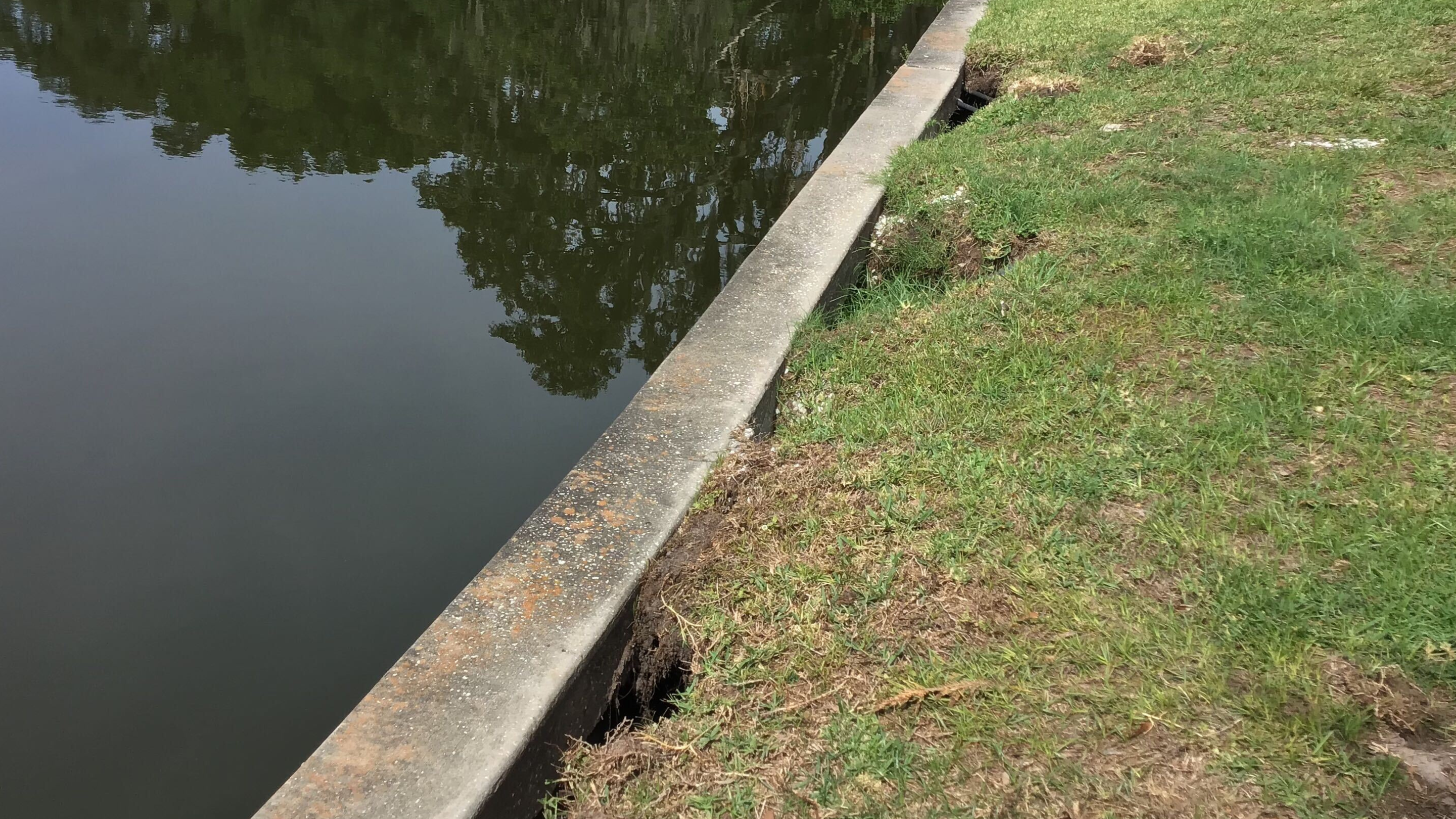
Some seawalls have small voids behind the cap. Others have soil loss along a long section of wall. Some have failed filter fabric or black filter fabric. Some have clogged weep holes or poor pressure relief. Some have pavers, pool decks, patios, walkways, or landscaping settling behind the wall. Some walls are still mostly straight and serviceable, while others have major structural movement.
The same visible symptom can have different repair needs.
For example:
- A few small voids behind a serviceable wall may require soil stabilization and void filling.
- Recurring holes behind the wall may mean soil is still escaping through joints, cracks, failed filters, or pressure-related weak points.
- Settled pavers along the cap may indicate soil support has been lost below the surface.
- Sand or soil mounds on the water side may show that backfill is actively escaping through the wall.
- A cracked cap with soil loss may indicate movement or stress in the seawall system.
- A wall that is leaning severely at the top or kicked out at the bottom may need replacement evaluation.
That is why an inspection matters. The cost depends on whether the issue is mainly soil erosion behind a serviceable wall or whether the wall itself has extreme, extensive, or large-degree structural damage.
Read more: Seawall Repair vs Replacement: What Homeowners Should Know
Common Seawall Soil Erosion Repair Cost Ranges
| Seawall Issue or Repair Type | Typical Cost Range | What It Usually Addresses |
| Seawall inspection | Free within Helicon’s service area | Identifies soil loss, voids, pressure issues, and wall condition |
| Smaller seawall soil stabilization | Around $5,000 to $15,000 | Limited soil loss, smaller voids, shorter affected sections |
| Larger seawall stabilization or void filling | Around $15,000 to $40,000 | Longer wall sections, larger voids, more soil loss, pressure relief needs |
| Jet Filters or Well Points | Typically part of stabilization scope when needed | Pressure relief when viable or when Jet Filters are not viable |
| Seawall cap repair | Contractor-specific | Isolated cap cracks or concrete deterioration |
| Seawall cap replacement | Project-specific | Severely deteriorated or damaged cap sections |
| Full seawall replacement | Around $800 to $1,500 per linear foot | Structurally failing or beyond-repair seawalls |
*These are typical Florida pricing examples based on published industry resources and contractor pricing guides. They are intended for educational purposes only and are not Helicon’s pricing. Every home is different, and a professional inspection is the only way to determine the appropriate repair and provide an accurate quote.
These are general planning ranges. The actual cost depends on the wall length, soil conditions, access, void size, depth of treatment, pressure relief needs, and whether the existing wall is still serviceable.
A smaller soil stabilization project and a full seawall replacement are completely different scopes. A homeowner may spend thousands stabilizing soils behind a serviceable wall, while full replacement can easily become a much larger investment depending on the length and complexity of the wall.
What Seawall Soil Erosion Repair Is Designed to Solve
Seawall soil erosion repair is designed to address soil loss behind a serviceable seawall.
It may be appropriate when the wall is still standing and mostly serviceable, but the soil behind it is washing out or losing support.
Seawall soil erosion repair may help address:
- Voids behind the seawall
- Soft spots along the land side of the wall
- Depressions near the cap
- Holes that return after being filled
- Pavers settling near the seawall
- Concrete, pool decks, or patios sinking near the wall
- Soil or sand mounds on the water side
- Water moving through joints or cracks
- Failed black filter fabric
- Failed or clogged weep holes
- Poor pressure relief
- Soil escaping through wall joints, gaps, or defects
The goal is not simply to fill the visible hole. The goal is to stabilize the soils behind the wall, fill voided areas, reduce continued soil loss, and improve pressure relief when needed.
Read more: What Causes Soil Loss Behind Seawalls?
Cost Factor #1: Length of Seawall Affected
The length of seawall affected is one of the biggest cost factors.
A small isolated void behind one section of seawall is different from soil loss along 80, 100, or 150 linear feet of wall. Longer affected areas may require more injection points, more material, more labor, and more pressure relief planning.
Cost may increase when:
- Soil loss extends along a long section of wall
- Multiple voids are present
- Pavers or concrete have settled along the wall
- Water is moving through several joints or cracks
- Multiple pressure relief points are needed
- Access is limited along the wall
- The wall condition changes from one section to another
A good inspection should identify whether the problem is isolated or part of a longer erosion pattern.
Cost Factor #2: Size and Depth of Voids
Void size and depth have a major effect on cost.
Small surface holes may be easy to see, but the void beneath the surface may be larger than expected. A depression behind the seawall cap can sometimes indicate deeper or wider soil loss below.
Voids may form:
- Behind the seawall cap
- Under pavers
- Beneath patios
- Under pool decks
- Around walkways
- Behind landscape beds
- Near drains or weep holes
- Along panel joints
- Behind cracked or separated wall sections
The larger the voided area, the more material and labor may be needed to fill and stabilize it.
This is why simply filling visible holes with dirt, sand, shell, or gravel is usually not a long-term repair. The surface may look better for a while, but if the void remains active or the escape pathway is still open, the hole can return.
Read more: Voids Behind Seawalls: Why They Happen and How to Fix Them
Cost Factor #3: Whether Soil Is Still Escaping
A one-time void and an active soil-loss pathway are different problems.
If soil is still escaping through wall joints, cracks, failed filters, failed black filter fabric, weep holes, drains, or pressure-related weak points, the repair must address more than the empty space.
Signs that soil may still be escaping include:
- Holes that return after being filled
- Soil or sand mounds on the water side
- Water flowing through joints or cracks
- Pavers continuing to settle
- Soft spots expanding behind the wall
- Concrete or pool decks dropping near the seawall
- Soil loss after heavy rain, high tides, or storm events
Active soil loss can increase cost because the repair may need to include soil stabilization, void filling, erosion pathway reduction, and pressure relief improvements.
The key is to understand where the soil is going and why it is leaving.
Cost Factor #4: Pressure Relief and Drainage
Pressure relief is one of the most important parts of seawall soil erosion repair.
When water builds up behind a seawall and cannot release properly, it creates pressure. That pressure can push water and soil toward weak points in the wall. If water exits through an unfiltered opening, it can carry soil with it. If water cannot exit at all, pressure can build and stress the wall.
Pressure and drainage problems may include:
- Clogged weep holes
- Missing or failed weep hole filters
- Failed drains
- Poor pressure relief
- Water collecting behind the wall
- Downspouts or drains sending water toward the seawall
- Pool deck or patio runoff
- Heavy rain saturating backfill
- Water flowing through joints or cracks
- Failed black filter fabric
Helicon commonly installs Jet Filters when viable to improve pressure relief while helping reduce soil loss. When Jet Filters are not a viable installation option, Well Points may be used depending on site conditions.
Pressure relief can affect cost, but it is often a critical part of a long-term repair plan. A project that fills voids but does not address pressure may not solve the underlying problem.
Read more: Jet Filter Pressure Relief System
Cost Factor #5: Wall Condition
The condition of the seawall determines whether soil erosion repair is appropriate or whether replacement should be evaluated.
Seawall soil stabilization may be a good option when the wall is still mostly straight and serviceable, but the soils behind it are being lost.
Replacement may need to be evaluated when the wall has extreme, extensive, or large-degree structural damage.
Warning signs that replacement may be needed include:
- Severe leaning at the top
- The wall kicked out at the bottom
- The wall no longer plumb from top to bottom
- Bowing or rotating panels
- Major cap separation
- Severe cap cracking or deterioration
- Exposed rebar
- Advanced spalling
- Tieback, deadman, or anchor failure
- Large wall cracks
- Wall sections separating
- Partial collapse
- Repeated movement after prior repairs
If the wall is no longer structurally serviceable, stabilizing soil behind it may not be enough. In that case, a structural engineer, marine contractor, or seawall replacement contractor may need to evaluate the wall.
Cost Factor #6: Nearby Pools, Patios, Pavers, and Structures
Seawall soil erosion repair can become more urgent and more complex when nearby improvements are at risk.
Soil loss behind a seawall can affect:
- Pavers
- Pool decks
- Patios
- Walkways
- Lanais
- Outdoor kitchens
- Landscaping
- Docks
- Driveways
- Garages
- Houses or additions near the wall
If voids are forming near a pool deck, patio, walkway, or structure, the repair decision should consider more than the wall itself. The question becomes whether soil loss is threatening the improvements behind the wall.
In some cases, a project may need both seawall soil stabilization and concrete slab support evaluation. For example, a sinking pool deck near the seawall may involve both slab settlement and soil loss behind the wall.
Read more: Pool Deck Sinking Near Coping: Causes and Repair Options
Cost Factor #7: Access to the Work Area
Access can affect cost, but Helicon’s seawall soil stabilization process has a very low equipment footprint compared with full seawall replacement.
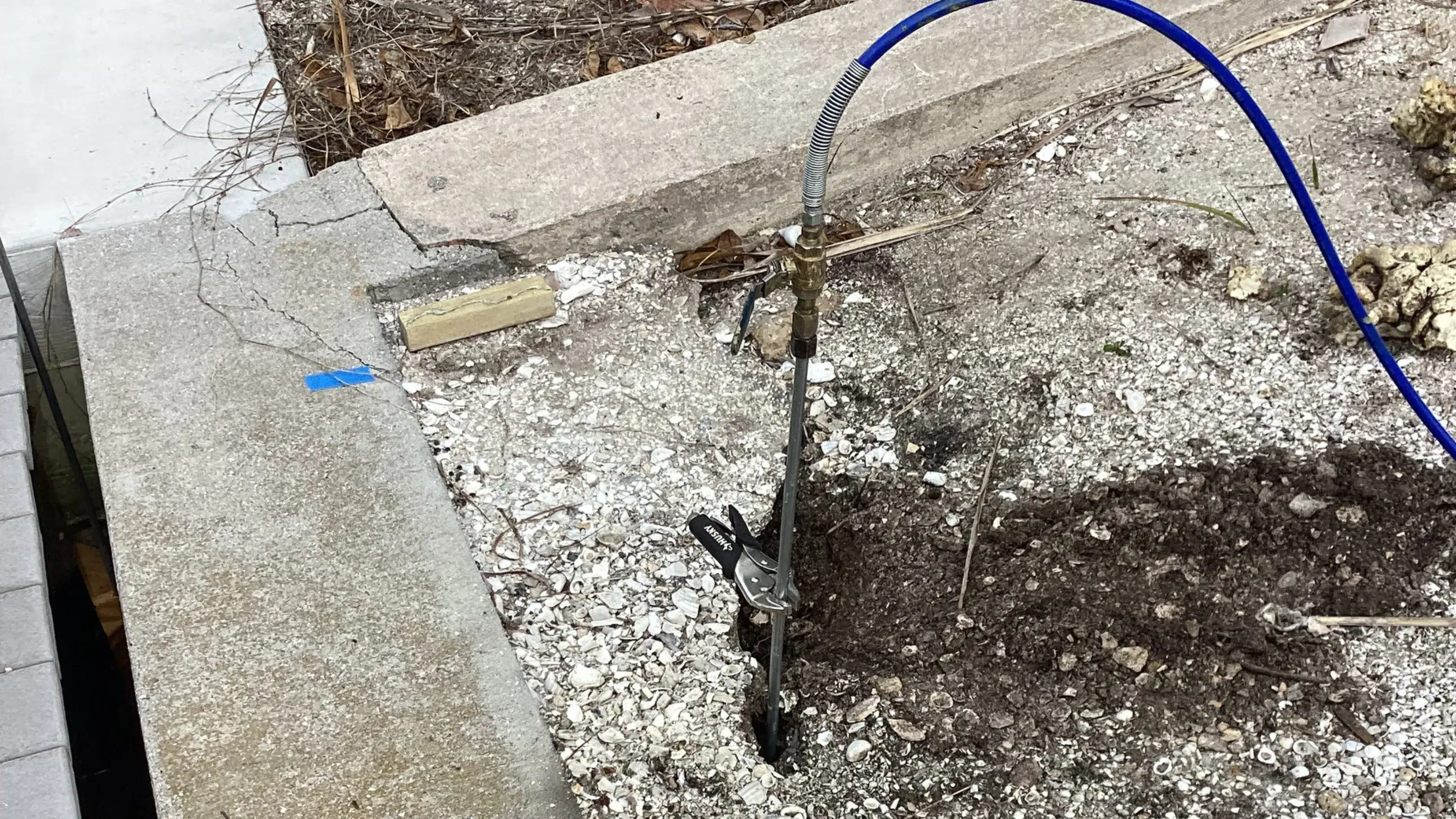
For many projects, Helicon’s polyurethane injection equipment is mounted on a regular F-350 flatbed truck. Long hose reels can carry material to each injection point, often allowing crews to access tight waterfront properties without bringing large equipment into the yard or accessing the site by water.
This is a major difference compared with full seawall replacement. Replacement often requires larger equipment, heavier construction access, demolition, material staging, panel installation, cap work, backfill, and restoration. If land-side access is limited, replacement equipment may need to be brought in by water barge, which can significantly increase cost and complexity.
Cost may be affected by:
- Limited land-side access along the wall
- Tight waterfront yards
- Screen enclosures
- Pools close to the wall
- Paver or concrete surfaces
- Landscaping
- Docks and lifts
- Equipment limitations
- Long material runs
- Working around utilities or drains
- Whether replacement equipment would require barge access
For seawall soil stabilization, tight access is usually much less of a problem than it is for replacement. That can make stabilization a faster, less invasive option when the wall is still serviceable.
Timeline and Disruption: Stabilization vs Replacement
Seawall soil stabilization is not only less expensive in many cases. It is also much faster and less disruptive when the existing wall is still serviceable.
A typical Helicon seawall soil stabilization project with polyurethane injections and Jet Filters can often be completed in 2 to 3 days. The work is performed with low-footprint equipment, small injection points, and limited disruption compared with demolition and reconstruction.
Full seawall replacement is a much larger project. It can involve engineering, permitting, demolition, material staging, new panels, new cap, tiebacks or anchors, drainage, filtration, backfill, restoration, and sometimes barge access.
Replacement can take 4 to 6 months or longer when permitting, engineering, scheduling, construction, access, and site conditions are included.
That timeline matters when a homeowner is trying to protect the property before hurricane season. If the wall is still serviceable but actively losing soil, soil stabilization may provide a much faster path to reduce continued erosion and protect the shoreline while replacement is planned or evaluated.
Some homeowners still choose soil stabilization even when a new seawall may be needed in the future. The goal may be to extend the useful life of the existing wall, reduce active soil loss, and protect the property as much as possible until a new wall can be designed, permitted, and installed.
Seawall Soil Erosion Repair vs Full Replacement Cost
Seawall soil erosion repair and full seawall replacement are very different scopes.
Seawall soil erosion repair is often focused on stabilizing soil behind a serviceable wall. It may include void filling, soil stabilization, erosion pathway reduction, and pressure relief improvements.
Full replacement involves removing and rebuilding the wall system. It may include engineering, permitting, demolition, new panels, new cap, tiebacks or anchors, drainage, filtration, backfill, restoration, and site access.
| Scope | Typical Cost Range | Best Fit |
| Smaller soil stabilization or void filling | Around $5,000 to $15,000 | Limited soil loss behind a serviceable wall |
| Larger soil stabilization or void filling | Around $15,000 to $40,000 | Longer affected sections, larger voids, pressure relief needs |
| Full seawall replacement | Around $800 to $1,500 per linear foot | Structurally failing or beyond-repair wall |
The lowest-cost option is not always the best repair. The highest-cost option is not always required. The right decision depends on whether the wall is still serviceable and whether the main issue is soil loss, pressure, or structural failure.
Why Filling Holes With Dirt or Shell Is Not the Same as Repair
Many homeowners try to repair seawall erosion by filling holes with dirt, sand, shell, gravel, or bags of material.
This may make the surface look better temporarily, but it usually does not solve the problem.
The hole is not the cause. The hole is the result.
If soil escaped through a joint, crack, failed filter, failed black filter fabric, drain, weep hole, or pressure-related weak point, new fill can wash out the same way.
Filling holes without stopping soil loss can lead to:
- Recurring holes
- Larger voids below the surface
- Settled pavers
- Sinking concrete
- Pool deck settlement
- Patio or walkway settlement
- Continued soil loss into the water
- Higher repair costs later
If the same hole keeps coming back, the problem is not that you need more dirt. The problem is that soil is still escaping.
Why Waiting Can Make Seawall Erosion More Expensive
Waiting to address seawall soil erosion can increase the risk that a repairable soil-loss problem becomes a structural seawall problem.
The biggest risk is not always that soil stabilization itself becomes slightly more expensive. The bigger risk is that continued soil loss, void growth, and pressure behind the wall can eventually contribute to structural damage. Once the wall begins leaning severely, bowing, rotating, kicking out at the bottom, cracking badly, or deteriorating beyond repair, full seawall replacement may become the only realistic option.
Early soil loss is often the best time to act. If the wall is still serviceable, stabilizing the soil, filling voids, reducing continued soil loss, and improving pressure relief may help protect the wall and extend its useful life.
Waiting may increase the risk of:
- More soil loss behind the wall
- Larger voids
- Settled pavers or concrete
- Pool deck or patio settlement
- More pressure on the wall
- Larger cap cracks
- Wall movement
- Bowing or rotation
- The wall kicking out at the bottom
- Structural deterioration
- Expensive seawall replacement becoming the only option
This is especially important before hurricane season. Full seawall replacement can take months when engineering, permitting, scheduling, and construction are included. If a homeowner is trying to protect the shoreline before the next major storm season, soil stabilization may provide a much faster way to protect the property when the existing wall is still serviceable.
Some homeowners choose soil stabilization even when replacement may be on the near-term horizon. The goal may be to extend the life of the existing seawall, reduce active soil loss, protect the property, and keep the wall performing as well as possible until a new seawall can be designed, permitted, and installed.
What Homeowners Should Not Do
The biggest mistake homeowners make is treating seawall soil erosion like a simple landscape fill problem.
Homeowners should avoid:
- Filling holes with dirt, sand, shell, or gravel without stopping soil loss
- Ignoring soft spots because the wall still looks upright
- Resetting pavers before stabilizing the soils below
- Replacing concrete or pool deck areas before addressing voids
- Ignoring soil or sand mounds on the water side
- Ignoring failed drains, clogged weep holes, or pressure buildup
- Assuming every seawall issue requires full replacement
- Assuming a standing wall means the soil behind it is stable
- Waiting until the wall leans, bows, rotates, or kicks out at the bottom
- Comparing prices without comparing repair scopes
The right first step is to understand whether the issue is soil loss, pressure relief, structural wall movement, or a combination.
How Helicon Evaluates Seawall Soil Erosion Cost
When Helicon evaluates seawall soil erosion, the goal is to determine what is causing the soil loss and whether the wall is still serviceable.
A proper evaluation may include:
- Looking for voids, holes, depressions, and soft spots
- Checking whether soil is still escaping
- Looking for soil or sand mounds on the water side
- Inspecting pavers, concrete, pool decks, patios, walkways, and landscaping
- Checking panel joints, cracks, and gaps
- Reviewing failed black filter fabric indicators
- Checking weep holes, drains, and pressure relief
- Looking for water movement through the wall
- Evaluating the seawall cap for cracking, separation, rust stains, exposed steel, or spalling
- Looking for leaning at the top, bowing, or rotating panels
- Looking for the wall kicked out or displaced at the bottom
- Reviewing tieback, deadman, or anchor concerns
- Using a soil probe behind the wall where appropriate
- Determining whether the wall appears serviceable
- Determining whether the issue is soil-related, pressure-related, structural, or a combination
The inspection should answer several key questions:
- How much of the seawall is affected?
- Are voids present behind the wall?
- Is soil still escaping?
- Where is the soil likely going?
- Is pressure relief working?
- Is the wall still serviceable?
- Are nearby improvements at risk?
- Is soil stabilization appropriate, or should replacement be evaluated?
- What repair range is likely?
The best cost estimate comes after the wall, soil, voids, pressure relief, and access conditions are understood.
When to Schedule a Seawall Soil Erosion Inspection
You should schedule a seawall soil erosion inspection if you notice signs that soil is moving, settlement is occurring, or the wall system is under stress.
Call an expert if you notice:
- Voids behind the seawall
- Soft spots along the land side
- Depressions or holes near the cap
- Holes that return after being filled
- Soil disappearing behind the wall
- Pavers settling near the seawall
- Concrete or pool deck settlement near the wall
- Soil or sand mounds on the water side
- Water flowing through joints, cracks, or openings
- Gaps between panels
- Failed black filter fabric
- Clogged or failed weep holes
- Poor pressure relief
- Cracks in the seawall cap
- Rust stains, exposed rebar, or spalling
- Wall panels leaning, bowing, or rotating
- The wall kicked out or displaced at the bottom
- A seawall near a pool, patio, deck, house, walkway, or structure
If the wall is still serviceable, repair may be possible. If the wall has major structural movement or deterioration, replacement may need to be evaluated.
Why Florida Homeowners Trust Helicon
Helicon has been helping Florida homeowners solve seawall erosion repair, soil stabilization, foundation repair, concrete lifting, sinkhole repair, compaction grouting, void filling, and slab support problems since 2004.
As a family-owned Florida company, Helicon understands the soil conditions, water movement, storm exposure, drainage issues, wall systems, pressure problems, filter failures, and settlement patterns that affect waterfront properties across Tampa Bay, Orlando, Southwest Florida, and surrounding areas.
We are not there to tell every homeowner that every seawall needs to be replaced. We are also not there to ignore structural wall movement when replacement or engineering may be needed.
Sometimes the wall is still serviceable, but the soil behind it is being lost. Sometimes voids need to be filled. Sometimes pressure relief needs to be improved. Sometimes the cap is deteriorated. Sometimes the wall is structurally compromised and replacement needs to be evaluated.
The goal is always the same: identify the cause, protect the property, and recommend the least invasive repair that provides a long-term solution.
Schedule a Free Seawall Soil Erosion Cost Inspection
If you are wondering how much seawall soil erosion repair may cost, Helicon can help evaluate the issue.
Our team can review the wall, soil loss, voids, drainage, pressure relief, cap condition, nearby improvements, and structural warning signs to help determine whether the problem appears soil-related, pressure-related, structural, or a combination.
Schedule a free seawall soil erosion inspection with Helicon to find out what is causing the issue, whether the wall appears serviceable, and what the likely repair range may be.
FAQ
How much does it cost to repair seawall soil erosion?
Smaller seawall soil stabilization projects often range from $5,000 to $15,000. Larger seawall stabilization or void filling projects often range from $15,000 to $40,000. The cost depends on wall length, soil loss, void size, access, pressure relief needs, and wall condition.
Is seawall soil erosion repair cheaper than replacement?
Often, yes. When the wall is still serviceable, seawall soil stabilization is often dramatically less than full replacement and, in many cases, can be 80% to 100% less depending on wall length, replacement pricing, and repair scope. Full seawall replacement often ranges from $800 to $1,500 per linear foot.
How long does seawall soil stabilization take?
A typical Helicon seawall soil stabilization project with polyurethane injections and Jet Filters can often be completed in 2 to 3 days. Full seawall replacement can take 4 to 6 months or longer when permitting, engineering, scheduling, construction, and site conditions are included.
Does seawall soil stabilization require permits?
Seawall soil stabilization typically does not involve the same permitting process as full seawall replacement. Replacement usually requires permitting, engineering, scheduling, and larger construction access.
What affects the cost of seawall soil erosion repair?
Cost is affected by the length of wall involved, void size, amount of soil loss, depth of treatment, access, drainage, pressure relief needs, wall condition, nearby structures, and whether Jet Filters or Well Points are needed.
What is included in seawall soil erosion repair?
Seawall soil erosion repair may include soil probing, polyurethane soil stabilization, permeation grouting, void filling, erosion pathway reduction, Jet Filters when viable, Well Points when Jet Filters are not viable, drainage improvements, and evaluation of the wall condition.
Do Jet Filters increase the cost?
Jet Filters may be part of the overall repair scope when viable because pressure relief is often important for long-term seawall performance. When Jet Filters are not a viable installation option, Well Points may be used depending on site conditions.
Can I just fill holes behind my seawall?
Filling holes with dirt, sand, shell, or gravel may make the surface look better temporarily, but it usually does not stop the soil loss. If the escape pathway remains open, the hole can return.
Does soil loss mean I need a new seawall?
Not always. Soil loss behind a seawall may be repairable if the wall is still serviceable. If the wall is leaning severely, kicked out at the bottom, bowing, rotating, structurally deteriorated, or beyond repair, replacement may need to be evaluated.
Why would someone stabilize a seawall if replacement may be needed later?
Some homeowners stabilize soil behind an aging but serviceable seawall to reduce active soil loss, protect the property, and extend the wall’s useful life while future replacement is planned, permitted, or scheduled. This can be especially important before hurricane season if replacement cannot be completed in time.
How much does seawall replacement cost?
Full seawall replacement often ranges from $800 to $1,500 per linear foot for vinyl, steel sheet, or concrete panel seawalls. Actual cost depends on wall type, access, permitting, engineering, depth, water conditions, site conditions, and nearby structures.
How do I get an accurate seawall erosion repair cost?
The best way to get an accurate cost is to schedule an inspection. The estimate should be based on wall condition, soil loss, void size, access, pressure relief, drainage, nearby improvements, and whether the wall is still serviceable.