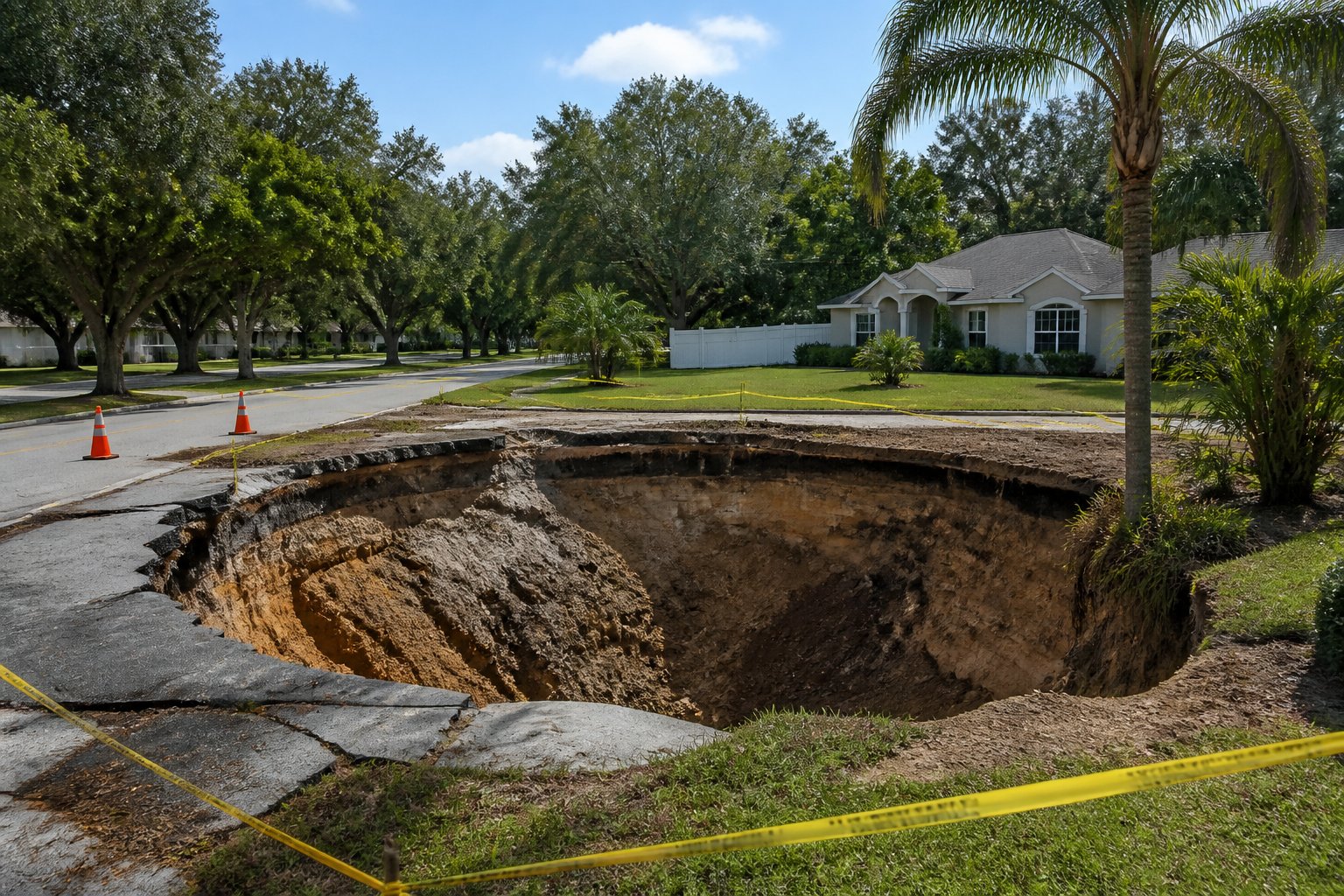
Direct Answer
Florida sinkholes form primarily because much of the state is underlain by limestone and other carbonate rock that can slowly dissolve when exposed to slightly acidic groundwater.
Over time, this process can create underground openings. A sinkhole may develop when overlying soil gradually moves into those openings or suddenly collapses after losing support.
Changes in groundwater, drought followed by heavy rainfall, groundwater pumping, construction, and added surface loads can sometimes contribute to or trigger movement where vulnerable underground conditions already exist.
But if you notice a crack, depression, sticking door, or uneven floor, do not automatically assume you have a sinkhole.
Poor compaction, loose soil, erosion, plumbing or drainage failures, buried debris, organic material, slab settlement, and ordinary foundation settlement can create similar symptoms.
For most homeowners, the right approach is:
Take unusual or progressing changes seriously—but determine what is actually happening before assuming the worst.
Read more: Foundation Problems in Florida: The Complete Homeowner Guide
What Is a Sinkhole?
A sinkhole is a depression or collapse of the land surface associated with movement into an underground opening in soluble rock.
Florida is particularly susceptible because much of the state is underlain by limestone and dolostone.
Rainwater is naturally slightly acidic. As it passes through soil and organic material, it can become more acidic and gradually dissolve carbonate rock along:
- Cracks
- Joints
- Fractures
- Other natural openings
Over long periods, those openings can become larger.
This type of geology is known as karst and can include sinkholes, springs, caves, and underground drainage systems.
Eventually, the soils above an underground opening may gradually settle downward or collapse more suddenly.
The dramatic hole seen at the surface is therefore usually the visible result of a process that began underground.
Why Does Florida Have So Many Sinkholes?
Florida combines three important conditions:
1. Soluble Limestone
Much of the state is underlain by carbonate rock that groundwater can slowly dissolve.
2. Water
Rainfall and groundwater continually move through the subsurface and can enlarge natural openings over geologic time.
3. Soil Above the Limestone
Sand, clay, fill, and other sediments sit above the limestone.
Depending on their thickness and composition, those materials may gradually move into underground openings or remain temporarily supported until a collapse occurs.
This combination creates widespread karst geology.
It does not mean every Florida home is sitting above a dangerous cavity or will experience a sinkhole.
The Three Main Types of Sinkholes in Florida
| Sinkhole Type | How It Develops | What It May Look Like |
| Solution sinkhole | Limestone is exposed or thinly covered and gradually dissolves | Gradually developing shallow depression |
| Cover-subsidence sinkhole | Permeable soils slowly move into openings below | Slowly developing bowl-shaped depression |
| Cover-collapse sinkhole | Soil remains temporarily bridged over a cavity before collapsing | Sudden, potentially deep ground opening |
Solution Sinkholes
These generally occur where limestone is exposed or close to the surface.
Water gradually dissolves the rock and creates a depression.
Cover-Subsidence Sinkholes
These tend to develop more slowly as loose or permeable soils move downward into openings in the underlying rock.
Cover-Collapse Sinkholes
These are the dramatic collapses often seen in news reports.
The material above a cavity can remain temporarily supported until it can no longer bridge the opening, allowing the ground to collapse relatively quickly.
Because sinkholes develop differently, there is no single appearance or warning pattern that applies to every event.
What Actually Causes the Underground Cavities?
The underlying process usually occurs over a long period.
Water combines with carbon dioxide from the atmosphere and soil to form weak carbonic acid, which can slowly dissolve limestone along cracks, joints, and other openings.
Over time:
- An underground opening develops or enlarges.
- Soil above it may begin moving downward.
- The overlying ground loses support.
- The surface gradually subsides or suddenly collapses.
The dissolution of limestone creates the underlying opportunity for a sinkhole.
Weather, groundwater changes, construction, or other events may influence when that condition becomes visible at the surface.
What Can Trigger a Sinkhole Collapse?
An important distinction is:
A trigger is not necessarily the original cause.
The underground condition may have developed over centuries.
A later event can change groundwater, soil, or loading conditions enough to contribute to movement.
Possible triggers or contributing conditions include:
Drought
Lower groundwater levels can change subsurface support conditions around existing cavities.
Heavy Rainfall
Large rainfall events can rapidly change moisture conditions and add water and weight to soils above vulnerable openings.
Rapid Groundwater Changes
Significant groundwater withdrawal can alter subsurface support.
Construction
Excavation, grading, vibration, drainage changes, or other construction activities can alter site conditions.
Added Surface Loads
Substantial new loading can sometimes influence already-vulnerable ground.
This does not mean:
“Rain causes sinkholes.”
or:
“Construction creates sinkholes.”
More accurately:
These conditions can sometimes help trigger movement where susceptible geology already exists.
Should Florida Homeowners Worry About Sinkholes?
Florida homeowners should understand the risk without assuming every crack or depression means a sinkhole is forming.
A reasonable approach is:
Do Not Ignore Meaningful Changes
Unusual or clearly progressing ground or structural movement deserves attention.
Do Not Diagnose a Sinkhole From One Symptom
Cracks, sticking doors, floor changes, and depressions can have many causes.
Look for Patterns
Multiple related symptoms developing together are more meaningful than one isolated condition.
Treat Rapid Changes Differently
A suddenly opening hole or rapidly changing structure deserves a very different response from an old stable drywall crack.
Awareness makes sense. Panic does not.
What Are Possible Warning Signs of a Sinkhole?
Possible signs can occur around the property or structure.
Around the Property
Watch for:
- A new circular or bowl-shaped depression
- A hole appearing unexpectedly
- Ground that continues sinking
- Soil disappearing into an opening
- Ground cracking
- Leaning fences or trees
- New low areas collecting water
- Changes around driveways, pools, patios, or walkways
Around the Home
Possible signs include:
- New or progressing wall cracks
- Stair-step masonry cracks
- Floor or slab cracks
- Changing floor elevations
- Doors or windows beginning to stick
- Increasing gaps around openings
- Separation between parts of the structure
- Noticeable foundation movement
None of these symptoms alone confirms sinkhole activity.
Read more: Florida Sinkhole Warning Signs: What Homeowners Should Know
A Crack Does Not Mean You Have a Sinkhole
A foundation crack can result from:
- Material shrinkage
- Ordinary foundation settlement
- Poor compaction
- Weak soils
- Erosion
- Slab movement
- Construction conditions
- Plumbing problems
- Moisture changes
- Historic movement
Sinkhole activity is one possible explanation in appropriate geologic conditions.
It is not the automatic conclusion.
A sinking foundation is not automatically a sinkhole.
Read more: How Florida Soil Conditions Affect Your Home Foundation
What Can Look Like a Sinkhole but Isn’t One?
Many ground depressions have nothing to do with a limestone cavity.
Possible causes include:
- Poorly compacted soil
- Buried organic material
- Decomposing tree stumps
- Broken sewer or drain pipes
- Septic-system problems
- Compressible organic soils
- Buried construction debris
- Erosion or washout
- Other localized subsurface settlement
When the cause of a depression has not been verified, it is more accurate to treat it as a subsidence incident until the underlying condition is determined.
That distinction matters when homeowners review reported sinkhole information or nearby incidents.
Sinkhole vs. Ordinary Foundation Settlement
| Condition | Possible Sinkhole-Related Movement | Ordinary Foundation or Soil Settlement |
| Cause | Soil moving into karst-related underground openings | Weak soils, poor compaction, erosion, fill settlement, other support loss |
| Surface depression | Can occur | Can also occur |
| Foundation cracks | Possible | Also common |
| Uneven floors | Possible | Also possible |
| Sticking doors | Possible | Also possible |
| Visible ground opening | Possible | Other ground failures can create depressions too |
| Can symptoms alone confirm the cause? | No | Usually not |
| May require subsurface investigation | Yes | Sometimes |
The overlap is significant.
The symptom tells you something is moving. It does not necessarily tell you why.
What About Sinkhole Maps?
Sinkhole maps can provide useful information about regional geology and reported subsidence history, but they have limitations.
Reported incidents are not necessarily confirmed sinkholes.
Some may never receive field investigation, and their exact cause may remain unknown.
A map should therefore not be interpreted as:
“Every dot is a confirmed sinkhole.”
Nor can it reliably tell you:
“My property will—or will not—develop a sinkhole.”
There is currently no reliable method for predicting exactly when and where an individual sinkhole will develop.
Read more: Florida Sinkhole Map
What If My Neighbor Has a Sinkhole?
A nearby sinkhole is understandably concerning.
But it does not automatically mean one will form beneath your home.
Pay attention to conditions on your own property, including:
- Ground elevations
- New depressions
- Cracks
- Doors and windows
- Floor conditions
- Exterior slabs
A neighboring event is useful information.
It is not a diagnosis of your property.
Can a Foundation Inspection Confirm a Sinkhole?
Not by itself.
A foundation evaluation can identify:
- Structural symptoms
- Settlement patterns
- Relative floor elevations
- Exterior settlement
- Ground depressions
- Drainage or erosion
- Other visible conditions
Those findings may indicate that deeper investigation is appropriate.
Confirming or ruling out a sinkhole-related subsurface condition generally requires specialized geologic or geotechnical investigation.
Depending on the property, that may include:
- Soil borings
- Ground-penetrating radar
- Electrical resistivity
- Other subsurface testing
Even specialized testing can have limitations.
The purpose of the initial evaluation is therefore not to declare:
“You have a sinkhole.”
It is to determine whether the evidence points toward a more routine foundation or soil problem—or whether deeper investigation is warranted.
Who Should Evaluate Suspected Sinkhole Activity?
Different professionals may have different roles.
Foundation Contractor
Evaluates visible structural symptoms, elevation patterns, site conditions, and repair history.
Professional Engineer
Evaluates structural movement, damage, and engineered repair requirements.
Professional Geologist
Evaluates subsurface geology and whether conditions are consistent with sinkhole activity.
Geotechnical Engineer
Evaluates soil and foundation conditions and may help coordinate subsurface investigation.
Complex suspected sinkhole conditions can therefore require expertise beyond a routine foundation inspection.
What Should I Do If a Hole Suddenly Opens on My Property?
Safety comes first.
Keep People and Pets Away
Do not approach the edge of an actively changing depression.
Secure the Area if It Is Safe to Do So
Prevent accidental access.
Do Not Add Water
Water entering the opening may contribute to additional erosion or enlargement.
Watch for Structural Movement
A hole close to a home, pool, road, seawall, or other structure deserves greater concern.
Leave the Building if It Appears Unsafe
Rapid sinking, major cracking, sagging, or other immediate hazards require caution and may justify contacting local emergency authorities.
Contact Your Insurance Company When Appropriate
Especially when the condition is affecting or threatening an insured structure.
Do not attempt to diagnose an actively changing ground collapse by entering or standing over it.
What About Sinkhole Insurance in Florida?
Homeowners should understand the distinction between catastrophic ground cover collapse and broader sinkhole-loss coverage.
Catastrophic ground cover collapse generally involves specific conditions such as:
- Abrupt ground collapse
- A clearly visible depression
- Structural damage
- The insured structure being condemned and ordered vacant
Broader sinkhole-loss coverage may be separate depending on the policy and insurer.
So:
Do not assume that “ground collapse” coverage means every form of sinkhole-related damage is covered.
Review the actual policy and speak with the insurer or insurance professional about specific coverage.
Insurance requirements, policy language, and available coverage can change, so homeowners should rely on their current policy and insurer for coverage decisions.
Can Sinkholes Be Prevented?
Homeowners cannot stop the natural dissolution of limestone deep underground.
No drainage improvement can guarantee that a sinkhole will never form.
However, homeowners can address avoidable conditions that contribute to soil loss or changes near the structure.
Useful steps include:
- Repair plumbing and irrigation leaks
- Manage concentrated runoff
- Maintain drainage
- Investigate recurring soil loss
- Avoid directing water into unexplained depressions
- Address damaged drain or septic systems
- Monitor progressing ground or foundation movement
These actions are worthwhile even when the underlying problem is not sinkhole-related.
How Are Sinkhole Problems Repaired?
There is no single repair for every sinkhole condition.
The project’s engineer determines the final repair design based on the subsurface investigation, affected soil profile, foundation condition, nearby structures such as pools, and other site factors.
In Helicon’s experience across thousands of Florida sinkhole repairs, the most common engineered approach combines:
- Compaction Grouting for the deeper soils
- Chemical Grouting with polyurethane for the shallower soils
- Foundation underpinning when structural stabilization or lifting is required
Compaction grouting is typically performed first, followed by chemical grouting.
Underpinning can be performed before or after the grouting operations depending on the engineer’s design and the needs of the structure.
1. Compaction Grouting: Treating the Deeper Soils
Compaction grouting is typically the core deep-soil treatment in an engineered sinkhole repair plan and is commonly included in the engineer’s repair recommendation.
A thick, high-strength cementitious grout is injected under pressure into deeper weak or loose soils.
Treatment typically begins near the limestone layer and progresses upward through the affected soil profile.
As the grout is pumped under pressure, it forms dense grout bulbs that compact surrounding soils, improve ground support, and help reduce the risk of future settlement.
Because compaction grouting uses relatively high pressure, engineers typically maintain a stand-off depth near sensitive structures.
As a common engineering practice on many Florida sinkhole repairs:
- Near a home’s foundation, compaction grouting typically stops approximately 15 feet below the ground surface.
- Near or around a swimming pool, it may stop approximately 20 feet below the surface.
Actual treatment depths are determined by the engineer and site conditions.
Why leave that distance?
High-pressure grouting too close to a foundation can cause unwanted movement or foundation heave.
Near a swimming pool, excessive pressure can move the shell or, in extreme conditions, contribute to the pool shell lifting or “popping.”
This is why deeper compaction grouting and shallower chemical grouting are commonly used together.
Read more: Compaction Grouting
2. Chemical Grouting: Treating the Shallower Soils
After deep compaction grouting is completed, the engineer may specify chemical grouting with polyurethane for shallower soils closer to the foundation or pool.
Chemical grout is injected at much lower pressures than compaction grout, making it appropriate for treating soil closer to sensitive structures when included in the engineered repair.
A typical engineered treatment zone may extend from approximately:
10 feet below grade to about 5 feet below grade
although actual depths, spacing, and injection patterns are determined by the engineer.
Why is the upper approximately five feet often not directly injected?
First, treatment between approximately 5 and 10 feet can also influence the shallower soils above the injection zone.
Second, polyurethane needs surrounding soil to help contain the material.
If injected too close to the surface, the polyurethane can migrate upward rather than remain confined in the intended soil zone.
If material begins grouting to the surface, pumping at that location typically must stop.
The combination of deep compaction grouting followed by shallow chemical grouting allows different parts of the soil profile to be treated with methods appropriate for their depth and proximity to the structure.
Read more: What Is Soil Stabilization and How Does It Work?
3. Foundation Underpinning: When the Structure Also Needs Support
Underpinning is used less frequently than the combination of compaction grouting and chemical grouting, but it can play an important role when the structure itself requires additional support.
It may be recommended when:
- Foundation lifting or recovery is needed
- The structure requires additional deep support
- The foundation needs stabilization against additional settlement during deep grouting
- The engineer includes structural underpinning in the repair plan
Underpinning may be installed before or after the grouting work.
For example, it may be installed first when the engineer wants the foundation stabilized before high-pressure compaction grouting begins.
On another project, grouting may be completed first and underpinning performed afterward.
Push piers, drilled piers, or other engineered underpinning systems may be used depending on the structure and design.
Read more: Foundation Repair
Why the Repair Sequence Matters
For a typical engineered repair involving both deep and shallow soil treatment, the sequence is:
1. Compaction Grouting — deeper soils
2. Chemical Grouting — shallower soils
3. Underpinning — when required by the structural repair plan
Underpinning may move earlier when the foundation needs stabilization before deep grouting.
The core principle is:
Treat the deeper soils first, then treat the shallower soils above them.
Chemical grouting is not normally performed first because treating the shallow soil before the deep profile could interfere with the ability to properly perform the deeper compaction grouting.
The engineer determines:
- Treatment depths
- Grout locations
- Injection spacing
- Repair sequence
- Whether chemical grouting is required
- Whether underpinning is required
- How the structure will be monitored
In some cases, the engineer may determine that compaction grouting alone is the appropriate repair.
On many projects, the design includes both compaction grouting and chemical grouting.
The Engineer Oversees the Sinkhole Repair
Engineered sinkhole remediation is different from routine slab lifting or shallow-soil stabilization.
The engineer develops the repair plan and typically monitors the work to confirm that it follows the design.
Depending on the project, that oversight may include:
- Grout locations
- Treatment depths
- Injection pressures
- Material quantities
- Grouting response
- Foundation movement
- Field conditions encountered during repair
After the engineered remediation has been completed and the repair requirements have been satisfied, the engineer can provide the appropriate signed and sealed documentation closing out the repair.
The repair should follow the investigation and engineered design—not precede it.
Is Polyurethane Used for Sinkhole Repair?
Yes—but its role matters.
Polyurethane chemical grouting is commonly used for the shallower-soil portion of an engineered sinkhole repair, typically after the deep compaction grouting has been completed.
Its lower-pressure installation allows shallow soils near foundations and pools to be treated where high-pressure compaction grouting would create greater risk of unwanted movement.
That is very different from assuming polyurethane by itself is an appropriate repair for every suspected sinkhole.
Polyurethane is also used for non-sinkhole conditions such as:
- Shallow loose soils
- Localized voids
- Washout
- Slab-support loss
Polyurethane can be an important part of sinkhole remediation, but its role and treatment depth should follow the engineer’s repair design.
Read more: What Is Soil Stabilization and How Does It Work?
Checklist: Should I Be Concerned About a Possible Sinkhole?
Immediate Safety Concerns
- Has a hole or depression opened suddenly?
- Is it visibly getting larger?
- Is soil actively falling into it?
- Is it close to a home, pool, road, or other structure?
- Is the structure sagging, shifting, or cracking rapidly?
If immediate safety may be at risk, stay away and contact the appropriate emergency authorities.
Changes Around the Property
- Is a new depression developing?
- Does the ground continue sinking after being filled?
- Are trees, fences, or other objects beginning to lean?
- Has drainage suddenly changed?
- Is water disappearing into an unexplained opening?
Changes in the Home
- Are cracks new or clearly progressing?
- Are several doors or windows beginning to stick?
- Are floor conditions noticeably changing?
- Are gaps increasing around openings?
- Are multiple symptoms occurring in the same area?
Other Possible Causes
- Has there been a plumbing or sewer leak?
- Could a septic component have failed?
- Was the area previously excavated or filled?
- Could buried debris or organic material be present?
- Is erosion or washout occurring?
- Could the condition involve ordinary foundation or slab settlement?
Before Assuming It Is a Sinkhole
- Has the structure been evaluated?
- Do I understand the movement pattern?
- Has a qualified professional recommended deeper investigation?
- Do I understand that visual inspection alone cannot confirm sinkhole activity?
- Have I reviewed my insurance coverage if structural damage is involved?
Checking several boxes does not confirm a sinkhole.
It means further evaluation may be appropriate.
How Helicon Approaches Possible Sinkhole Conditions
Helicon has worked with Florida foundations, soils, and sinkhole remediation since 2004 and has completed thousands of sinkhole repairs.
Our experience includes:
- Compaction grouting
- Chemical grouting with polyurethane
- Foundation underpinning
- Sinkhole remediation
- Soil stabilization
- Structural void filling
- Deep foundations
That experience matters because similar-looking symptoms can have very different causes underground.
We Do Not Start by Assuming “Sinkhole”
An initial evaluation may consider:
- Crack and symptom patterns
- Relative floor elevations using a Zip Level when appropriate
- Exterior settlement or depressions
- Drainage and erosion
- Slab movement
- Property and repair history
The initial questions are:
- What appears to be moving?
- Could the condition involve a slab or shallow soil?
- Is the structural foundation involved?
- Are other causes such as erosion, fill settlement, or plumbing plausible?
- Does the evidence justify deeper engineering or geologic investigation?
If a sinkhole-related condition is confirmed, Helicon performs the remediation according to the engineer’s design.
That commonly means deep compaction grouting followed by shallow chemical grouting, with underpinning added when the structure requires it.
The engineer determines and monitors the repair and provides the appropriate signed and sealed project documentation when the engineered remediation is complete.
The goal is not to call every settlement problem a sinkhole. It is to determine what level of investigation—and repair—the evidence actually supports.
Read more: Sinkhole Repair
Schedule a Foundation or Sinkhole Evaluation
If you are seeing a ground depression, progressing cracks, uneven floors, sticking doors, or other unusual movement, you do not need to decide for yourself whether it is a sinkhole.
Helicon can evaluate the visible symptoms, relative elevations when appropriate, exterior conditions, and other relevant site factors to help determine the appropriate next step.
Sometimes the problem is ordinary foundation settlement.
Sometimes it involves shallow soil or a slab.
Sometimes monitoring is appropriate.
And sometimes the evidence justifies deeper geologic or engineering investigation.
The first question should not be “How do we repair the sinkhole?” It should be “Do we have evidence that this is actually a sinkhole-related condition?”
Click Here to Get Started
FAQ
What causes sinkholes in Florida?
Sinkholes primarily form when slightly acidic groundwater dissolves limestone or other carbonate rock, creating underground openings into which overlying soils can gradually subside or suddenly collapse.
Why is Florida prone to sinkholes?
Florida has widespread carbonate rock, abundant groundwater, and rainfall—conditions that create extensive karst geology.
Does heavy rain cause sinkholes?
Heavy rain can sometimes help trigger movement in susceptible ground, but the underlying karst condition generally develops over a much longer period.
Can drought cause sinkholes?
Drought and groundwater declines can alter subsurface support conditions, and rapid changes afterward may contribute to movement in vulnerable areas.
Can groundwater pumping cause sinkholes?
Large groundwater withdrawals can lower groundwater levels and have been associated with sinkhole formation in some Florida areas.
Does a crack in my house mean I have a sinkhole?
No. Cracks can result from ordinary settlement, poor compaction, erosion, slab movement, construction conditions, and many other causes.
Does a depression in my yard mean I have a sinkhole?
Not necessarily. Pipe failures, septic problems, poor compaction, organic material, buried debris, and erosion can create similar depressions.
What is the most dangerous type of sinkhole?
Cover-collapse sinkholes can be particularly hazardous because they may form rapidly.
Can you predict where a sinkhole will form?
Not precisely. There is no reliable method for predicting exactly when and where an individual sinkhole will develop.
Should I worry if my neighbor had a sinkhole?
A nearby event is worth knowing about, but it does not automatically mean your property is affected.
Can a foundation contractor confirm a sinkhole?
No. A foundation evaluation can identify symptoms and determine whether further investigation may be appropriate, but it cannot by itself confirm or rule out sinkhole activity.
How is a possible sinkhole investigated?
Qualified professionals may use soil borings, geophysical methods, engineering evaluation, geological review, and other subsurface testing.
Does homeowners insurance cover sinkholes in Florida?
Coverage depends on the policy. Catastrophic ground cover collapse and broader sinkhole-loss coverage are not necessarily the same.
How are sinkholes repaired?
The engineer determines the repair. In Helicon’s experience, the most common engineered approach combines deep compaction grouting followed by shallower chemical grouting with polyurethane, with underpinning added when required.
Which comes first, compaction grouting or chemical grouting?
Compaction grouting comes first to treat the deeper soils. Chemical grouting follows when the engineer specifies treatment of the shallower zone.
Why isn’t compaction grouting performed all the way to the surface?
Because it uses relatively high pressure. Engineers typically maintain stand-off depths near foundations and pools to reduce the risk of unwanted structural or pool-shell movement.
Can polyurethane be used in sinkhole repair?
Yes. Polyurethane chemical grouting is commonly used for the shallow-soil portion of an engineered repair after the deeper compaction grouting has been completed.
Is underpinning always required?
No. Underpinning is generally used when the foundation needs lifting, additional structural support, or stabilization during the grouting process.
What should I do if a sinkhole suddenly opens?
Keep people and pets away, secure the area if it can be done safely, avoid adding water, and seek immediate assistance if the opening threatens a structure or creates a physical hazard.