Direct Answer
If your driveway, sidewalk, patio, pool deck, garage floor, or other concrete slab has settled, there are usually three broad options:
- Polyurethane concrete lifting — expanding structural polyurethane is injected beneath the slab to fill voids, restore support, and lift the concrete when appropriate.
- Mudjacking — a heavier cementitious slurry is pumped beneath the slab to raise and support it.
- Concrete replacement — the existing slab is removed, the base is prepared, and new concrete is poured.
None is automatically right for every slab.
In general:
- Polyurethane lifting is often a good choice when the existing concrete is still worth saving and a lightweight, relatively low-disruption repair is appropriate.
- Mudjacking can also lift concrete that is still in suitable condition when the slab, soils, access, and project are appropriate for the method.
- Replacement is generally the better choice when the concrete itself is badly broken, crumbling, severely deteriorated, poorly constructed, root-damaged, or needs a different slope, layout, or finish.
Before choosing any of them, ask:
“Why did the concrete settle in the first place?”
If water is washing soil away, the base was poorly compacted, voids exist, or weak soils are contributing to the settlement, the repair should account for those conditions when relevant.
The best repair is not automatically the newest method, the cheapest method, or the most complete-looking method. It is the one that fits the condition of the slab and the reason it moved.
Read more: Concrete Lifting vs. Replacement: What Is the Better Option?
Polyurethane vs. Mudjacking vs. Replacement at a Glance
| Factor | Polyurethane Concrete Lifting | Mudjacking | Concrete Replacement |
| Main objective | Lift and support existing concrete | Lift and support existing concrete | Remove and rebuild concrete |
| Material | Expanding structural polyurethane | Pumpable cementitious slurry | New concrete over prepared base |
| Existing slab stays in place | Yes | Yes | No |
| Material weight beneath slab | Relatively lightweight | Significantly heavier than polyurethane | Depends on new slab and base |
| Injection holes | Relatively small | Typically larger than polyurethane holes | Not applicable |
| Return to service | Generally fast | Depends on material and project | Requires concrete curing |
| Preserves existing surface | Yes | Yes | No |
| Can fill voids beneath slab | Yes | Yes, depending on application | Base can be rebuilt after removal |
| Best when slab is still worth preserving | Often | Often | Not required |
| Corrects severely deteriorated concrete | No | No | Yes |
| Can change thickness, finish, slope, or layout | No | No | Yes |
| Automatically fixes drainage or active washout | No | No | No |
| Automatically corrects deeper weak soils | No | No | No |
The last two rows matter.
None of these methods automatically corrects every underlying cause of settlement.
First: Why Did the Concrete Settle?
Concrete depends on the material supporting it.
A slab may lose support because of:
- Poorly compacted fill
- Loose soils
- Soil settlement
- Water erosion
- Washout
- Drainage problems
- Plumbing or irrigation leaks
- Voids beneath the slab
- Loss of fill along slab edges
- Construction-related conditions
Two driveways can look similar at the surface and need different repairs.
One may simply need to be lifted.
Another may need void filling or additional soil treatment.
Another may be too deteriorated to justify saving.
And another may continue settling unless a water source is corrected.
Start with the cause. Then choose the repair.
Read more: Why Does Concrete Sink in Florida?
1. How Polyurethane Concrete Lifting Works
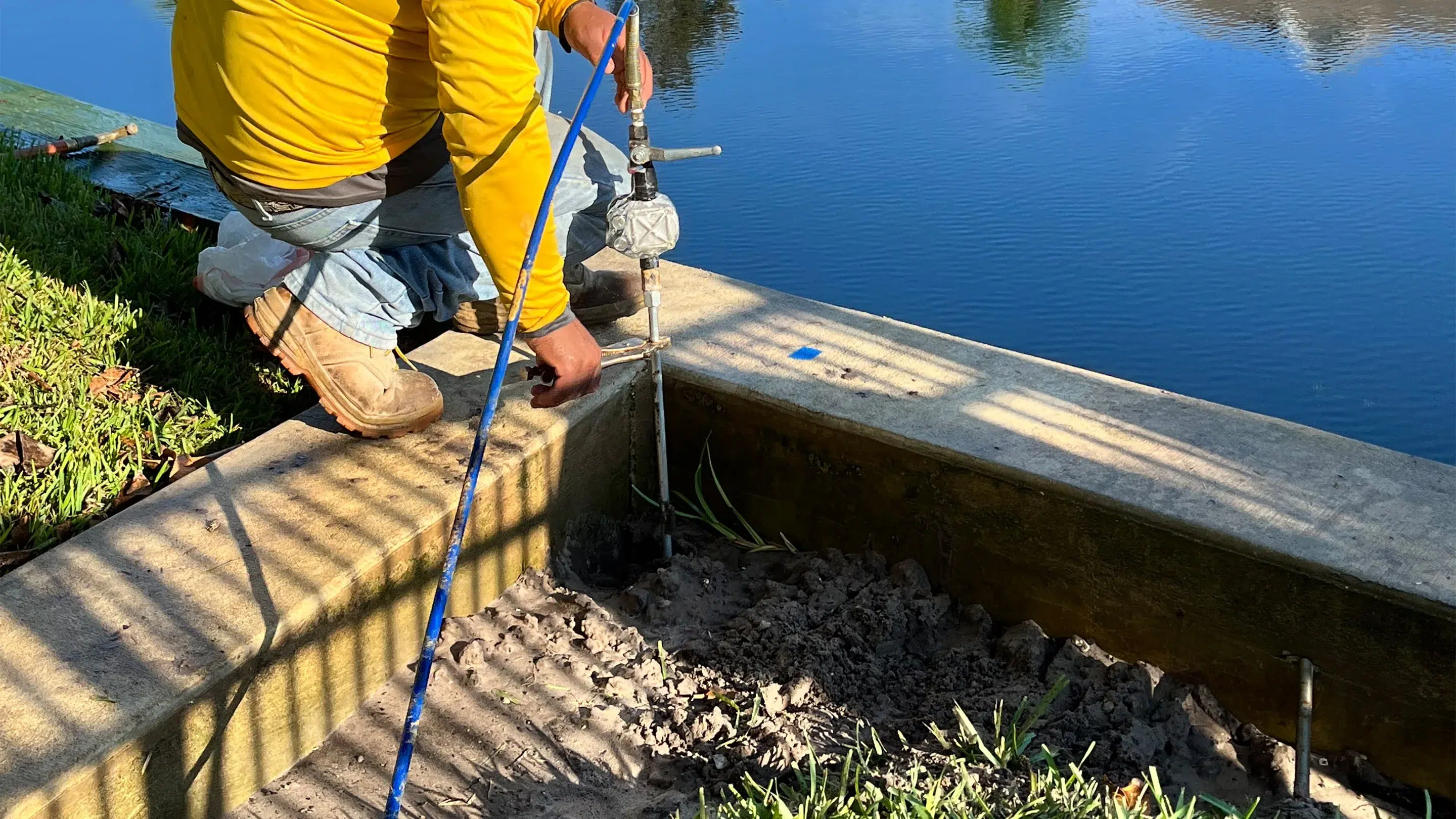
Polyurethane concrete lifting—sometimes called polyjacking, foam jacking, or polyurethane slab lifting—uses expanding structural polyurethane beneath settled concrete.
Small holes are drilled through the slab at selected locations, and the material is injected below it.
Depending on the repair objective, polyurethane can:
- Fill voids
- Restore contact beneath unsupported concrete
- Help improve support
- Lift settled sections
- Stabilize selected areas beneath the slab
Because polyurethane is lightweight, it adds relatively little additional load to soils that may already have experienced settlement or support loss.
Common applications include:
- Driveways
- Sidewalks
- Pool decks
- Patios
- Lanais
- Garage floors
- Some interior slabs
Where Polyurethane Has an Advantage
For many residential projects, practical advantages can include:
- Small injection holes
- Lightweight material
- Fast curing
- Limited demolition
- Void-filling capability
- Controlled lifting when conditions allow
- Relatively little disruption compared with replacement
Those characteristics can be useful in Florida, where settlement may involve loose fill, erosion, washout, or voids.
But polyurethane does not make damaged concrete new again.
If the slab itself is beyond reasonable repair, replacement may be the better investment.
Read more: Concrete Lifting
2. How Mudjacking Works
Mudjacking is an older form of slab lifting.
Instead of polyurethane, a contractor pumps a cementitious slurry beneath the concrete through drilled access holes.
The material fills space beneath the slab and can raise it as pressure develops.
Mudjacking can work.
That is worth saying clearly because comparisons written by polyurethane contractors sometimes portray mudjacking as though it is automatically an improper repair.
It is not.
A qualified contractor may successfully use mudjacking when:
- The slab is still suitable for lifting
- Supporting conditions are appropriate
- Access is adequate
- The soils can accommodate the heavier material
- The lift can be properly controlled
Where Mudjacking Can Make Sense
Mudjacking may be worth considering when a reputable contractor has strong experience with the method, the slab and soils are appropriate, larger injection holes are acceptable, and the project economics make sense.
One important difference is material weight.
Traditional cementitious mudjacking slurry is considerably heavier than polyurethane foam.
That does not automatically make it a poor choice.
But when the underlying soils are already loose, weak, washed out, or poorly compacted, the additional weight is a legitimate factor to consider.
3. How Concrete Replacement Works
Replacement takes a different approach.
Instead of preserving the existing slab, the contractor generally:
- Breaks and removes the old concrete.
- Evaluates and prepares the base.
- Adjusts grade or layout when necessary.
- Forms the area.
- Places new concrete.
- Finishes and cures the new slab.
Replacement offers something lifting cannot:
A new concrete surface.
That matters when the condition of the concrete itself is the problem.
Replacement May Be Better When Concrete Is:
- Severely cracked or fragmented
- Crumbling
- Heavily scaled or spalled
- Too thin or poorly constructed
- Significantly damaged by roots
- Not in suitable condition for lifting
- At the wrong slope and needs redesign
- Near the end of its useful life
- In poor enough condition that preserving it provides little value
Replacement also allows changes to:
- Finish
- Color
- Thickness
- Layout
- Drainage slope
- Joint locations
- Overall appearance
Neither polyurethane nor mudjacking gives an old slab a new surface.
The Most Important Question: Is the Existing Concrete Worth Saving?
Many comparisons begin with:
“Is polyurethane better than mudjacking?”
But the first question should often be:
“Should this slab be lifted at all?”
A driveway that has settled but remains relatively intact may be an excellent candidate for lifting.
A driveway that is severely fragmented, deteriorated, and nearing the end of its useful life may not be.
The decision requires looking at both:
The Support Problem
Why did the slab move?
The Concrete
Is the existing slab still worth supporting and lifting?
A technically successful lift of concrete that should have been replaced may still be a poor use of the homeowner’s money.
Polyurethane vs. Mudjacking: What Actually Matters?
The practical differences matter more than claims that one system is always “better.”
Material Weight
Polyurethane is much lighter than traditional cementitious mudjacking material.
That can be advantageous when the underlying soils have already shown poor support.
Whether the added weight of mudjacking matters depends on the soil and site conditions.
Injection Hole Size
Polyurethane generally uses smaller access holes than mudjacking.
That can matter on visible surfaces such as driveways, patios, and pool decks.
Both methods still require injection locations to be patched.
Speed and Return to Service
Polyurethane cures quickly and generally allows a fast return to use.
Mudjacking typically requires more time for the cementitious material to set.
Actual timing depends on the system, project, site conditions, and contractor.
Control During Lifting
Both methods require experienced installation.
The contractor must control:
- Injection locations
- Material quantity
- Lift sequence
- Slab movement
- Adjacent elevations
- Drainage
- Joints and cracks
- Nearby structures
Trying to force settled concrete perfectly back to its original position can sometimes create additional cracking or unwanted movement.
The goal is a controlled, practical repair—not necessarily perfection.
What Neither Polyurethane Nor Mudjacking Can Do
Neither method can:
- Make deteriorated concrete new
- Remove existing cracks
- Restore a badly spalled surface
- Fix every drainage problem
- Stop an active plumbing leak
- Remove tree roots
- Redesign a poorly sloped slab
- Guarantee every crack will close
- Correct every deeper soil problem
- Turn poorly constructed concrete into properly constructed concrete
That is why slab condition matters as much as lifting capability.
What Replacement Does NOT Automatically Fix
Replacement can appear to be the most complete solution because the visible concrete is new.
But new concrete can settle too.
If the original slab moved because of poor compaction, ongoing washout, weak fill, drainage, leaks, or significant soil loss, those conditions should be addressed when relevant.
Removing the old slab creates an opportunity to prepare the base properly.
It does not mean every underlying condition is automatically corrected.
When replacement is chosen, proper removal of unsuitable material and preparation and compaction of the new base are important parts of reducing the risk of future settlement.
New concrete over the same unresolved support problem can become settled concrete again.
Read more: Drainage Problems and Concrete Settlement in Florida
Void Filling, Concrete Lifting, and Soil Stabilization Are Not the Same Thing
This distinction is particularly important with polyurethane.
“Foam injection” does not describe a single repair objective.
Concrete Lifting
The objective is to raise settled concrete toward a desired elevation.
Void Filling
The objective may simply be to restore support beneath an unsupported slab without significant lifting.
Soil Stabilization
The objective is to improve weak or loose soils beneath or adjacent to the slab.
Some properties may involve more than one of these conditions.
A settled slab with weak supporting soils may require more than simply injecting enough material to raise the concrete.
Read more: Voids Under Concrete Slabs: What Causes Them and How to Fix Them
Read more: Polyurethane Soil Stabilization
Which Repair Is Best for Different Conditions?
| Condition | Option Usually Worth Considering |
| Good concrete that has settled | Polyurethane or mudjacking |
| Good slab with voids underneath | Void filling, lifting, or another appropriate slab-support method |
| Weak or loose shallow soils | Soil stabilization may need to be considered |
| Severely cracked or fragmented concrete | Replacement |
| Crumbling or heavily deteriorated surface | Replacement |
| Slab displaced by significant roots | Root correction and often replacement |
| Existing slab has an unsuitable drainage slope | Replacement may provide more flexibility |
| New finish, thickness, or layout desired | Replacement |
| Limited-access area where demolition is undesirable | Polyurethane may offer practical advantages |
| Supporting soils have already demonstrated weakness | Lightweight polyurethane may be worth considering because it adds less material weight |
| Active washout or drainage problem | Correct the water source plus the appropriate slab repair |
| Cause of settlement is uncertain | Diagnose before choosing the method |
This is a decision guide, not a substitute for evaluating the actual slab.
What About Cost?
Cost depends on more than the repair method.
Important factors can include:
- Project size
- Number of affected slabs
- Amount of settlement
- Size of voids
- Material required
- Access
- Interior vs. exterior work
- Soil conditions
- Slab condition
- Water or drainage issues
- Need for soil stabilization
- Demolition and disposal
- Concrete thickness and finish
- Restoration requirements
Mudjacking may sometimes have a lower initial cost than polyurethane.
Replacement usually involves more demolition, disposal, forming, new material, finishing, and curing than lifting an existing repairable slab.
But price alone should not decide the repair.
Lifting deteriorated concrete simply because it costs less may postpone replacement.
Replacing good concrete that could reasonably be lifted may create unnecessary cost and disruption.
Read more: Cost to Lift a Driveway or Concrete Slab in Florida
What About Appearance?
Replacement has a clear advantage when the homeowner wants a completely new concrete surface.
Polyurethane and mudjacking preserve the existing slab—which means they also preserve:
- Stains
- Surface wear
- Discoloration
- Old cracks
- Previous repairs
- Texture differences
Injection holes also need to be patched.
If the primary goal is to make an aging driveway look new, lifting may not meet expectations even if the slab can technically be raised.
Replacement provides a new surface, although newly poured sections may not perfectly match older surrounding concrete.
Can Cracked Concrete Still Be Lifted?
Sometimes.
A crack does not automatically require replacement.
Consider:
- Number of cracks
- Crack width and pattern
- Overall slab condition
- Whether pieces can still move together predictably
- Surface deterioration
- Whether lifting may worsen existing cracking
- Whether the slab will still be worth preserving afterward
Some cracked slabs can be lifted successfully.
Others have reached the point where replacement makes more sense.
The decision should be based on the overall condition of the concrete, not simply whether a crack exists.
When Would Helicon Recommend Replacement Instead of Polyurethane?
Helicon performs polyurethane concrete lifting and stabilization rather than traditional mudjacking.
Homeowners should know that when reading our comparison.
We believe polyurethane has meaningful advantages for many Florida concrete-settlement problems.
But that does not mean every settled slab should be injected.
We may recommend that a homeowner consider replacement when:
- The slab is too deteriorated to justify lifting
- It is severely fragmented
- Surface condition is poor
- Significant roots need to be addressed
- Construction quality is inadequate
- Grade or drainage slope requires substantial redesign
- The homeowner’s main objective is a new surface
- Lifting would not provide a reasonable finished result
The fact that a slab can potentially be lifted does not always mean it should be.
Why Helicon Generally Uses Polyurethane Instead of Mudjacking
For the residential concrete-lifting work Helicon performs, polyurethane generally fits the conditions we encounter because it offers:
- Lightweight material
- Small injection locations
- Rapid curing
- Controlled installation and lifting when conditions allow
- Relatively low disruption
That is why it is our preferred lifting method.
But preferred does not mean universally superior.
Mudjacking can still be a legitimate lifting method on an appropriate slab and site when performed by an experienced contractor.
The better question is:
“Which method makes the most sense for this slab, on this soil, for this repair objective?”
Checklist: Should I Lift This Concrete or Replace It?
Before choosing polyurethane, mudjacking, or replacement, ask:
About the Concrete
- Is the slab still suitable for lifting?
- Is it badly cracked or fragmented?
- Is the surface crumbling, scaling, or severely spalled?
- Is the slab sound enough to preserve?
- Would I be satisfied keeping the existing surface if it were level again?
About the Cause
- Do I understand why the slab settled?
- Are voids present?
- Is soil washout occurring?
- Are drainage problems contributing?
- Is there a plumbing or irrigation leak?
- Could weak or poorly compacted soils require additional treatment?
About the Repair
- Is the objective lifting, void filling, soil stabilization, or replacement?
- Why is this method appropriate?
- What will happen to existing cracks?
- What elevation can realistically be restored?
- What will the repaired surface look like?
About the Alternatives
- Was replacement considered?
- If replacement is recommended, why isn’t lifting appropriate?
- If lifting is recommended, why is the slab worth preserving?
- If comparing polyurethane and mudjacking, how do the support conditions affect that choice?
If those questions cannot be clearly answered, more information may be needed before deciding.
Questions to Ask a Concrete Lifting Contractor
Ask:
- Why did my concrete settle?
- Is the slab still worth saving?
- Are there voids beneath it?
- Do the underlying soils need treatment?
- What material will you inject?
- Why do you prefer it for this property?
- What are the limitations of the repair?
- How much elevation can realistically be restored?
- What happens to existing cracks?
- How will the injection holes be patched?
- Is water contributing to the problem?
- When would you recommend replacement instead?
A contractor should be able to explain not only why its preferred method works, but when it is not the right choice.
What Homeowners Should Not Do
Do not choose polyurethane simply because it is newer.
Do not choose mudjacking simply because it may cost less.
Do not choose replacement simply because it sounds more permanent.
And do not assume a contractor recommending replacement is overselling—or that a contractor recommending lifting is automatically giving you the better value.
Instead, determine:
- Why did the slab move?
- Is the concrete worth preserving?
- What support problem needs to be addressed?
- Which option best fits the condition?
The repair method should follow the condition—not the marketing.
How Helicon Approaches Settled Concrete
Helicon has worked with Florida foundations, slabs, and soils since 2004.
Our experience includes polyurethane concrete lifting, structural void filling, soil stabilization, foundation repair, compaction grouting, sinkhole repair, and deep foundation systems.
That broader experience means we are not only asking:
“How do we raise this concrete?”
We also want to understand:
“Why did it lose support?”
The evaluation may consider slab condition, settlement pattern, voids, drainage, erosion, soil support, access, and what the homeowner expects from the finished repair.
Then the question becomes:
“What is the least invasive repair that properly addresses the condition?”
Sometimes that is polyurethane lifting.
Sometimes support needs to be restored without significant lifting.
Sometimes soil stabilization or correcting a water source also matters.
And sometimes the honest recommendation is to replace the slab rather than spend money trying to preserve it.
Read more: About Helicon
Schedule a Free Concrete Lifting Inspection
If your driveway, sidewalk, pool deck, patio, garage floor, or other concrete is settling, you do not need to choose a repair method before understanding the problem.
Helicon can evaluate:
- Concrete condition
- Settlement pattern
- Voids beneath the slab
- Soil-support concerns
- Drainage or erosion when relevant
- Whether the existing concrete is worth preserving
If polyurethane lifting is appropriate, we can explain why.
If replacement makes more sense, homeowners should understand that too.
The goal is to determine whether the existing concrete is worth saving and, if it is, how to support it properly.
Click Here to Get Started
FAQ
Is polyurethane better than mudjacking?
Not in every situation. Polyurethane is lightweight, uses relatively small injection holes, cures quickly, and works well for many residential lifting projects. Mudjacking can also be effective where the slab and site are appropriate.
Is mudjacking outdated?
It is an older method, but older does not mean ineffective. Experienced contractors still use cementitious slab-lifting methods successfully.
Why does Helicon use polyurethane instead of mudjacking?
Its lightweight material, small injection locations, rapid curing, and controlled installation make it a good fit for many of the Florida slab conditions Helicon encounters.
Is polyurethane more expensive than mudjacking?
It can be. Pricing varies by project and market. The better comparison is the total repair needed for the slab and its support conditions.
Is lifting concrete cheaper than replacing it?
Often, when the slab is worth preserving. But lifting badly deteriorated concrete simply because it costs less may not provide good long-term value.
When should concrete be replaced instead of lifted?
Replacement may be better when the slab is severely cracked, fragmented, crumbling, heavily deteriorated, poorly constructed, root-damaged, or needs a different slope, finish, or layout.
Can polyurethane fix cracked concrete?
It can sometimes lift and support a cracked slab, but it does not erase or repair the existing cracks themselves.
Does mudjacking add weight beneath the slab?
Yes. Traditional mudjacking slurry is substantially heavier than polyurethane foam. Whether that matters depends on the supporting conditions.
Can polyurethane fill voids without lifting the slab?
Yes. Void filling and concrete lifting are different objectives. A slab may need restored support without needing significant lifting.
Will replacing concrete prevent it from settling again?
Not automatically. If poor support, erosion, drainage, washout, or another underlying condition remains, replacement concrete can also settle.
Can concrete lifting fix drainage?
It may improve the elevation or slope of a settled slab in some situations, but it does not automatically correct the source of a drainage, runoff, or erosion problem.
How long before I can use concrete after lifting?
Polyurethane generally allows a relatively fast return to service. Mudjacking and replacement concrete may require longer depending on the materials and project conditions.
How do I know which option is right for my slab?
Start with three questions: Why did the slab settle? Is the existing concrete worth saving? What repair best addresses the lost support?