If you are planning a new build in Florida, one of the biggest decisions you will make happens before the foundation is even poured.
It is not the finished schedule. It is not the framing package. It is not even the final structural design. It is whether you truly understand the ground you are building on.
That is the core message behind Helicon’s “On Solid Ground” podcast conversation with CEO Jay Silver, Principal Engineer David Grindley, and Social Media Manager Joe Boyle. The episode is also a strong example of Helicon’s collaborative approach with Grindley Williams Engineering, bringing practical field experience and engineering insight together to help property owners make smarter decisions before construction begins. Their discussion makes a point that is easy to overlook during the excitement of a new project: foundations do not fail in a vacuum. When structural problems show up later, the real cause is often in the soil below.
For developers, builders, commercial property owners, investors, and custom-home clients, that matters more than ever in Florida. The state’s ground conditions can change quickly from one property to the next. Sandy soils, buried organics, clay pockets, poor drainage, buried debris, and even sinkhole-related conditions can all affect how a foundation performs over time. Florida soils are unpredictable and a proper soil test and stabilization plan can help prevent settlement and foundation failure before construction begins.
That is why pre-construction soil testing is not just a technical step. It is a risk-reduction step.
Why Soil Testing Matters Before You Build
Every building depends on the soil beneath it. If that soil is weak, compressible, expansive, organic, poorly drained, or inconsistent across the site, the foundation above may not perform the way the plans assume.
That does not always mean a dramatic failure. More often, it means differential settlement, slab cracking, sticking doors and windows, sloping floors, or foundation movement that becomes expensive to diagnose and repair after the structure is already complete.
Explore the site early, verify shallow and deep conditions as needed, then choose the right stabilization or foundation strategy before concrete is placed. A phased process can include a site walk, shallow checks, GPR diagnostics, SPT or CPT borings, lab testing, and then the appropriate fix based on bearing and serviceability targets.
That is the real value of testing early. It gives the project team options.
If poor soils are found before construction, the site can often be cleaned up, over-excavated, surcharged, stabilized, or redesigned with a more appropriate foundation system. Once a building is already there, every repair becomes more invasive.
What Can Soil Testing Actually Reveal?
One of the best parts of the podcast is how clearly it explains that soil problems are not limited to one thing.
Yes, people in Florida think about sinkholes first. But according to the discussion, weak site conditions can also include shallow organics, buried trash, old tree stumps, clay, poor drainage, and other hidden subsurface issues that may never be visible from the surface before construction starts.
Weak, sandy, or silty soils across Florida can create long-term risks for homes, roadways, and construction sites, and that early stabilization improves load-bearing capacity while reducing settlement risk.
In practical terms, soil testing may reveal problems such as:
- buried organic material that should not remain under a foundation
- fill dirt or construction debris that may compress over time
- clay soils that can expand when wet and shrink when dry
- poor bearing conditions in the near-surface soils
- weak deeper zones that may require further exploration
- possible sinkhole-related raveling or voiding that needs confirmation
- drainage patterns that affect long-term site performance
This is exactly why a “build it like every other lot” approach can go wrong. Two nearby sites can look similar above grade but behave very differently below grade.
What Usually Comes After Soil Testing?
Once the soil conditions are known, the next step is not always the same.
That is another useful point from the podcast. If the issue is shallow organics, buried trash, or other unsuitable near-surface material, it may be possible to scrape it away and build on a cleaner, stronger layer. If the site has area-wide clay or broader weak-soil conditions, the foundation itself may need to be designed differently. If deeper instability or sinkhole-related concerns are present, further investigation and ground improvement may be needed before construction can safely move forward.
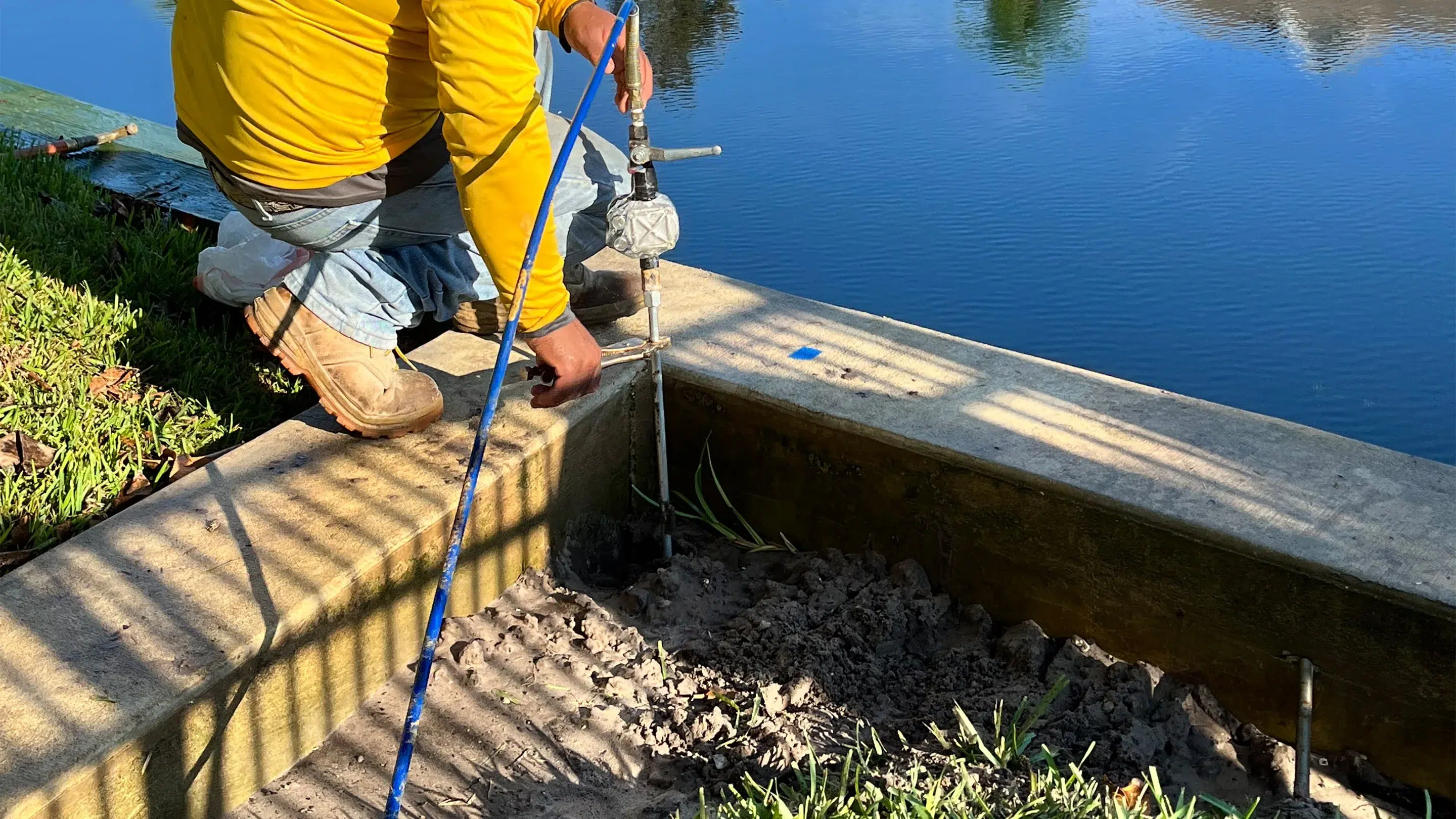
For some sites, compaction grouting can densify soils, fill voids, and improve ground strength before construction. For others, a different combination of stabilization or foundation support may be more appropriate. The key point is that the fix should follow the soil conditions, not the other way around.
That flexibility is one of the biggest benefits of testing before you build. It keeps the project team from making assumptions that may be expensive later.
Why Skipping Soil Testing Gets So Expensive Later
This is where the conversation becomes especially practical for both builders and homeowners. For a developer or contractor, skipping soil testing can turn into change orders, schedule delays, warranty issues, and foundation repair after the structure is already complete. For a homeowner building a custom home, it can mean discovering serious foundation trouble only after the finishes, flooring, cabinetry, and walls are already in place.
The problem is not just the repair itself. It is everything wrapped around it: demolition, access, engineering, delays, and restoring what had already been completed.
The podcast makes this point especially well.
Fixing a soil or foundation problem after the structure is in place is almost always more complicated than dealing with it upfront. Once the building is already there, you are no longer working on an open lot. You may be dealing with finished floors, interior load-bearing walls, completed utilities, occupied spaces, interior finishes, landscaping, paving, and all the disruption that comes with cutting through completed construction.
According to the discussion, that is why post-construction repair can easily cost two to three times as much as proactive investigation and planning before the build. And in severe cases, the consequences are far greater than money alone. If a major instability issue is left undiscovered and the building experiences partial collapse, the cost may include business interruption, displacement, liability exposure, and even life safety risk.
For commercial owners, that difference matters even more. A foundation problem in a completed apartment building, office, retail property, or mixed-use development is not just a repair issue. It can become a schedule problem, tenant problem, financing problem, warranty problem, and reputation problem at the same time.
For homeowners, the same lesson is simpler but just as important: it is almost always easier and less expensive to solve a soil problem before the house is built than after the family has moved in.
Why Commercial Projects Usually Take This More Seriously
One of the more interesting observations in the podcast is the contrast between commercial construction and residential construction.
Commercial projects tend to perform pre-construction soil studies far more consistently. That is not surprising. The higher the stakes, the more likely the owner, lender, engineer, and contractor are to require clearer information about subsurface conditions before work begins.
In contrast, some smaller residential projects still rely on broad assumptions about what the local soils “probably” are. That may save a little money upfront, but it can create unnecessary risk. The podcast discussion even points out that in some parts of Florida, old building habits were imported from regions that do not have the same sinkhole exposure, rain patterns, or local soil conditions. What worked elsewhere does not always translate safely here.
That does not mean homeowners should feel intimidated by the process. In many cases, even modest shallow testing can provide valuable insight before building begins. For custom-home projects, that small step can help owners avoid much larger stress later.
That makes Florida-specific testing and foundation design especially important.
What Types of Testing Might Be Used?
The podcast gives a helpful overview of the tools that may come into play, depending on the site.
For straightforward issues, the first step may simply be a site walk and shallow investigation. Sometimes obvious near-surface issues can be spotted quickly. Other times, the site needs more advanced evaluation.
A two-stage style approach that mirrors the podcast closely: a field visit and shallow checks first, then deeper diagnostics if conditions suggest something more is going on. Those diagnostics may include GPR or electrical resistivity methods to flag suspicious areas, followed by SPT or CPT borings to better understand the soil profile.
Here is a simple breakdown:
Ground Penetrating Radar and similar scans
These methods can help identify areas of concern, but they do not provide a full soil sample by themselves. They are useful for targeting where deeper exploration should happen next. The podcast makes the important point that scans do not “show” a sinkhole in a cinematic way. They indicate unusual subsurface echoes or patterns that still need confirmation.
SPT borings
Standard Penetration Test borings help evaluate both the strength of the soil and the material itself. They allow sampling at depth so the project team can understand what the soil layers actually are.
CPT testing
Cone Penetration Testing is often faster and can be cost-effective, but it does not always provide the same direct sample information that a deeper boring can provide.
Lab testing
If clay, peat, or organics are encountered, lab testing becomes especially important. As discussed in the podcast, not all clay is equally expansive, and the percentage of organics matters. The conversation specifically referenced around 5% organics as a practical threshold where soils may no longer be suitable for supporting a substantial structure without mitigation.
Florida Areas Where Soil Awareness Matters Especially More
This blog is not about singling out one part of the state as “bad ground.” Florida is too geologically varied for that kind of shortcut. However, the podcast does make an important point: some regions deserve especially careful attention because of known sinkhole activity, shallow limestone, historic building practices, or variable subsurface conditions.
Areas around Orlando, Pasco County, Spring Hill, Holiday, Tampa Bay, and parts of Central Florida often come up in these conversations because of either sinkhole history, weak sandy soils, shallow support issues, or older slab-on-grade construction habits. That does not mean every site in those places is problematic. It does mean assumptions are riskier there than many owners realize.
For developers, builders, and homeowners, the takeaway is simple: local history matters, but site-specific testing matters even more. A nearby property may be fine while the next lot has buried organics, trash fill, or deeper instability.
Common Soil Problems Florida Builders and Homeowners Should Not Ignore
Florida is not one uniform soil environment, and that is part of the challenge.
Statewide soil stabilization emphasizes weak sands, silts, moisture-sensitive soils, and variable groundwater behavior. The podcast adds useful on-the-ground examples: old swamp material, buried roots, trash fill, expansive clay, poor grading, and sinkhole-prone conditions in certain areas.
Some of the most important conditions to evaluate include:
- Organics and peat: compressible, unsuitable, and often better removed, surcharged, or designed around
- Expansive clay: can heave when wet and shrink when dry, creating movement in slabs and roadways
- Buried debris or trash: may compress unpredictably under structural loads
- Weak sandy soils: common in Florida and sometimes stable, but not always adequate without verification
- Sinkhole-related voiding or raveling: rare on many sites, but too important to ignore where risk is known
- Poor drainage: long-term water movement changes soil behavior and affects foundation performance
The deeper point here is that the problem is not just “bad dirt.” The problem is a mismatch. A foundation is only as good as its ability to match the real site conditions beneath it.
What Property Owners Should Watch For If Damage Already Exists
The podcast also addresses a different but related issue: what to do if you already own a structure and are seeing signs of movement.
According to the discussion, no single symptom should be judged in isolation. A sticking door by itself may not mean much. A floor out of level by itself may not prove foundation trouble. But when you begin seeing combinations of signs—sloping floors, cracks, separation at walls, doors or windows out of square, nearby distress in finishes—that is when the case for further investigation becomes much stronger.
That same logic applies to new builds as well: it is far better to investigate what is below before signs of movement appear above.
A Smarter Way to Think About Cost
For both developers and homeowners, the smartest way to think about soil testing is not as an added cost. It is as a form of insurance against avoidable surprises. A relatively modest investment in testing can protect a far larger investment in the building itself.
Many owners hesitate at the idea of spending more before construction starts.
That is understandable, but the podcast gives a useful perspective here. For some projects, shallow near-surface testing may cost only a few thousand dollars. More advanced scanning may still be relatively modest compared with the total cost of a custom home or commercial project. And if those early steps reveal something concerning, the team can make an informed decision about deeper borings or pre-construction stabilization rather than guessing.
For most owners, the real question is not whether soil testing costs money. It is whether not knowing the site conditions is worth the risk.
FAQ
Why should I do soil testing before a new build in Florida?
Because Florida soils can vary dramatically from one property to the next. Testing helps identify weak soils, buried organics, drainage concerns, and possible subsurface hazards before the foundation is designed and poured.
Is pre-construction soil testing mostly for commercial projects?
No. Commercial projects tend to do it more consistently, but custom homes, builder-led residential projects, and smaller developments can benefit just as much, especially in areas with known sinkhole activity, poor soils, or past land disturbance.
What if the testing finds a problem?
That does not automatically stop the project. It usually gives the team better options, such as removing unsuitable soil, redesigning the foundation, or stabilizing the site before construction.
Can shallow testing be enough?
Sometimes, yes. The podcast discussion explains that many near-surface issues can be identified early with a site visit and shallow exploration. If those findings suggest deeper concerns, that is when more advanced testing can be added.
Final Takeaway
Helicon’s podcast collaboration with Grindley Williams Engineering is a reminder that the best building decisions often come from combining field experience with engineering analysis.
Pre-construction soil testing is one of the smartest early investments a Florida builder or property owner can make.
It helps reveal what the site is really made of, reduces guesswork, improves foundation design, and can prevent much larger costs after the building is complete. It also gives owners something every major construction project needs more of: clarity.
For commercial projects, that clarity protects budgets, schedules, and long-term asset performance. For custom homes, it protects peace of mind and resale value. In both cases, the principle is the same.
Before you build on the lot, understand the ground.
Call 844-Helicon today for a free inspection or fill out the form on our site.
Visit Grindley Williams Engineering’s site to learn more.