In a growing city like Tampa, building expansion projects often come with a hidden challenge below the surface: making sure the ground can support what is being built above it.
That was exactly the case for Valley National Bank on S. Franklin Street in downtown Tampa, where a major expansion called for the construction of a new elevator shaft and improvements near Stair B on the south side of the building. While the finished structure would serve employees and customers every day, the long-term success of the project depended on something far less visible—whether the soils beneath the foundation area were stable enough to support the load.
In Florida, that question matters more than many property owners realize. Sandy soils, loose granular deposits, changing moisture conditions, and variable subsurface profiles can all create settlement risks for commercial structures. For critical structural components like elevator shafts and access points, even minor ground movement can lead to major headaches later, from operational issues and uneven support to repair costs and project delays.
Before vertical construction could move forward, the bank’s team needed confidence that the subsurface conditions would not compromise the new addition. That is why Helicon was brought in to provide an engineered soil stabilization solution using polyurethane permeation grout injection.
Working in tandem with Ed Taylor Construction, Helicon designed and installed a targeted grouting program to strengthen the sandy soils in a tight-access downtown environment. The work was completed in just one day, helping keep the project on schedule while delivering the stable support the structure required.
This project is a strong example of how Helicon helps commercial property owners, contractors, and project teams solve complex subsurface challenges quickly, precisely, and with minimal disruption.
The Project: Supporting a Bank Expansion in Downtown Tampa
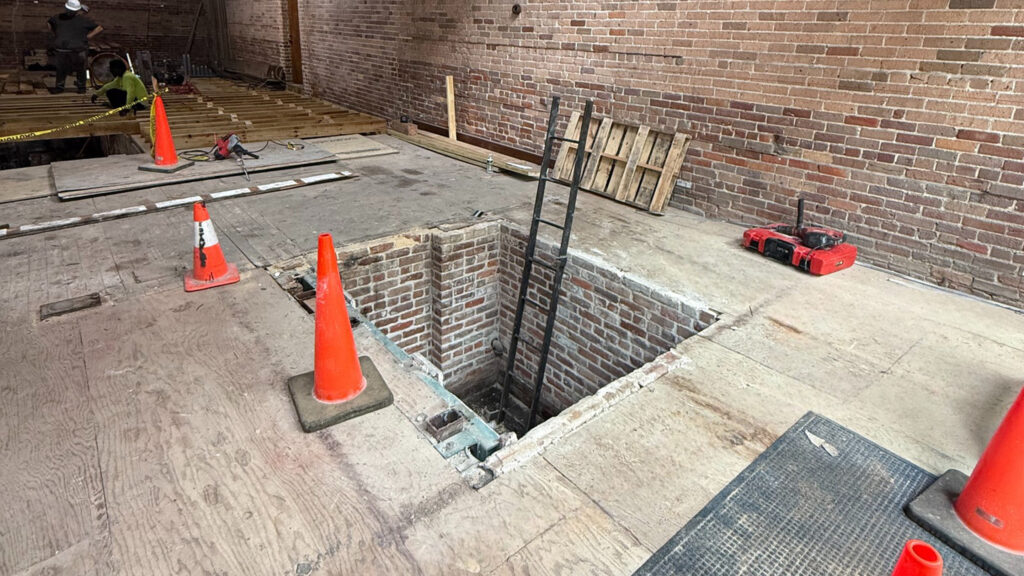
Valley National Bank planned a significant building expansion at its downtown Tampa location to better serve customers and support future operational needs. The scope included construction related to a new elevator shaft, an essential structural component that would connect multiple floors and become part of the daily function of the building.
Unlike decorative or lightly loaded building elements, elevator shafts demand reliable support from the ground up. They must remain properly aligned and capable of handling both the static weight of the structure and the dynamic forces created during repeated elevator operation. If the supporting soils are loose or inconsistent, the risk of settlement can increase substantially.
Because this project was located inside an existing older building on S. Franklin Street, it required careful coordination, precise execution, and a solution that could be installed in a confined urban setting. Traditional heavy-equipment approaches were not practical. The site conditions called for a method that could deliver ground improvement without excessive disruption to the surrounding building or jobsite.
That combination of tight access, structural sensitivity, and Florida sandy soils made polyurethane permeation grouting the right fit.
Why Soil Stabilization Is Critical for Elevator Shafts in Florida
Florida construction projects often face unique geotechnical challenges. In the Tampa Bay region, subsurface conditions can vary dramatically even within a small area. A site may include loose sands, fill materials, moisture-sensitive soils, or weak zones that are not suitable for supporting concentrated structural loads without improvement.
For an elevator shaft, those conditions are especially important.
If soils beneath the footprint are not properly stabilized, the structure may experience uneven support over time. That can affect performance, maintenance requirements, and long-term durability. In a commercial environment, those risks can translate into downtime, tenant concerns, operational inconvenience, and expensive corrective work after construction is already complete.
Early intervention is almost always the smarter path. Stabilizing soils before construction advances gives the project team a stronger foundation, reduces uncertainty, and helps avoid future settlement-related problems.
For this downtown Tampa bank expansion, Helicon’s role was to make sure the soils supporting the new shaft and adjacent structural area were improved before they could become a problem.
The Challenge: Tight Access and Loose Sandy Soil in a Downtown Building
This project presented two major technical hurdles.
Tight-access conditions inside an existing structure
The work area was located within an existing older building in the urban core of Tampa. Access was limited, clearances were tight, and the project environment did not allow for bulky traditional stabilization equipment. In many downtown commercial projects, that alone can restrict which repair methods are practical.
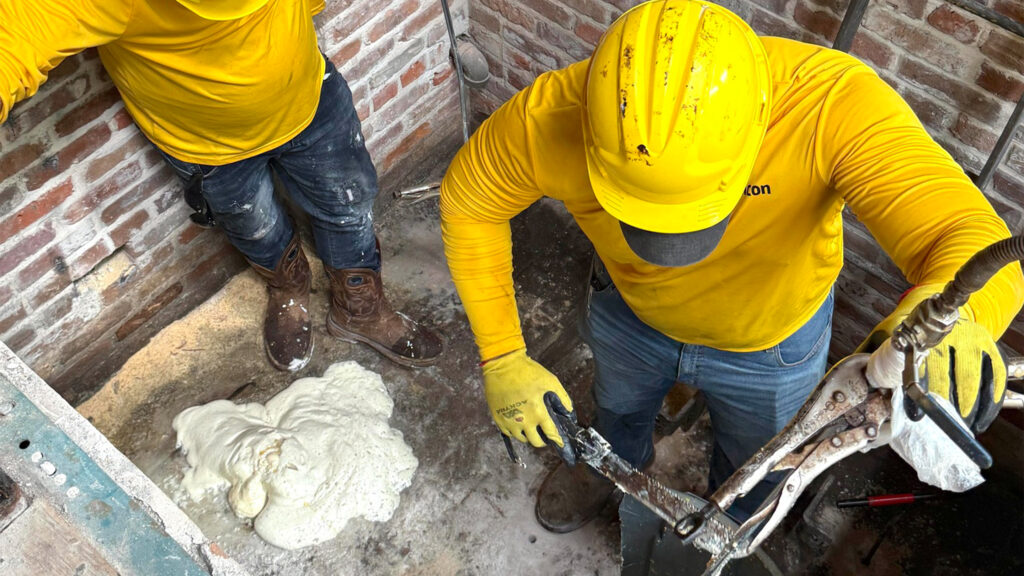
Helicon’s polyurethane injection systems are specifically designed for these kinds of conditions. Our equipment has a low footprint and can be used in confined areas where larger machinery cannot operate efficiently. That makes it ideal for work inside buildings, beneath slabs, near structural walls, in parking garages, and other restricted commercial environments.
For this project, that tight-access capability was a major advantage. It allowed Helicon to perform the work precisely where it was needed without creating unnecessary disruption to the building or surrounding construction activities.
Sandy, unstable subsurface conditions
The second challenge was the soil itself.
As is common in Florida, the subsurface in the treatment area consisted primarily of loose, granular sandy soil. While sandy soils can appear stable at the surface, they may shift, compress, or settle under concentrated structural loads if they are not improved. For a critical load-bearing element like an elevator shaft, that was not a risk the project team could accept.
Helicon needed a solution that would:
- Strengthen the sandy soils without adding excessive weight
- Improve uniform load distribution beneath the structural footprint
- Work effectively in a confined downtown setting
- Be installed quickly so construction could stay on track
The Solution: AP600 Polyurethane Permeation Grout Injection
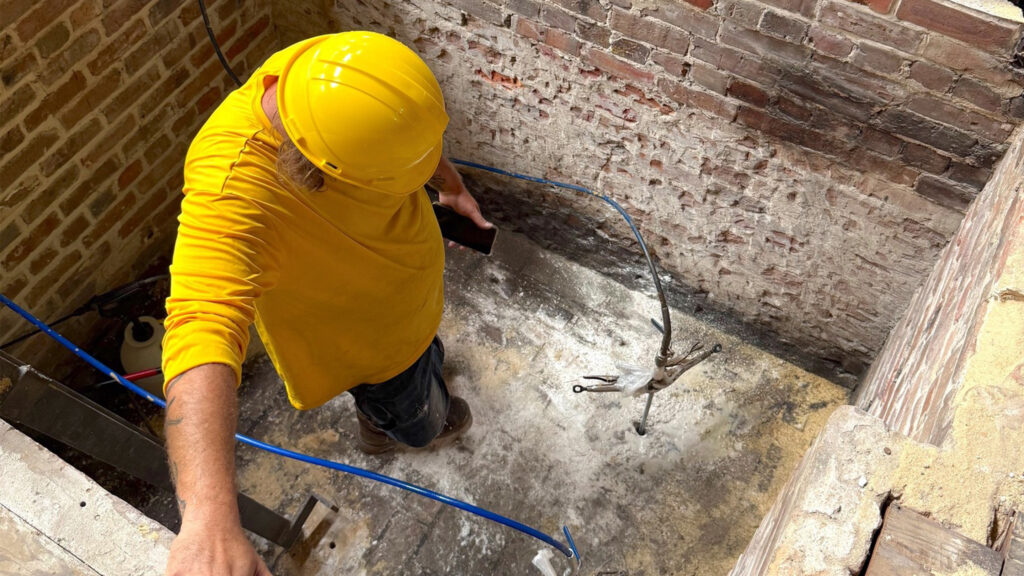
After evaluating the site conditions and structural demands, Helicon determined that AP600 one-part polyurethane permeation grout was the ideal solution for this application.
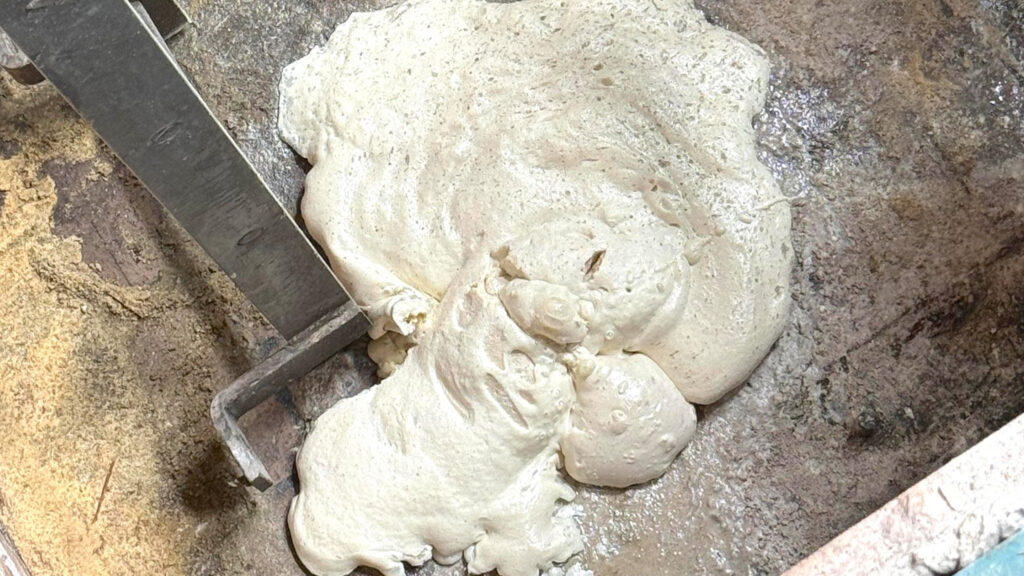
Polyurethane permeation grouting is a highly effective soil stabilization method for loose sandy soils because it is designed to move through the soil mass, bind soil particles together, and create a denser, more stable load-bearing zone. Rather than relying on large-scale excavation or heavier foundation systems, this process improves the soil in place.
That approach offered major benefits on this project.
Why AP600 was the right material
AP600 is particularly well-suited for sandy soil stabilization in Florida because it combines low viscosity with strong long-term performance. On a project like this one, those characteristics matter.
Key advantages of AP600 include:
- Low viscosity for deep permeation into loose granular soils
- Lightweight structural improvement without overburdening the site
- Permanent stabilization by binding sandy soil particles together
- Resistance to water intrusion is an important factor in Florida conditions
- Fast, clean installation for commercial environments where disruption must be minimized
This type of grout is commonly used for demanding applications such as elevator shafts, commercial foundations, bridge abutments, stormwater structures, structural slabs, and other high-load areas where reliable soil support is essential.
Precision Installation Plan for the Downtown Tampa Site
To address the specific needs of the project, Helicon developed a targeted treatment plan beneath the elevator shaft area and the adjacent structural zone.
The installation included chemical permeation grout at an approximate depth of 5 feet below grade surface, with excavation depth to be 3 feet below grade surface. The treatment also extended across 21 total lineal feet at Stair B on the south side of the building.
This level of specificity is important because soil stabilization is not a one-size-fits-all service. Each project requires a solution tailored to the building layout, structural loading, access conditions, and subsurface profile.
Helicon also designed a grid-based injection approach beneath the elevator shaft footprint to ensure that the treatment area received consistent and complete coverage. In the original shaft zone, the plan called for 14 injection points, each strategically positioned to target the soil layers most vulnerable to movement and settlement.
As the AP600 grout permeated the sandy soils, it produced multiple improvements in the treated zone:
- Weak areas and void-prone zones were addressed
- Soil density was increased
- Shear strength was improved
- Load-bearing capacity was enhanced
- Uniform support was created beneath the foundation area
This kind of precision is one reason polyurethane grouting is so effective in commercial applications. It allows Helicon to strengthen the ground exactly where support is needed, rather than over-treating the site or relying on more invasive alternatives.
Completed in Just One Day
One of the biggest advantages of polyurethane grouting for commercial projects is speed.
At Valley National Bank, the entire installation took only one day.
That rapid turnaround delivered several major benefits. It minimized disruption to the ongoing construction effort, reduced the amount of time crews needed to work in the confined area, and allowed the project team to move forward quickly with confidence in the newly stabilized soils.
For owners, contractors, and developers, speed matters—but only if it comes with precision and performance. On this project, Helicon delivered both.
The Result: Stable Support for a Critical Structural Element
With the AP600 injections complete, the bank expansion project gained a stronger, more reliable foundation beneath the new elevator shaft and adjacent treated area at Stair B.
The stabilized soils now provide a durable load-bearing base capable of handling the demands of the structure. Just as importantly, the work was completed efficiently and cleanly in a way that fit the constraints of an older downtown building.
By addressing the issue before construction progressed further, the project team reduced the risk of:
- Future settlement beneath the shaft
- Uneven support and alignment concerns
- Construction delays caused by subsurface surprises
- Long-term repair costs and operational problems
In short, Helicon helped make sure the project could proceed on solid ground.
Why This Project Matters for Commercial Properties Across Tampa and Florida
Although this was a specific downtown Tampa bank expansion, the underlying challenge is common throughout Florida.
Commercial buildings in Tampa, St. Petersburg, Clearwater, Brandon, Lakeland, Orlando, Kissimmee, Sarasota, Fort Myers, and Naples are often built on soils that can shift, settle, or lose strength over time. In many cases, the problem is not visible until construction begins or structural distress appears.
That is why proactive soil stabilization is so valuable for projects involving:
- Elevator shafts
- Structural columns
- Equipment pads
- Additions and expansions
- Retaining systems
- Slabs and foundation elements in weak soils
For these types of applications, polyurethane permeation grouting offers a compelling solution. It is precise, effective in sandy soils, fast to install, and ideal for projects where access is limited and disruption must be kept low.
This project shows how Helicon applies that technology in real-world commercial settings across Florida.
Why Helicon Is Trusted for Foundation Repair and Soil Stabilization in Florida
Helicon has built its reputation by solving difficult structural and geotechnical problems with the right combination of engineering judgment, specialized equipment, and field experience.
We do not simply treat symptoms. We identify the subsurface condition, understand how it affects the structure, and install a solution designed for the specific project environment. That is especially important for commercial work, where every decision can affect timelines, budgets, and long-term building performance.
Whether the issue is foundation repair, soil stabilization, sinkhole repair, polyurethane grouting, or concrete lifting, Helicon serves property owners and project teams throughout Tampa Bay, Orlando, and Southwest Florida with solutions built for long-term reliability.
The Valley National Bank project on S. Franklin Street is a strong example of that approach in action: a tight-access commercial job, unstable sandy soils, a critical structural element, fast execution, and a lasting result.
Need Commercial Soil Stabilization in Tampa or Elsewhere in Florida?
If your project involves a new elevator shaft, an expansion, a heavy structural feature, or loose soils beneath a commercial building, early stabilization can save time, money, and future complications.
Helicon provides expert solutions for commercial, industrial, municipal, and specialty structural projects across Florida. From downtown Tampa to Orlando to Southwest Florida, our team helps owners and contractors strengthen the ground before settlement becomes a larger problem.
Schedule a free foundation inspection today and speak with our team about the best solution for your project. Call 844-Helicon or visit our site at: https://heliconusa.com/