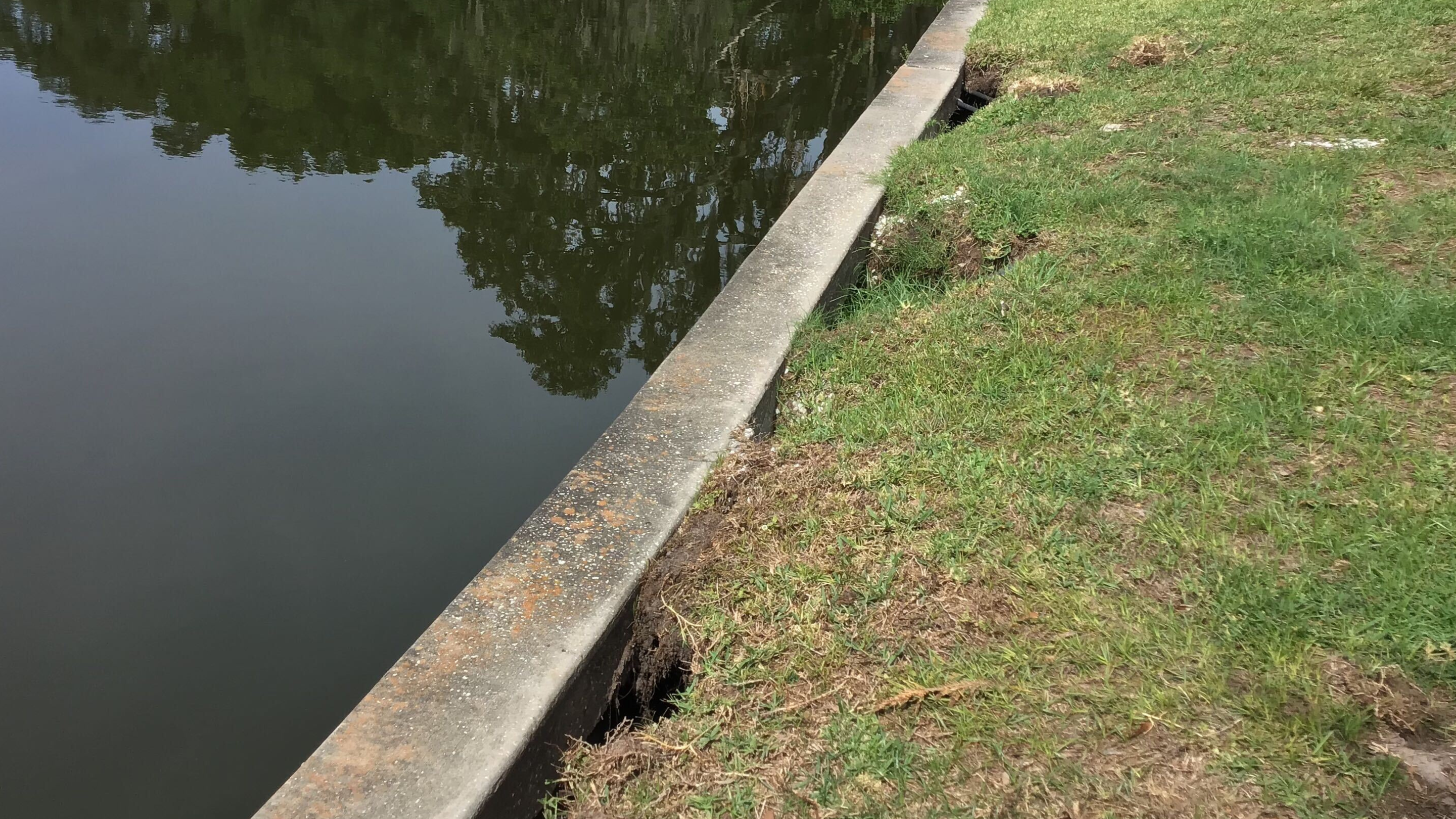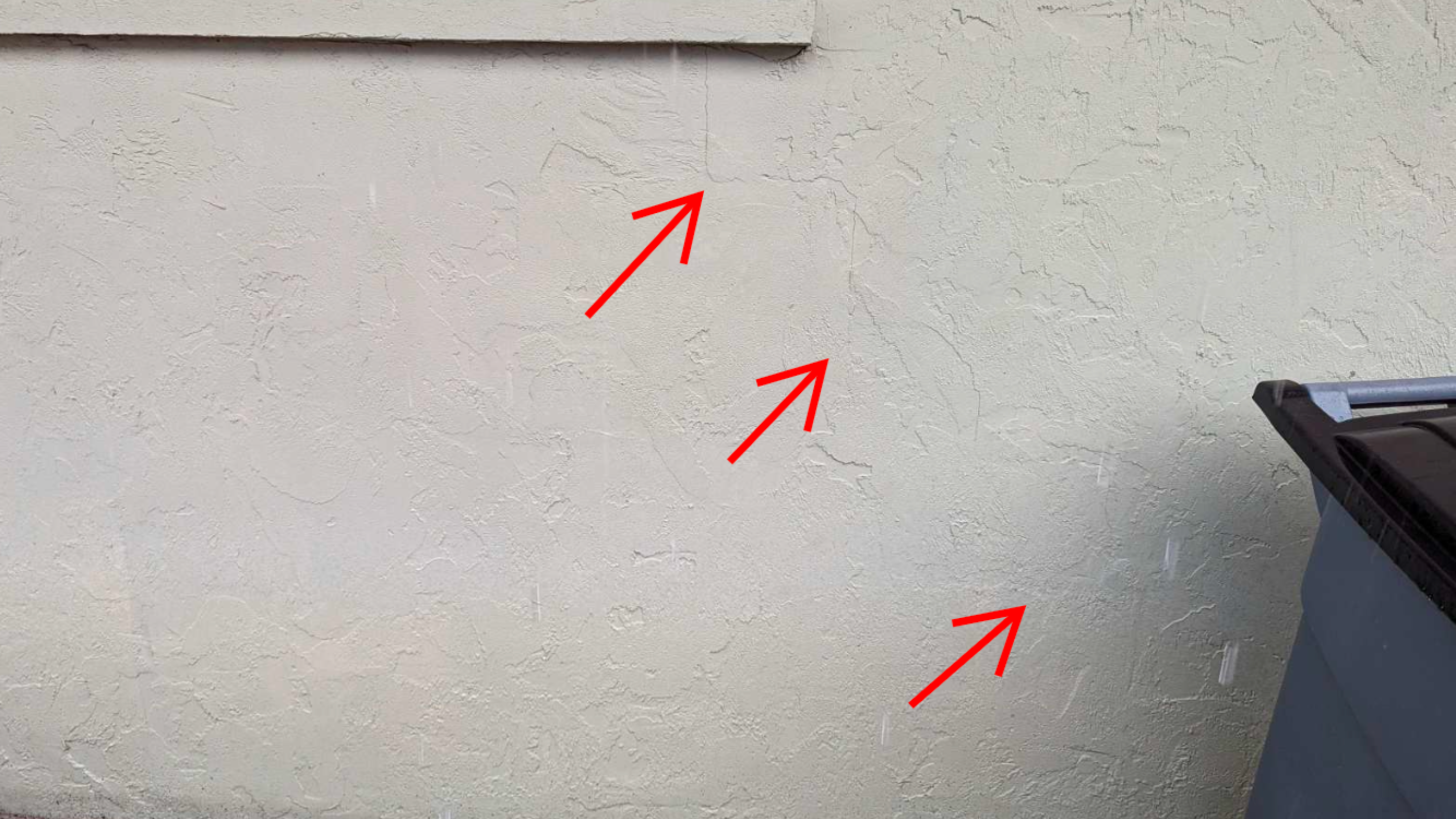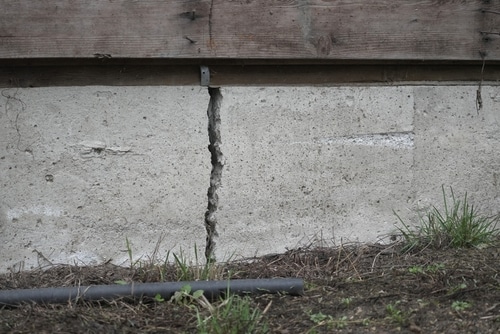
A settling porch can create several problems at once.
Cracks may form where masonry meets the house. Concrete slabs can drop and create uneven transitions. Doors may begin to rub. Water can collect in low areas. A wood deck may pull away from the structure or become difficult to rebuild correctly because the surface beneath it is still moving.
For one Sanford homeowner, solving the problem required more than a single repair method. The porch needed foundation repair to stabilize its structural load, soil stabilization to address weak and voided soils beneath the area, and concrete lifting to restore support and elevation beneath the adjoining slabs.
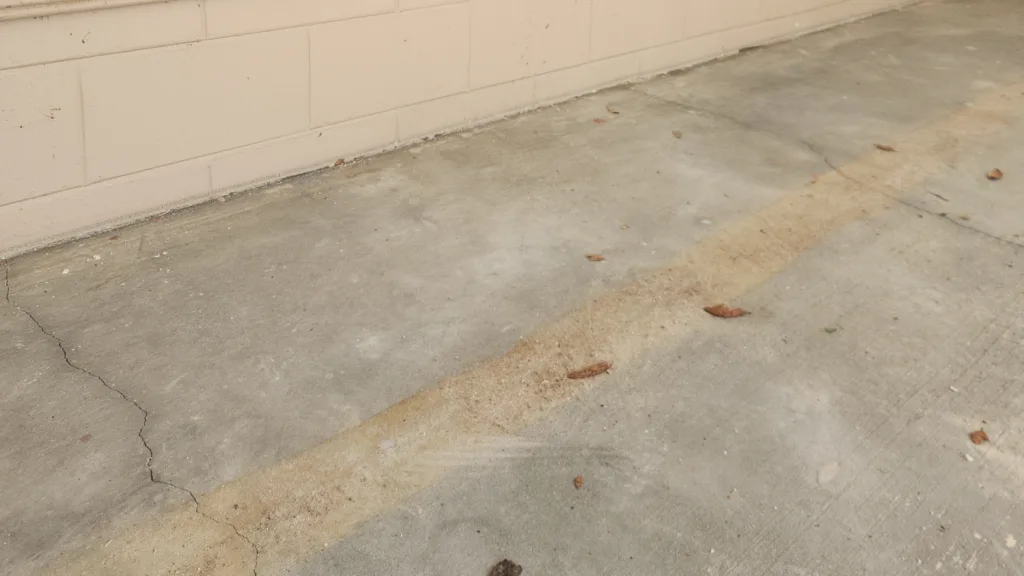
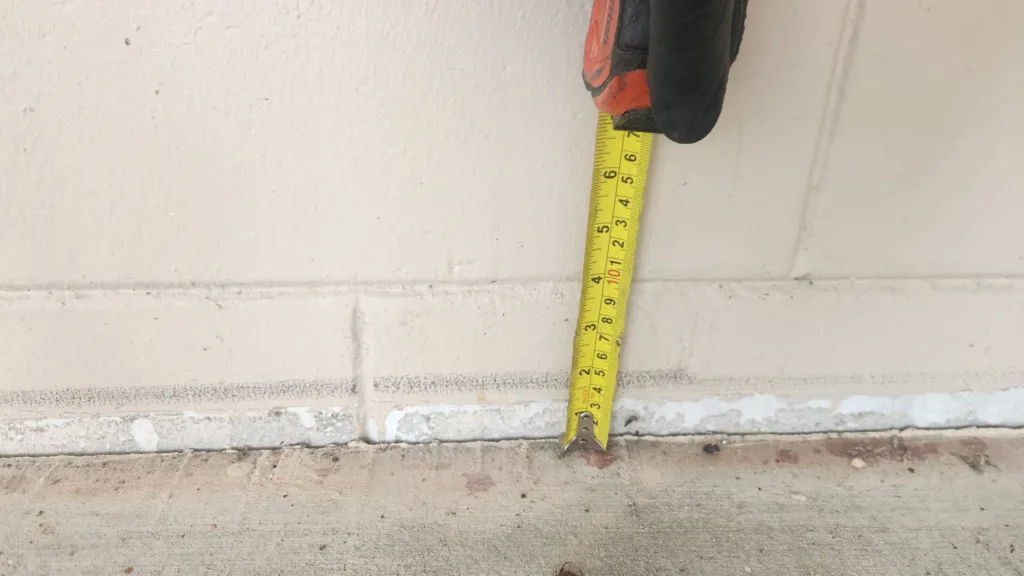
The rear porch had experienced differential settlement, meaning one area had moved more than another. Cracking was visible at masonry interfaces and slab joints. The exterior concrete slabs had also lost support in places, and level checks indicated voiding beneath portions of the concrete.
The homeowner wanted to know whether the porch could be stabilized, whether the dropped areas could be lifted, whether the work would create a major disruption, and whether future masonry and deck repairs would remain intact after the project was completed.
Helicon designed a combined foundation repair, soil stabilization, and concrete lifting/repair plan to address each of those concerns. Six helical piers were installed to transfer the porch load to competent soils, while two-part structural polyurethane was used beneath the slabs and shallow soil zones to fill voids, improve support, and help recover elevation.
Once both systems were in place, the crew performed a coordinated simultaneous lift across the affected footprint. The result was a stabilized porch, re-supported concrete slabs, and successful elevation recovery without the major demolition that many homeowners fear.
What Causes a Porch to Settle?
Porches and exterior slabs are especially vulnerable to settlement because they are often located at the edge of the building pad.
The soils directly beneath the main house may have received more controlled preparation during construction. Soil near the yard-facing edge of a porch, patio, or deck may be more exposed to moisture changes, erosion, organic decay, and differences in backfill compaction.
In Sanford and throughout Seminole County, near-surface soils commonly include sand and variable fill. Sandy soils can support a structure when they are properly compacted and remain confined. Problems can develop when water movement carries fine particles away, when buried organic material decomposes, or when one zone was compacted less consistently than another.
Common settlement contributors include:
- Poorly compacted backfill
- Soil washout from roof or surface drainage
- Irrigation concentrated near the porch
- Plumbing or drainage leaks
- Decay of buried roots or other organic material
- Repeated wet and dry cycles
- Concentrated loads at porch columns or exterior edges
- Voids beneath concrete slabs
- Changes to landscaping or drainage patterns
When support is lost, the porch or slab moves downward into the weakened zone.
The movement is rarely uniform. One corner may drop more than another. A slab edge may sink while the center remains supported. Masonry may crack where different materials respond to the movement at different rates.
This uneven response is what makes porch settlement both visible and potentially damaging.
The Homeowner’s Biggest Concern: Will the Problem Keep Getting Worse?
The most important question was whether the settlement would continue.
Cosmetic repairs alone would not answer that question. Filling a crack, replacing deck boards, or resurfacing the concrete might improve the appearance temporarily, but those repairs could crack or separate again if the supporting soils continued to move.
The homeowner also had several practical concerns:
- Could the porch be lifted closer to its previous elevation?
- Would the adjacent slabs remain uneven?
- Would the repair damage the house or masonry?
- Would the work interfere with daily use of the property?
- Could the area be made ready for a new deck?
- Would the repair address the soil problem or only hide the symptoms?
These are the same concerns many homeowners have when they see a sagging porch or sinking exterior concrete.
A dependable repair must address the load-bearing structure, the shallow soils and the concrete slab support. Treating only one part of the problem can leave the other components vulnerable.
Why Stabilization and Slab Support Require Different Tools
One of the most important technical lessons from this Sanford porch repair is that structural settlement and slab voiding are not the same problem.
They may occur in the same area, but they involve different load paths.
The porch structure transfers vertical loads through its framing, columns, walls, or footing into the soil. When those soils become unreliable, the structure needs a new support path that reaches stronger material below the weak zone.
The adjacent concrete slabs behave differently. They spread their weight across the near-surface soils directly beneath them. When voids form, the slabs lose contact and begin to crack, rock, or settle.
A deep pier can support the porch structure, but it does not automatically fill the voids under a broad slab.
Polyurethane can restore support beneath a slab and improve shallow soil conditions, but it is not a substitute for a deep foundation element when the structure requires verified bearing at depth.
That is why Helicon used both helical piers and two-part structural polyurethane. Each system performed a specific job.
How Helical Piers Stabilize a Settling Porch
Helical piers are steel foundation elements equipped with helical plates.
They are installed by rotating them into the ground, much like a large screw. This is completed through a process called underpinning. As the pier advances, the helical plates engage the surrounding soil. Installation continues until the pier reaches the required torque and bearing conditions.
Torque is important because it provides measurable information during installation. The resistance required to advance the pier correlates with its load capacity. This gives the installation team a way to confirm that each pier has reached suitable support rather than relying only on depth.
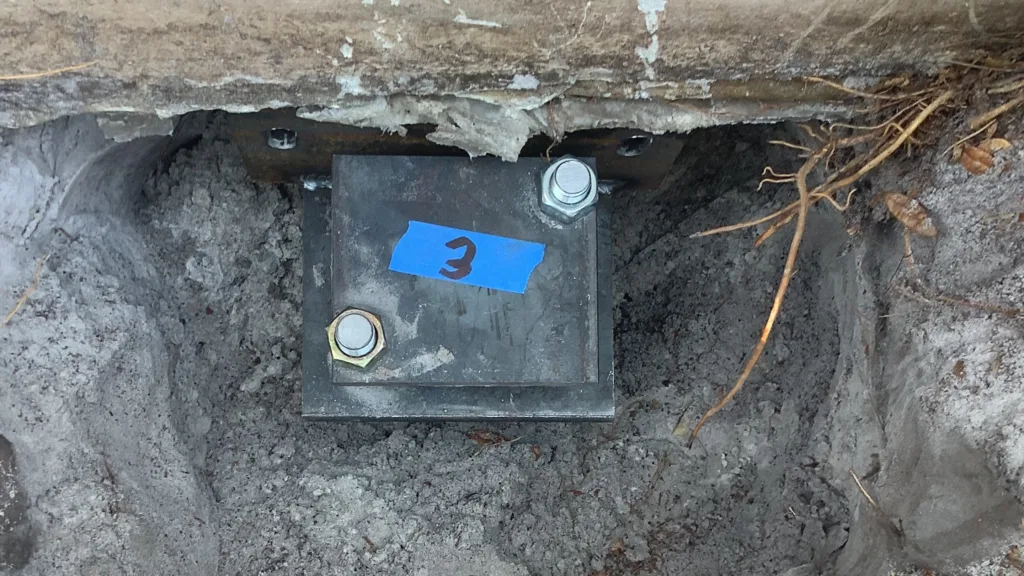
For the Sanford porch, Helicon installed six helical piers.
Once each pier reached the required design torque, brackets connected the porch’s load-bearing elements to the pier shafts. This transferred the load away from the weak or variable shallow soils and into the deeper bearing system.
The advantages of helical piers for this project included:
- Verifiable installation capacity
- Immediate load-carrying ability
- Minimal excavation
- Compact installation equipment
- Good performance in tight residential access areas
- A stable platform for controlled lifting
- Reduced dependence on moisture-sensitive surface soils
The helical piers did more than support the porch. They created the foundation for the lift itself.
Without a reliable bearing, attempting to raise the porch could have simply compressed the weak soils further or produced uneven movement.
Why the Rotted Deck Helped the Repair Process
The existing wood deck was deteriorated and already scheduled for removal.
Although the deck’s condition was a separate maintenance concern, its removal improved access for the repair.
The crew did not need to protect and reinstall aging boards after pier installation. This allowed the work area to remain more open and gave technicians cleaner access to the porch perimeter and foundation elements.
Removing the deteriorated deck also prevented the homeowner from rebuilding over an unstable base.
This sequence matters.
Structural stabilization should come before finish repairs, masonry work or deck replacement. Otherwise, newly installed materials may be damaged if the porch continues to move.
By completing the pier and polyurethane work first, the homeowner could move forward with future deck construction on a stabilized support system.
How Two-Part Polyurethane Restored Soil and Slab Support
After the deep structural support was established, Helicon addressed the shallow soil and slab conditions with two-part structural polyurethane.
The material begins as two liquid components. When they combine beneath the surface, a chemical reaction causes the polyurethane to expand and cure.
The expanding material moves into accessible voids and low-resistance zones. It can restore contact beneath a concrete slab, improve support, and tighten loose areas within the shallow soil matrix.
The Sanford project used polyurethane in two different ways.
Soil injections for shallow stabilization
Helicon injected approximately 140 pounds of polyurethane across seven soil-injection points.
These injections targeted weaker zones beneath the slab influence area and around the porch perimeter. The purpose was not simply to create lift. It was to improve stiffness, fill accessible voids, and re-establish contact within the treated soil zone.
Because the material is lightweight, it does not add the same mass as a heavy cementitious fill. That can be important where the existing soils have already demonstrated limited support capacity.
Slab injections for void filling and elevation recovery
The slabs received approximately 145 pounds of polyurethane through dedicated interface ports.
These injections were placed to fill voids directly beneath the concrete and restore slab-to-soil contact. Once support improved, technicians could make careful elevation adjustments at edges and transitions.
The process was monitored closely because polyurethane expansion can produce lift. Material must be introduced in controlled amounts to avoid over-correction.
Small injection ports were patched flush after the work was completed.
Why Polyurethane Works Well in Central Florida
Two-part structural polyurethane offers several advantages for porch, patio and slab stabilization in Sanford.
It is lightweight
Heavy fill materials can place additional load on already weak soils. Polyurethane provides support without introducing a large amount of added mass.
It cures quickly
The material reacts and cures rapidly, allowing exterior areas to return to service sooner than many traditional repair methods.
It works through small injection points
Large portions of the slab do not need to be removed to reach voids beneath the concrete.
It tolerates moist environments
Once cured, the material is inert and resistant to moisture, which is valuable in Central Florida’s humid and rain-prone conditions.
It allows precise adjustments
Experienced crews can control injection volume and monitor slab response during lifting. Polyurethane is not the right solution for every structural problem. In this project, it was effective because it was used for the work it is designed to perform: shallow soil improvement, void filling, slab support, and controlled elevation correction.
The Defining Moment: A Simultaneous Lift
The most memorable part of the Sanford repair was the simultaneous lift.
Once all six helical piers had reached design torque and the polyurethane support had been established beneath the slabs, the crew was ready to attempt elevation recovery.
A simultaneous lift is a coordinated process in which multiple support points are adjusted together.
The goal is to distribute movement across the porch footprint rather than lifting one location aggressively while the surrounding areas remain stationary.
This approach helps reduce concentrated stress.
During the lift, technicians monitored several indicators, including:
- Crack movement
- Slab transitions
- Porch alignment
- Door operation
- Elevation readings
- The response at masonry interfaces
- Movement around structural connection points
Small adjustments were made across the system so the porch could rise in a controlled and balanced manner.
This does not mean every point moved by exactly the same amount. It means the lift was managed as one connected structural event rather than as a series of isolated movements.
The porch responded favorably, allowing the team to achieve successful elevation recovery while remaining within safe tolerances.
Why Lift Can Never Be Guaranteed
Successful lift was an important outcome, but it was not promised before the project started.
That distinction protects both the home and the homeowner.
A structure that has settled may have adapted to its lowered position. Masonry, framing, plumbing, finishes, and connections may all react differently when elevation is restored.
The amount of safe lift depends on:
- How long the settlement has existed
- The condition of the porch footing or framing
- The rigidity of the masonry
- Existing cracks and separations
- Pier response during load transfer
- Soil response beneath adjacent slabs
- The risk of damaging connected finishes
- Door, window and utility tolerances
The first objective is always stabilization.
Once the porch is supported on reliable piers and the slab voids are addressed, the crew can determine whether lifting is safe and how far the system should move.
In Sanford, the response was uniform enough to support a successful simultaneous lift.
What the Repair Accomplished
The completed repair addressed the homeowner’s major concerns.
The porch received deep structural support
The load now transfers through six helical piers installed to verified torque. This reduces reliance on the variable shallow soils that contributed to the settlement.
The slab voids were filled
Polyurethane restored contact beneath portions of the concrete and reduced unsupported areas.
The shallow soil zone was improved
Seven soil-injection points helped tighten loose areas and increase support around the porch perimeter.
Elevation was successfully recovered
The simultaneous lift improved alignment and reduced visible distress at joints and transitions.
The site remained manageable
Compact equipment, targeted excavations, and small injection ports kept the repair area controlled.
The porch was prepared for future work
With active settlement addressed, the homeowner could proceed with masonry repairs and deck replacement on a more dependable foundation.
Should Masonry Repairs Be Completed Before Stabilization?
No.
Cosmetic repairs should usually follow structural stabilization.
If cracked masonry is repaired while the supporting porch is still moving, the crack may reopen, or a new crack may form nearby.
The recommended sequence is:
- Evaluate the cause of settlement.
- Stabilize the structural load path.
- Restore slab support.
- Complete any safe elevation recovery.
- Monitor the repaired area as recommended.
- Perform masonry, finish and deck repairs.
This sequence reduces the chance of repairing finishes over an active structural problem.
How Long Do Helical Piers and Polyurethane Last?
Helical piers are designed to provide long-term structural support when installed to the required torque and protected according to the system specifications.
Structural polyurethane remains inert after curing and is resistant to moisture. It is intended to maintain support and void fill within the treated area.
However, long-term performance also depends on the property’s drainage and loading conditions.
Homeowners should correct contributing issues such as:
- Downspouts discharging beside the porch
- Irrigation aimed toward the foundation
- Low areas that retain water
- Plumbing leaks
- Poor grading
- Water trapped near masonry or deck components
A repair can restore support, but controlling future water movement helps protect the surrounding soils.
When Should a Sanford Homeowner Request an Inspection?
A professional evaluation may be appropriate when you notice:
- A porch pulling away from the house
- Cracks at masonry joints
- Uneven or rocking slabs
- A sagging porch edge
- Doors near the porch that begin sticking
- Gaps between columns, walls or trim
- Water pooling on settled concrete
- Repeated repairs that continue to crack
- A deck that no longer sits level
- Visible soil loss near slab edges
Not every crack requires structural repair. Some are cosmetic or related to normal material movement.
The purpose of an inspection is to determine which situation you have.
A More Complete Approach to Porch Settlement
The Sanford project succeeded because the porch was treated as a connected system.
The helical piers addressed the deep structural bearing problem.
The polyurethane soil injections improved the shallow support zone.
The slab injections filled voids and restored contact beneath the concrete.
The simultaneous lift coordinated elevation recovery across the footprint.
No single product was expected to solve every condition.
For homeowners, that is one of the most important things to look for in a repair plan. The recommendation should explain what is moving, why it is moving and how each repair component addresses a specific part of the problem.
A sagging porch can be stressful, especially when it affects masonry, concrete, drainage and plans for a new deck. But when the structural and soil conditions are evaluated together, the repair can be targeted, measurable and far less disruptive than full demolition.
Frequently Asked Questions
Can a settled porch always be lifted?
No. Stabilization is the primary objective. Lift may be attempted after reliable support is established and only when the structure responds safely.
Why were both helical piers and polyurethane needed?
The helical piers supported the porch at depth. The polyurethane filled voids, improved shallow soil support, and helped lift the concrete slabs.
Are helical piers suitable for tight residential spaces?
Yes. Their compact installation requirements and limited excavation can make them well suited for porches and other confined areas.
Will polyurethane injection holes remain visible?
The ports are small and are patched flush after injection. Slight color variation may remain depending on the existing concrete.
Should a damaged deck be rebuilt before the porch is stabilized?
No. Structural and slab repairs should be completed first, so the new deck is built on a stable base.
How disruptive is this type of repair?
The work generally uses compact equipment, targeted excavation and small injection points. The exact disruption depends on access and the scope of repair.
Final Takeaway
A settling porch is rarely just a surface problem. It may involve deep structural support, shallow soil weakness, and voids beneath the surrounding concrete. By combining six torque-verified helical piers with targeted polyurethane injections and a carefully controlled simultaneous lift, Helicon stabilized the Sanford porch, improved slab support, and prepared the area for lasting masonry and deck repairs. For homeowners, the key lesson is simple: stabilize the structure first, restore support beneath the concrete second, and complete cosmetic improvements only after the movement has been addressed.
Helicon provides foundation repair, soil stabilization, and concrete lifting services throughout Sanford, Lake Mary, Altamonte Springs, and the Greater Orlando area. Call 844-HELICON or fill out the form on our site to schedule a free inspection and learn whether polyurethane chemical grout, helical piers, or both are the right stabilization solution for your project.