Not every foundation or slab repair needs to be dramatic to be important.
Sometimes the smartest repair is the one completed before the problem becomes obvious to everyone else.
That was the key lesson from this Miami courthouse settling basement slabs project. In a public-use commercial building, early movement below a floor slab can quickly become more than a maintenance issue. It can affect serviceability, long-term performance, water management, building operations, and future repair costs.
This project was not about lifting a severely sunken slab back into place. It was about something more precise: stabilizing the ground beneath a below-grade floor slab before the condition deteriorated.
That distinction matters.
In many slab repair conversations, people focus only on visible elevation change. Is the floor uneven? Can the slab be lifted? Will the surface look better afterward? Those questions matter in some projects, especially when concrete lifting is the main goal. In this courthouse basement, however, the real objective was not cosmetic improvement. The goal was to reinforce the support below the slab and reduce the risk of future settlement. That made this project a strong example of how commercial slab stabilization should be approached: evaluate first, understand the subsurface conditions, choose the right repair objective, and match the method to the actual problem.
A Sensitive Commercial Environment Below Grade
The project took place in a courthouse basement in Miami, Florida.
That setting immediately raised the importance of planning and execution. A courthouse is not an ordinary commercial building. It is a public-use institutional facility where reliability, access, safety, and long-term performance all matter. Even a floor slab issue that appears minor at first deserves serious attention because the building serves daily operational needs.
Basement slab settlement can be especially concerning because the slab is located below grade. Below-grade spaces often deal with conditions that are different from typical slab-on-grade environments, including:
- Groundwater influence
- Limited access
- Confined work areas
- Moisture-sensitive conditions
- More complicated water management
- Greater need for clean, controlled staging
- Higher consequences if the issue spreads or worsens
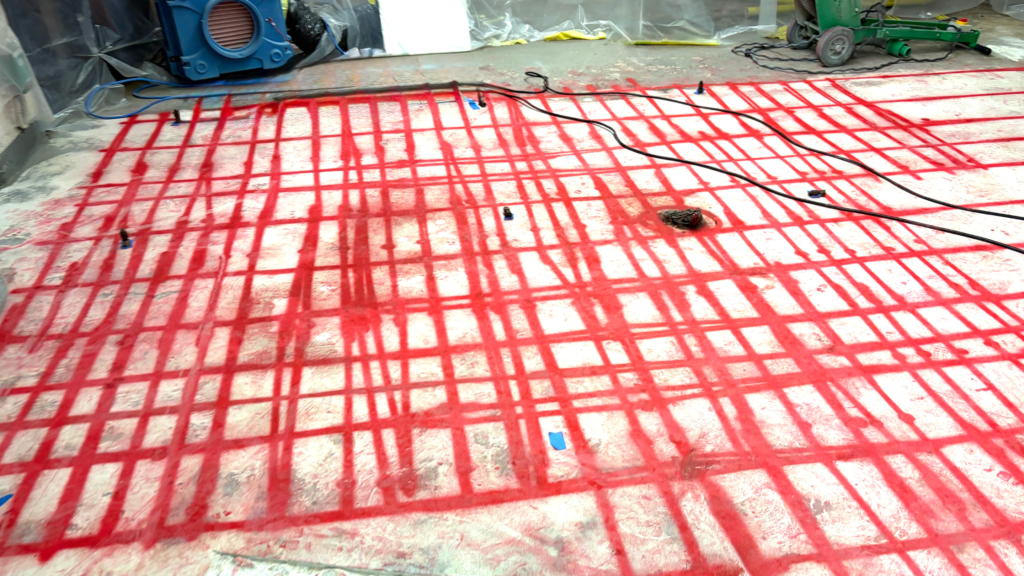
In this case, the slab was beginning to settle, but the project team did not wait until the issue became severe. They took a thoughtful approach by completing a Ground Penetrating Radar survey before stabilization work began.
That decision gave the repair team a clearer understanding of the subsurface context and helped confirm the right repair objective.
The conclusion was important: the slab did not need to be lifted. The soil below it needed to be stabilized.
Why the GPR Survey Was an Important First Step
A Ground Penetrating Radar survey, often called GPR, can help identify conditions below concrete without immediately resorting to invasive demolition. On projects like this, the purpose is to gain better information before deciding how to proceed.
That matters because not every settling slab should be treated the same way.
Some slabs need lifting. Some need void filling. Some need soil stabilization. Some require structural evaluation. Others may need a combination of approaches depending on what is happening below the surface.
The GPR survey helped guide the direction of this project by supporting a repair strategy based on field information rather than guesswork.
That is an important lesson for commercial owners, contractors, facility managers, and engineers. The best repair plan is not always the most aggressive one. It is the one that matches the actual condition.
For this courthouse basement, the survey helped confirm that the slab did not require elevation correction. Instead, the right move was to stabilize the support below the slab before the condition worsened.
Why a Settling Basement Slab Matters
A basement slab is more than a concrete floor.
In a commercial or institutional building, the floor slab contributes to the usability and performance of the space. When support beneath the slab begins to weaken, several concerns can follow over time.
Potential concerns include:
- Loss of uniform support below the slab
- Slab cracking or distress
- Uneven floor performance
- Water management complications
- Increased maintenance needs
- More expensive repair requirements if the issue is ignored
- Operational disruption if the slab condition worsens
In a courthouse environment, those risks are worth addressing early. Public-use buildings are expected to perform dependably, and small problems can become expensive if left untreated.
This project was a good example of prevention through stabilization. The slab had not reached the point where lifting was required, yet the support condition below it needed improvement. Addressing that issue at the stabilization stage gave the project team a better opportunity to protect the slab without creating unnecessary disruption.
Working Close to the Water Table
The central field challenge was water.
Because the work was so low to the ground, water kept rising as the crew worked close to the water table. That is a common reality in South Florida, especially in below-grade environments. Miami’s groundwater conditions can complicate slab stabilization because water can enter the treatment area, interfere with visibility, and require constant management during the repair.
This was not simply a minor inconvenience.
Below-grade stabilization depends on access, timing, control, and consistency. When water keeps entering the work area, the crew has to manage the site while still performing a technical repair. That requires discipline and experience.
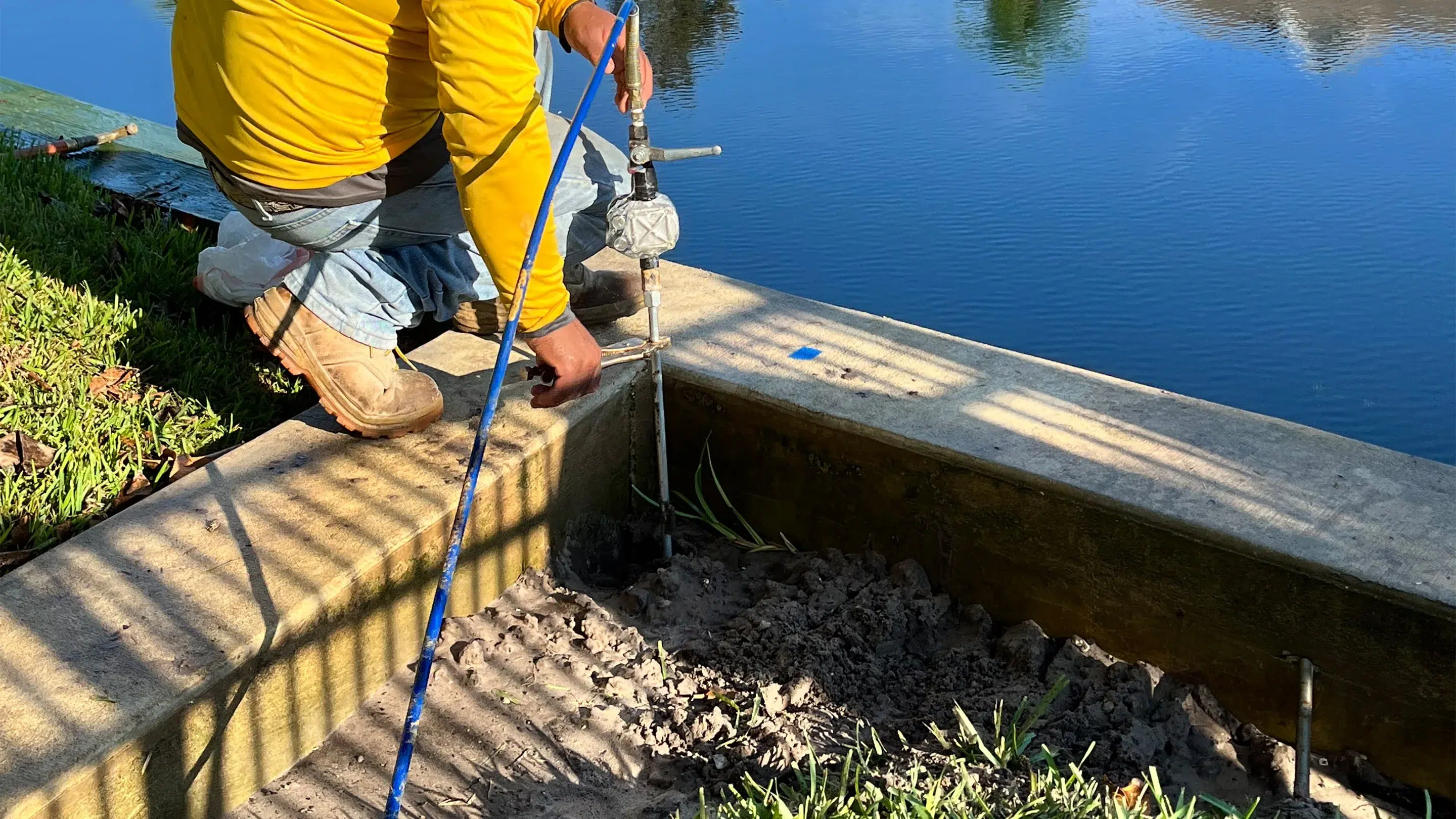
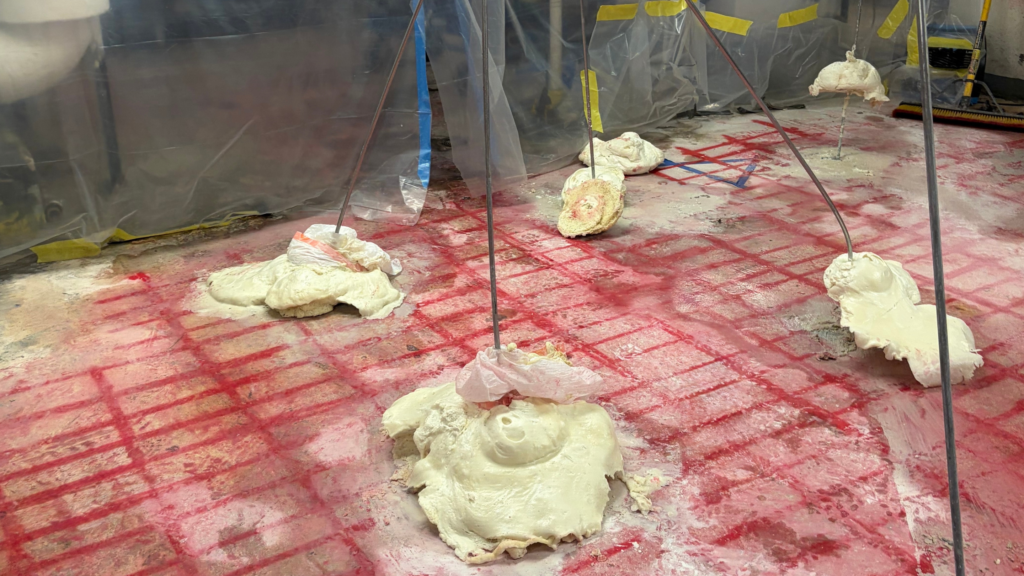
On this project, water had to be continuously removed throughout the work. The crew had to keep the treatment zone workable while preparing and completing the polyurethane chemical grout injections.
That added difficulty to the job in several ways:
- Water intrusion had to be actively controlled
- Work conditions had to remain clean enough for proper installation
- Injection timing had to be managed carefully
- The crew had to maintain consistency despite changing field conditions
- The repair had to be completed in a confined commercial environment
A less experienced team could easily lose efficiency or struggle to maintain control in this type of setting. Below-grade work near the water table requires a realistic understanding of field conditions, not just a good product.
No Lift Needed: Why Stabilization Was the Right Objective
One of the most important parts of this project was what the team did not do.
They did not lift the slab unnecessarily.
That matters because lifting is not always the correct objective. In some slab projects, lifting is necessary to restore elevation, improve functionality, or reduce trip hazards. In other cases, the slab may not need to move. The priority may be stabilizing the material below it to prevent future settlement.
This courthouse basement fell into the second category.
The slab needed improved support. It did not need elevation correction.
That approach avoided unnecessary movement and kept the project focused on the real issue: weak or unstable conditions beneath the floor slab.
For commercial buildings, that type of judgment is important. A repair should be measured by whether it solves the problem, not whether it creates a dramatic before-and-after photo. In this case, success meant a more stable slab support condition and reduced risk of continued settlement.
The Solution: AP440 Polyurethane Chemical Grout
Helicon selected AP440 polyurethane chemical grout for the stabilization work.
AP440 was a strong fit for this project because it allowed for targeted below-slab treatment in a confined basement environment. The material could be used to improve support beneath the settling floor slab without requiring broad demolition, excavation, or a more invasive repair approach.
The repair strategy was designed around treating the ground below the slab, filling voids where present, and improving the support condition so the slab would be less prone to future movement.
AP440 was appropriate for this courthouse basement because it could:
- Improve support beneath the settling slab
- Fill voids below the floor where needed
- Treat weak or unstable zones below grade
- Be installed in a confined commercial space
- Help reduce the likelihood of continued settlement
- Provide stabilization without unnecessary lifting
- Support a non-invasive repair strategy in a sensitive building environment
In a below-grade setting near groundwater, material selection and installation control both matter. The product must fit the environment, and the crew must understand how to work with the conditions present on site.
How the Repair Worked
The repair followed a practical sequence.
First, the slab and subsurface conditions were evaluated. The GPR survey helped clarify that lifting was not required. This kept the project focused on stabilization rather than elevation correction.
Next, the crew managed the water conditions. Because groundwater continued to enter the work area, water had to be removed throughout the project. That step helped keep the treatment zone workable and allowed the team to proceed with greater control.
Then AP440 polyurethane chemical grout was injected beneath the slab. The purpose was to improve the ground and support conditions below the courthouse basement floor. As the material was installed, it treated the subsurface area, filled voids where present, and helped reinforce the soil below the slab.
Finally, the slab area was stabilized for long-term performance. The repair did not need to look dramatic at the surface because the value of the work was below the slab. That is often the nature of high-quality stabilization work. The most important improvement may be the one no one sees.
Why Polyurethane Stabilization Was a Strong Fit Below Grade
Below-grade slab stabilization requires a method that can be targeted, efficient, and controlled.
Traditional excavation-based repairs can be disruptive, especially inside a courthouse basement. Removing slab sections, excavating below the floor, replacing material, and restoring the interior can create unnecessary disturbance when the problem can be addressed with injection-based stabilization.
Polyurethane chemical grout provided a less invasive alternative.
Instead of tearing into the basement slab broadly, Helicon could treat the support conditions beneath the floor through a targeted injection process. That helped reduce disruption while still addressing the underlying issue.
This approach made sense because the goal was not replacement. The goal was reinforcement.
For commercial and institutional facilities, less invasive repair can offer several advantages:
- Reduced disturbance to the building
- Faster execution compared with excavation-heavy repairs
- Cleaner work in confined interior spaces
- More focused treatment of the affected area
- Less impact on surrounding building operations
- Improved long-term support without unnecessary demolition
That is exactly why injection-based stabilization can be so valuable in sensitive commercial environments.
A Stabilized Basement Slab With Reduced Settlement Risk
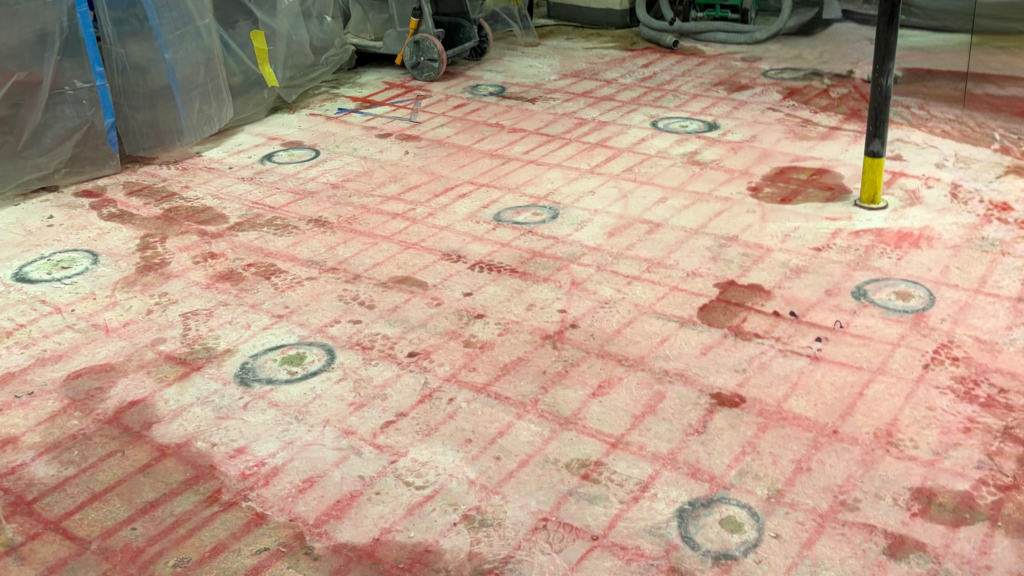
Once the AP440 polyurethane chemical grout injections were complete, the treated area beneath the courthouse basement slab had improved support.
The project achieved its central purpose: stabilize the floor slab and reduce the risk of further settlement in the repaired area.
Key outcomes included:
- The courthouse basement slab was stabilized without unnecessary lifting
- The support condition beneath the slab was improved
- Voids or weakened zones below the floor were treated
- Active groundwater conditions were managed throughout the job
- The risk of additional settlement in the repaired area was reduced
- The repair was completed with a targeted, non-invasive approach
- The project demonstrated a practical solution for below-grade commercial slab stabilization
For the contractor and client, the value was clear. The slab was addressed before the issue became more disruptive, more expensive, or more operationally difficult.
That is the advantage of early stabilization.
What Commercial Owners Can Learn From This Project
The Miami courthouse basement project offers a useful lesson for commercial property owners, facility managers, public agencies, general contractors, and engineers.
Do not wait until slab settlement becomes severe before evaluating the problem.
Early movement can often be stabilized more efficiently than advanced damage. Once a slab has cracked significantly, settled unevenly, or begun affecting building use, repair options may become more complicated.
Commercial buildings should consider slab stabilization when there are signs such as:
- Floor settlement
- Hollow-sounding areas below slabs
- Cracks in the basement or interior floor slabs
- Voids beneath concrete
- Water intrusion near below-grade slabs
- Recurring slab movement
- Soil instability identified through investigation
- Early signs of support loss below the floor
The earlier the issue is evaluated, the more options the project team may have.
In this case, the client’s team took the right first step by completing a GPR survey. That information helped confirm that stabilization was needed, not lifting. The result was a focused repair that addressed the real problem.
Commercial Slab Stabilization in Miami and South Florida
South Florida’s subsurface conditions can make below-grade stabilization challenging. Water, soil variability, access restrictions, and active building environments all affect how repair work should be planned and performed.
That is why commercial slab stabilization in Miami requires more than a generic approach.
The right contractor must understand:
- How groundwater affects below-grade repairs
- How to stabilize slabs without unnecessary lifting
- How to work inside sensitive commercial environments
- How to use polyurethane chemical grout properly
- How to coordinate with contractors, engineers, and building owners
- How to protect long-term performance while minimizing disruption
Helicon provides foundation repair, soil stabilization, slab stabilization, polyurethane chemical grout, concrete lifting, sinkhole remediation, and commercial stabilization solutions across Miami, South Florida, and the state.
For projects like this courthouse basement, the goal is not to overcomplicate the repair. The goal is to identify the problem, choose the right stabilization method, and execute it correctly.
Stabilize the Problem Before It Gets Bigger
The Miami courthouse basement project is a strong example of why early slab stabilization matters.
The slab did not need to be lifted. It needed better support.
By using AP440 polyurethane chemical grout, Helicon was able to treat the ground beneath the below-grade slab, manage challenging water conditions, and reduce the likelihood of continued settlement in the repaired area.
That is what a well-matched commercial stabilization plan should do.
It should solve the real problem without unnecessary disruption.
If your commercial building, courthouse, basement slab, parking structure, institutional facility, or below-grade concrete floor is showing signs of settlement in Miami or anywhere in South Florida, Helicon can help evaluate the conditions and recommend the right repair strategy.
Call 844-HELICON or fill out the form on our site to schedule a free inspection and learn whether polyurethane chemical grout is the right stabilization solution for your project.