In commercial construction, structural problems rarely begin where people can see them.
Cracks at the base of a wall. Minor movement around a building connection. Uneven load transfer near a planned expansion. On the surface, these can look like isolated issues. In reality, they often point to a deeper problem below grade: weak, inconsistent, or shifting soils that are no longer providing uniform support.
That is exactly why commercial foundation repair and soil stabilization through structural polyurethane grouting matter so much in Florida.
For hospitals, office buildings, industrial facilities, municipalities, schools, multifamily properties, and large retail sites, the real cost of structural settlement is not limited to concrete or masonry damage. It can affect timelines, budgets, tenant experience, operational continuity, risk exposure, and long-term asset value. In highly sensitive environments, the stakes are even higher. Any unnecessary vibration, excavation, or downtime can create ripple effects across an entire organization.
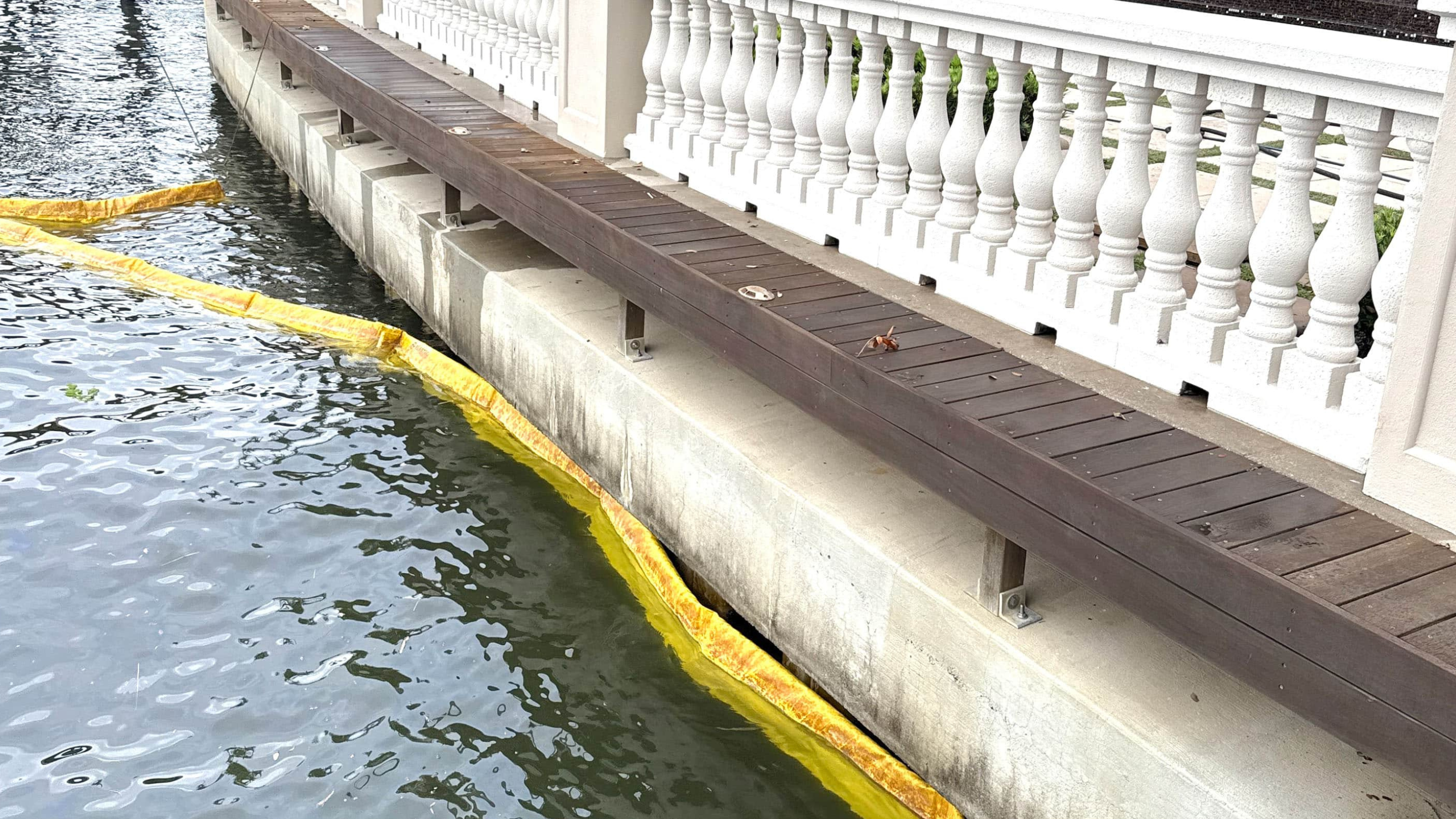
A recent Helicon project at Tampa General Hospital offers a strong example of what smart, proactive commercial soil stabilization looks like. The case involved a new wall planned adjacent to an existing building, where the underlying soils had already shown evidence of movement. Cracks had formed at the base of the structure, and introducing new load without first addressing the subsurface conditions could have increased the risk of differential settlement, cracking, and long-term maintenance issues.
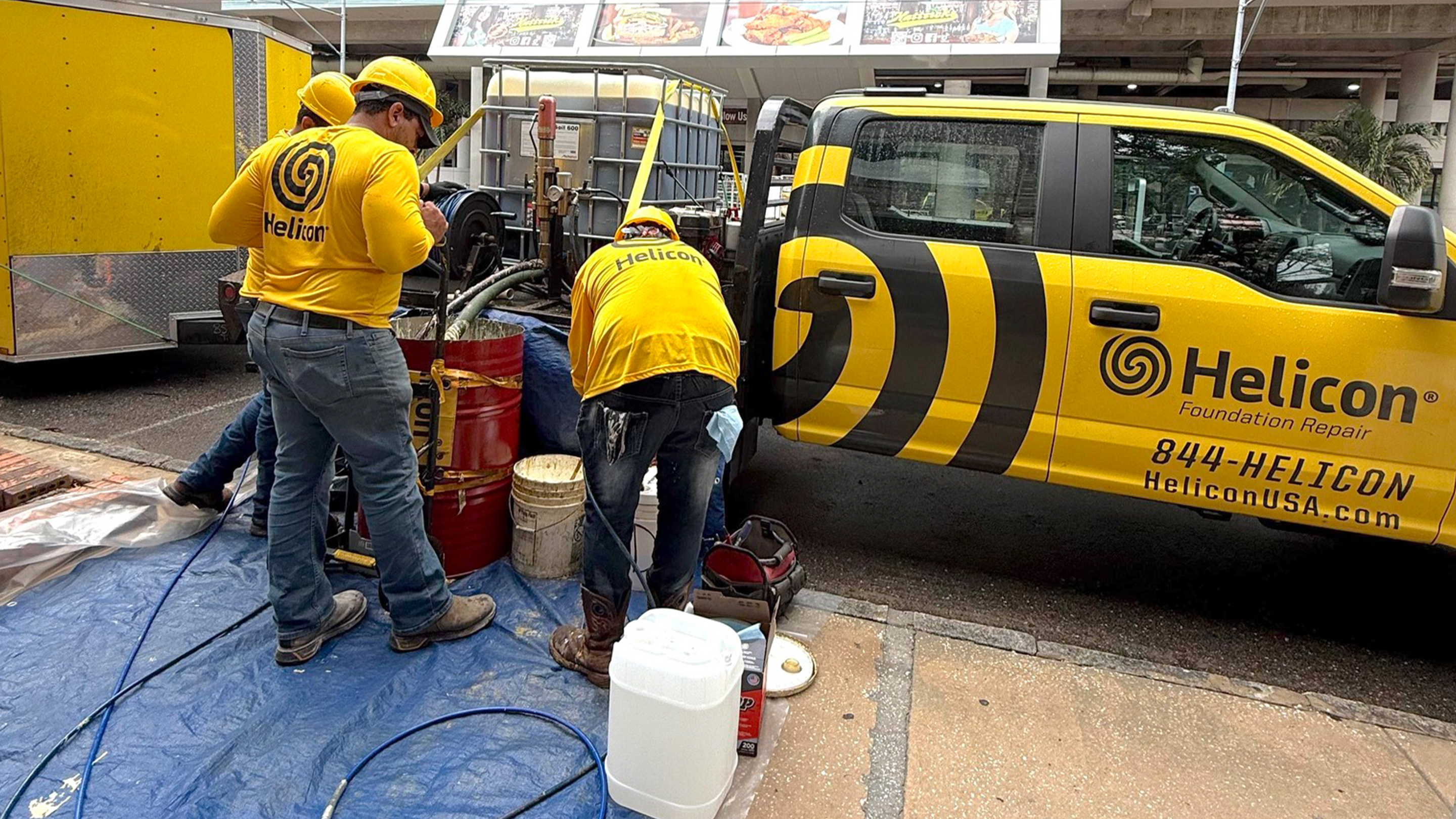
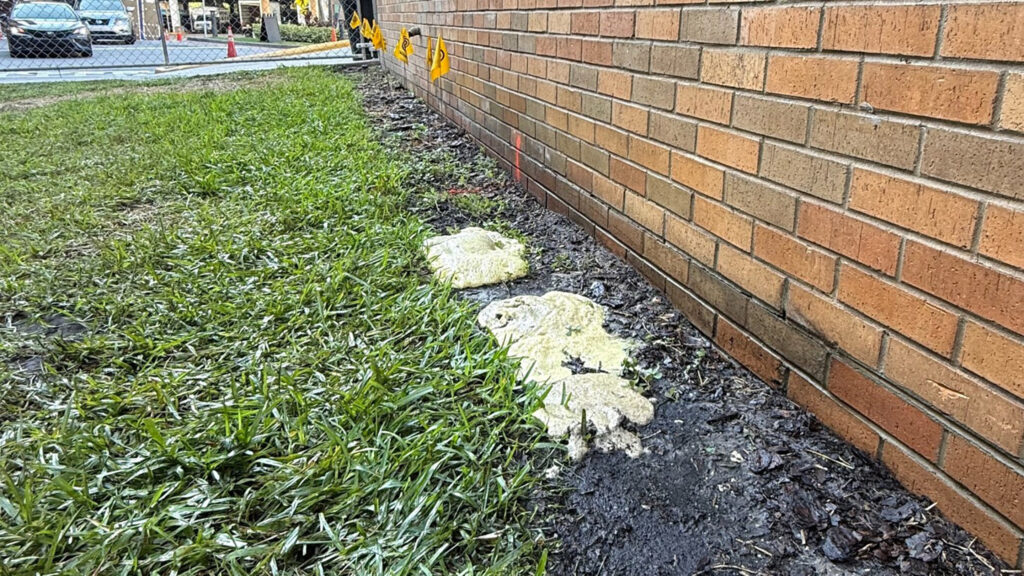
Helicon addressed the problem using a targeted polyurethane injection solution designed to strengthen weak soil zones, improve bearing capacity, and reduce future movement risk with minimal disruption to hospital operations. The installation included 68 injection points, real-time monitoring, and a non-invasive approach that avoided large-scale excavation or structural downtime. For commercial property leaders across Tampa, St. Petersburg, Clearwater, Sarasota, Bradenton, Lakeland, Orlando, Fort Myers, Naples, and surrounding Florida markets, this project reinforces an important lesson: the most effective foundation repair strategy is often the one that solves the soil problem before it becomes a structural crisis.
Why commercial foundation problems in Florida demand early action
Commercial buildings are heavy, complex, and unforgiving when support conditions change.
Florida properties often face a combination of challenges that make settlement and movement especially important to monitor closely. Buildings may sit on soils that vary significantly across short distances. Some areas may be relatively dense and stable, while others contain weak pockets, historic fill, poorly compacted zones, or moisture-sensitive material. Over time, those inconsistencies can reduce uniform load distribution beneath a structure. When that happens, small signs of distress begin to appear.
The warning signs can include:
- cracking at the base of walls
- slab or floor movement
- separation at joints
- distress near expansion areas
- recurring cosmetic repairs that never truly solve the issue
- concern about how an existing structure will perform when adjacent construction adds new load
Many owners delay action because the early signs do not always look dramatic. But in commercial settings, delay is often what turns a manageable stabilization project into a much larger repair program.
The better approach is to diagnose the cause early, understand the risk profile, and choose a repair method that aligns with the building, the site, and ongoing operations.
The hidden risk of building next to an existing structure
One of the most overlooked commercial risks is what happens when new construction is introduced beside an aging or already-settled building.
This was central to the Tampa General Hospital project. A new wall was planned next to an existing structure. Without first correcting the underlying soil conditions, the site risked uneven support between old and new structural elements. That can create differential settlement, cracking, joint separation, and future maintenance liabilities. In addition, the treatment had to be precise enough to avoid affecting nearby utilities or creating unnecessary cost through over-treatment.
This kind of situation is common across commercial Florida properties. Expansions, renovations, phased redevelopments, utility upgrades, and site improvements all change how loads are distributed. If the existing soils are inconsistent, new work can expose weaknesses that were quietly developing for years.
That is why commercial foundation repair is not just about fixing visible damage. It is about protecting future construction, preserving continuity, and ensuring structural reinforcement.
Why traditional repair methods are not always the best fit
When business leaders hear the phrase “foundation repair,” many picture excavation, demolition, heavy equipment, disruption, and extended schedules.
Sometimes those methods are necessary. But not every site can tolerate them, and not every problem requires them.
In active commercial environments, especially hospitals, repair methods must account for more than engineering performance. They must also account for noise, vibration, safety access, cleanliness, schedule compression, coordination with other trades, and the simple reality that the building often needs to keep operating while the work is being done.
At Tampa General Hospital, the site required a solution suited to an active healthcare environment. The case study specifically notes the need for low vibration methods, minimal noise, no excavation spoils, and controlled access and safety coordination. Traditional excavation or underpinning would have been more disruptive and operationally challenging.
That is a powerful point for commercial owners and project teams. The best repair strategy is not automatically the most invasive one. Often, the right solution is the one that delivers structural improvement while minimizing operational friction.
How polyurethane soil stabilization works in commercial settings
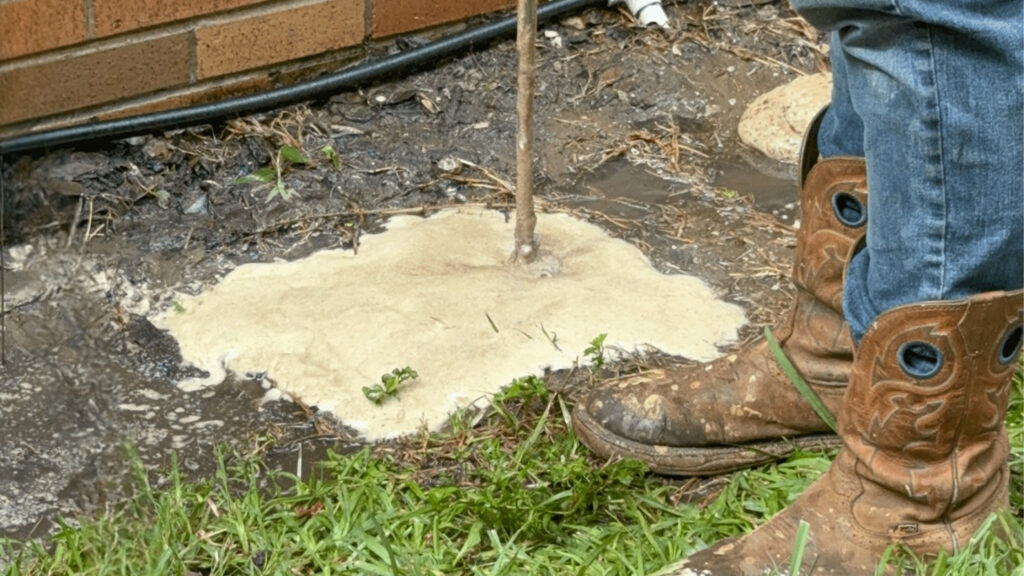
For the Tampa General Hospital project, Helicon used AP600 one-part polyurethane chemical grout for excavation support and structural soil stabilization. The material was selected because it can penetrate weak soil zones, expand in a controlled manner, increase soil density and bearing capacity, cure quickly, and minimize disruption to surrounding structures. The case study also notes that, unlike some traditional cementitious grouting approaches, AP600 does not introduce excessive dead load and can be precisely controlled in confined spaces.
In practical terms, that matters because commercial sites need solutions that are both effective and predictable.
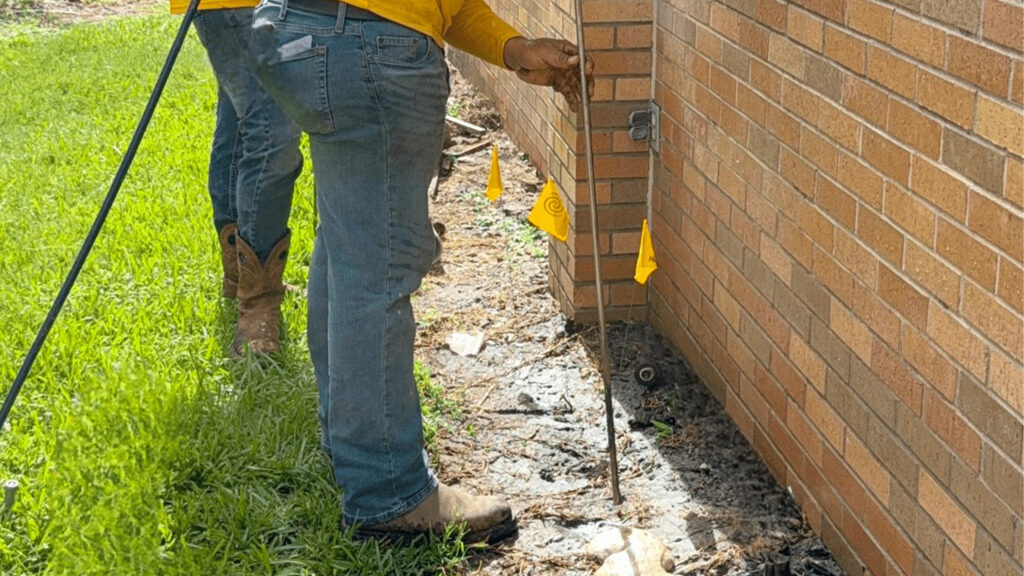
A polyurethane stabilization program typically allows contractors to target specific weak zones beneath or adjacent to a structure rather than broadly disturbing the entire area. Small-diameter injection ports are installed, the material is introduced under controlled pressure, voids and loose pockets are addressed, and bearing conditions improve as the material cures. At Tampa General Hospital, Helicon carefully mapped the injection locations in advance and monitored material take and ground improvement response in real time during installation.
For owners, engineers, and construction managers, this offers three major advantages:
First, it supports precision. Treatment can be directed where it is actually needed.
Second, it supports speed. In this project, the work was completed over four days, helping the team stay efficient while coordinating in a sensitive commercial environment.
Third, it supports continuity. At Tampa General Hospital, the work was performed in coordination with The Beck Group, and excavation proceeded afterward to confirm the site was properly stabilized for the next phase of work.
That sequencing is important. It shows this was not a cosmetic fix. It was part of a coordinated commercial construction strategy.
What caused the problem in the first place?
One of the strengths of this project is that it did not treat the symptoms alone. It addressed the root cause.
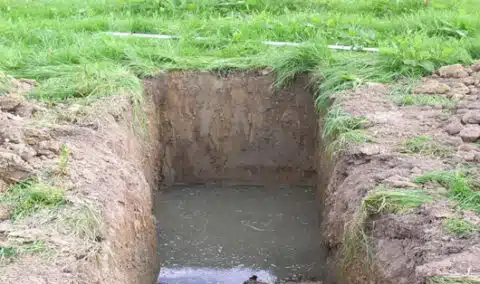
According to the case study, the subsurface conditions reflected dense but inconsistent soils, likely influenced by historic construction activity. Some areas were relatively compact, while others contained weak pockets that allowed settlement to occur over time. This kind of variability is common in aging commercial structures due to older compaction standards, construction staging, backfill variability, and long-term loading cycles.
That is a critical lesson for commercial property owners.
If a building shows cracking, movement, or distress tied to settlement, surface repairs alone rarely solve the real problem. Patching masonry, sealing cracks, or adjusting finishes may improve appearance temporarily, but they do not restore uniform support beneath the structure.
True long-term performance starts with the soil.
What commercial owners in Tampa, Orlando, and Southwest Florida should watch out for
Across Helicon’s core Florida markets, many commercial properties face similar structural questions, even if the symptoms appear different.
A hospital in Tampa may be managing risk around expansion and continuity. A multifamily development in Orlando may be seeing slab movement or distress tied to variable fill. An industrial site in Fort Myers may need foundation repair without interrupting operations. A commercial property in Naples may be evaluating settlement signs before renovation or acquisition.
The building types differ, but the decision framework is often the same:
- Are the signs cosmetic, or do they point to deeper soil movement?
- Is the issue isolated, or does it affect future construction and load transfer?
- Can the repair be executed with minimal disruption?
- Is the proposed solution treating the cause or just the symptoms?
- Does the contractor understand commercial coordination, safety, and structural performance?
These are executive-level questions. And they deserve executive-level answers.
Why Helicon’s approach matters
The Tampa General Hospital project illustrates what sophisticated commercial repair work should look like.
It was targeted. It was coordinated. It was engineered around the realities of an active site. And it aligned repair strategy with construction sequencing, instead of treating stabilization as an afterthought.
Helicon’s broader service capabilities also matter in that context. The case study describes Helicon as a Florida leader in soil stabilization, foundation repair, helical pier installation, concrete lifting, and sinkhole repair, serving commercial and healthcare clients with engineered solutions designed for long-term structural performance.
That breadth gives owners and project teams something valuable: a partner that can evaluate subsurface and structural risk from multiple angles rather than forcing every site into a one-size-fits-all fix.
The bottom line for commercial decision-makers
If your commercial property is showing signs of settlement, or if you are planning new construction near an existing structure, the smartest move is usually not to wait for the problem to become obvious to everyone else.
The smartest move is to investigate early, address the subsurface conditions directly, and choose a repair strategy that protects both the structure and the business operating inside it.
The Tampa General Hospital wall stabilization project is a strong example of that philosophy in action. Faced with existing settlement signs, future load concerns, and the operational demands of an active healthcare environment, Helicon delivered a controlled soil stabilization solution that improved support conditions, reduced structural risk, and kept the site moving forward.
For commercial owners and developers across Tampa Bay, Orlando, Fort Myers, Naples, and throughout Florida, that is the takeaway: foundation repair is not just about fixing a problem. It is about protecting the future performance of your asset from the ground up.
Need soil stabilization before your next commercial expansion?
If you’re planning new construction next to an existing building—or if your property is already showing signs of settlement—Helicon can help.
Our team specializes in:
- Commercial foundation repair
- Soil stabilization solutions
- Polyurethane injection systems
From hospitals and healthcare campuses to office buildings, industrial facilities, and other commercial properties, Helicon delivers engineered solutions designed for Florida’s unique soil conditions.
Whether your project is in Tampa, St. Petersburg, Clearwater, Sarasota, Orlando, Fort Myers, or Naples, our team can help you reduce settlement risk and protect your structure before problems grow more costly.
Schedule a free foundation inspection today and speak with our team about the best solution for your project. Call 844-Helicon or visit HeliconUSA.com.