
Tampa, FL
The Project
The Challenge
The Solution
FREE INSPECTION REQUEST

Market: Residential
Solution: Push Piers, Two-Part Structural Polyurethane Injections (Soil and Slab)
Services: Foundation Repair
The most visible problem at this Tampa home was stair-step cracking on the right side of the structure.
Stair-step cracks typically follow masonry joints in a pattern that resembles a staircase. While not every crack automatically means a home has a serious structural problem, this type of cracking can be associated with differential movement when one part of the foundation moves differently from another.
The homeowner wanted the affected area evaluated because the right side appeared to have settled enough that some improvement in elevation was desired.
The original goal was straightforward: support the affected portion of the house, attempt a controlled lift, and address the underlying structural condition rather than simply patching the visible cracks.
However, the project became more strategic once Helicon also identified cracking on the left side of the home.
That side hadn’t reached the same condition as the right, but it showed enough distress that waiting for the cracking to worsen would have meant letting another part of the home keep moving before taking action.
Because the homeowner planned to remain in the property for the long term, supporting that area earlier made sense.
Instead of treating only the worst visible symptom, the repair plan considered how to protect the home more comprehensively.
Stair-step cracking is one of the most common symptoms homeowners associate with foundation settlement.
The crack itself does not always identify the exact cause. Still, when it develops alongside other signs of movement, it should be evaluated before being covered with paint, mortar, stucco, or other cosmetic repairs.
Foundation-related movement can sometimes produce:
The Tampa homeowner made the right decision by addressing the structural concern before focusing only on appearances.
A crack repair may make a wall look better, but cosmetic work does not provide additional support beneath the foundation.
Professional foundation repair focuses first on the structural condition and then allows the homeowner to complete cosmetic restoration afterward.
One of the strongest aspects of this project was the decision to address an area that had not yet progressed as far as the right side.
The left side was also beginning to show cracking, and Helicon recommended supporting that area before it developed into a condition similar to the more affected side.
This is an important lesson in foundation maintenance.
Homeowners often wait until a crack becomes large, a wall visibly shifts, or a floor noticeably slopes before taking action. But foundation problems are generally easier to manage when they are evaluated early.
The homeowner intended to keep this house for the future, which made a proactive approach especially appropriate.
Rather than thinking only about what the home looked like today, the repair strategy focused on preserving structural performance over time.
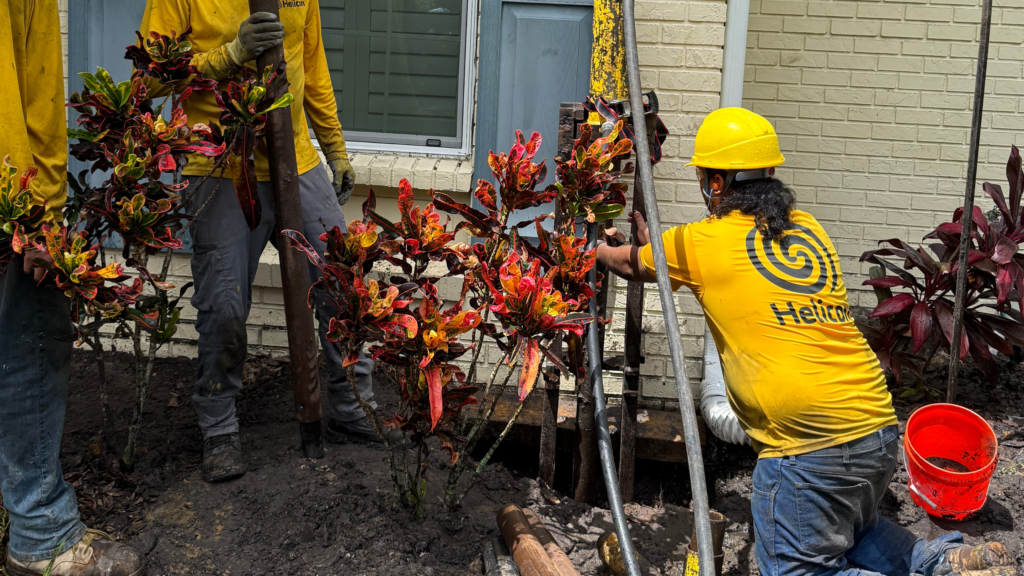
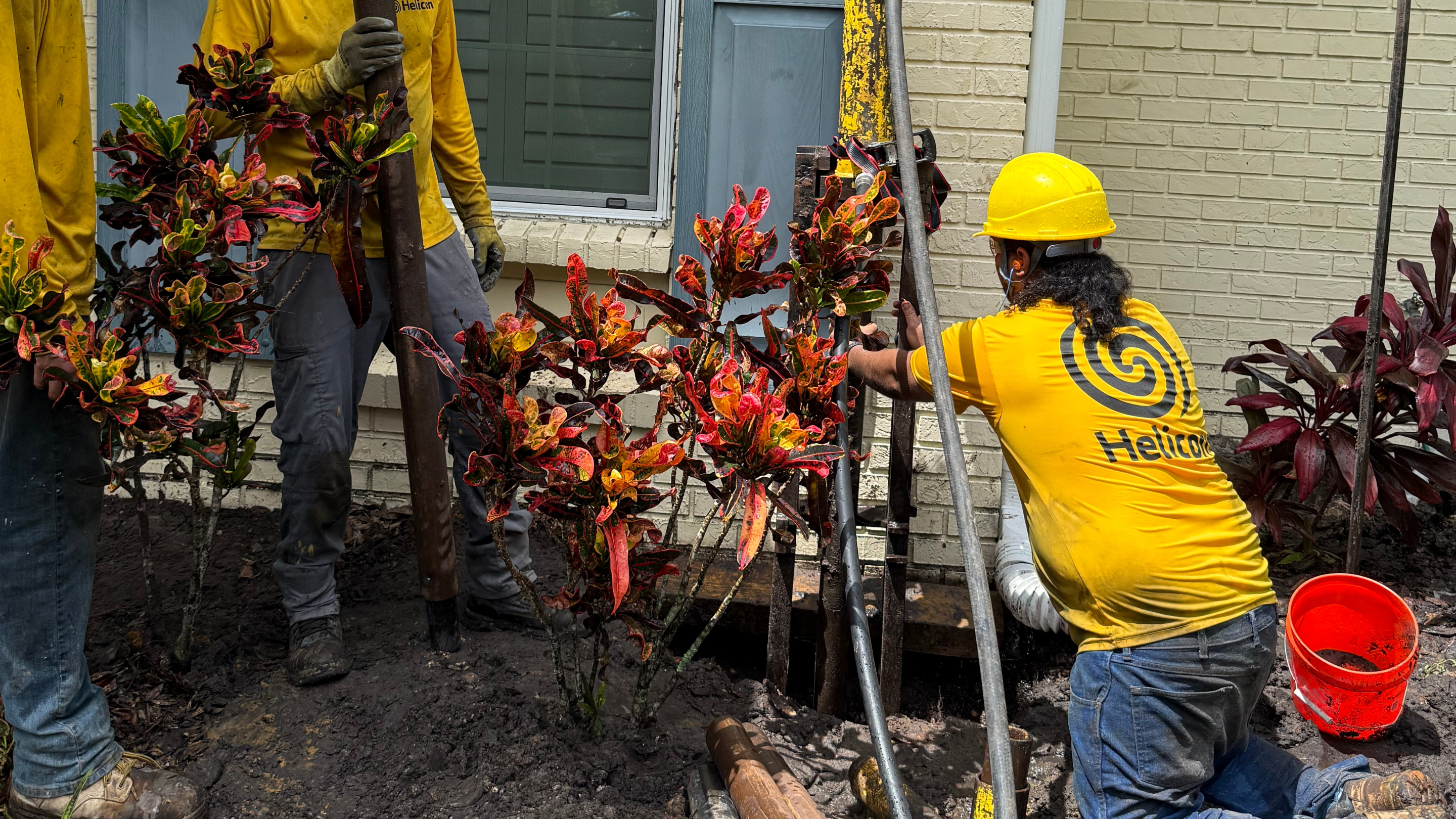
The primary field challenge involved accessing the footer for the underpinning installation.
The soil surrounding the foundation was particularly tough, making it more difficult to reach the required footer location.
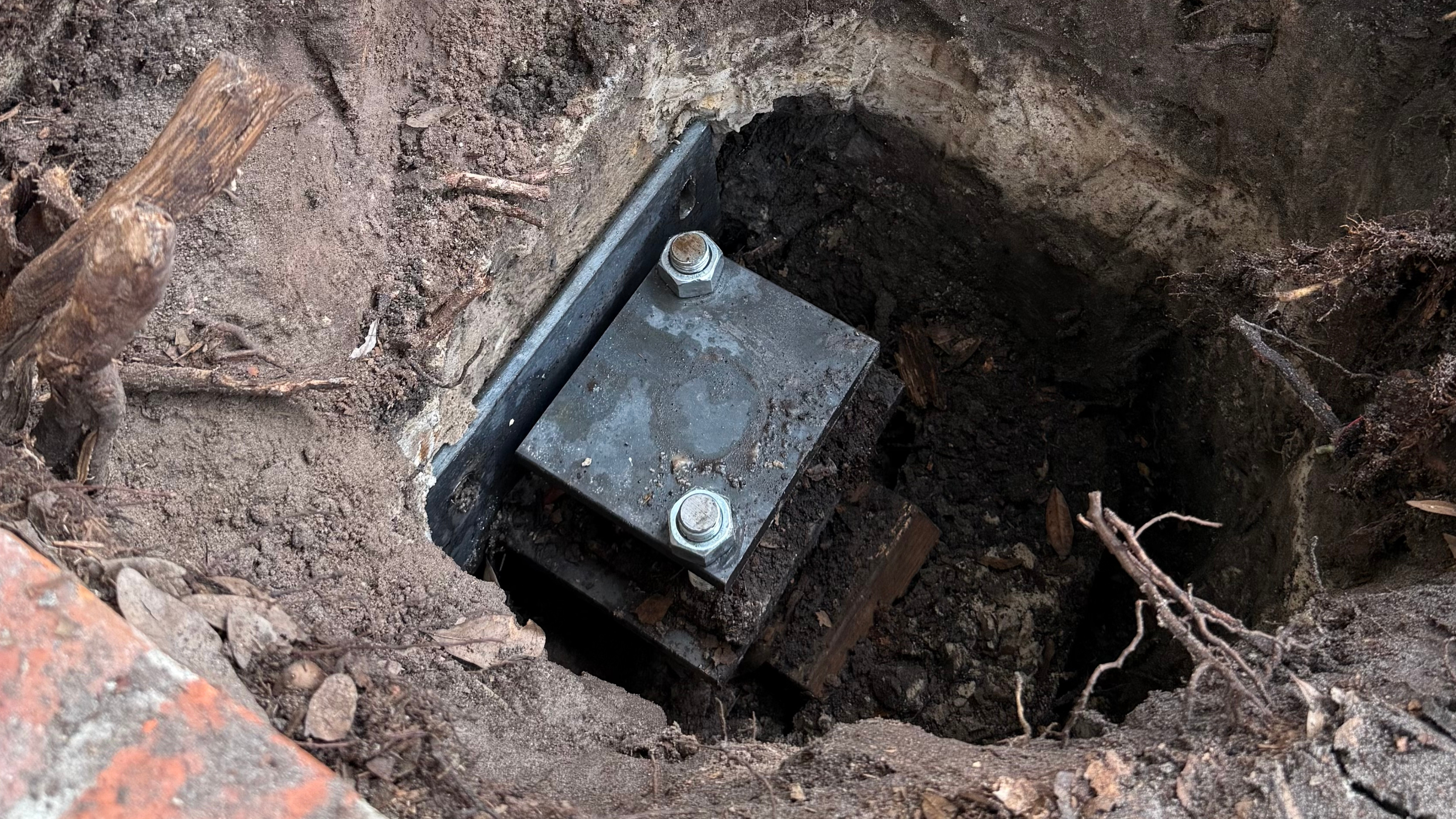
Push pier systems need to connect properly to the foundation so the structural load can be transferred into the pier system. That means the crew must expose and prepare the correct portion of the footer before installing the underpinning components.
When the surrounding material is unusually difficult to excavate, that process can require additional effort and careful field work.
The challenge was not a change in the structural design. It was a practical installation obstacle.
Despite the tough soil conditions, Helicon’s crew was able to reach the footer and complete the planned underpinning work.
This is the kind of field condition that illustrates why foundation repair depends on more than the product itself. Successful installation also requires experienced crews that can adapt to site conditions while still following the intended repair design.
Helicon installed 4 push piers in the affected foundation area.
Push piers are used in foundation underpinning when a section of a home requires deeper structural support.
Rather than relying only on the near-surface material that has already allowed settlement to occur, push piers provide a new support path for the affected portion of the foundation.
For this Tampa project, the push piers served two main purposes:
The use of push piers made sense because the homeowner wanted more than stabilization alone. The goal included recovering some of the settlement where the structure responded safely.
After the push piers were installed, Helicon completed a simultaneous lift across approximately 13 linear feet.
A simultaneous lift helps distribute movement more evenly along the treated section rather than concentrating force at one isolated location.
The objective was to improve the position of the affected foundation while continuously monitoring the structure’s response.
In professional foundation repair, lift should never be treated as an unlimited process.
A settled home has often adjusted to its position over time. Walls, framing, finishes, windows, doors, plumbing, and other building elements can all respond differently as elevation changes are introduced.
For that reason, the correct objective is a controlled lift, not a promise to return every component of the home to an exact original position.
The structural value of the repair came from the new underpinning support and the controlled improvement of the affected area.
The term underpinning refers to adding structural support beneath an existing foundation.
It is frequently used when part of a home has settled and the existing support conditions are no longer considered sufficient for that area.
For this home, the push piers became the deeper-support component of the overall repair plan.
Underpinning was particularly valuable because it allowed Helicon to:
This is what separates structural foundation repair from cosmetic crack repair.
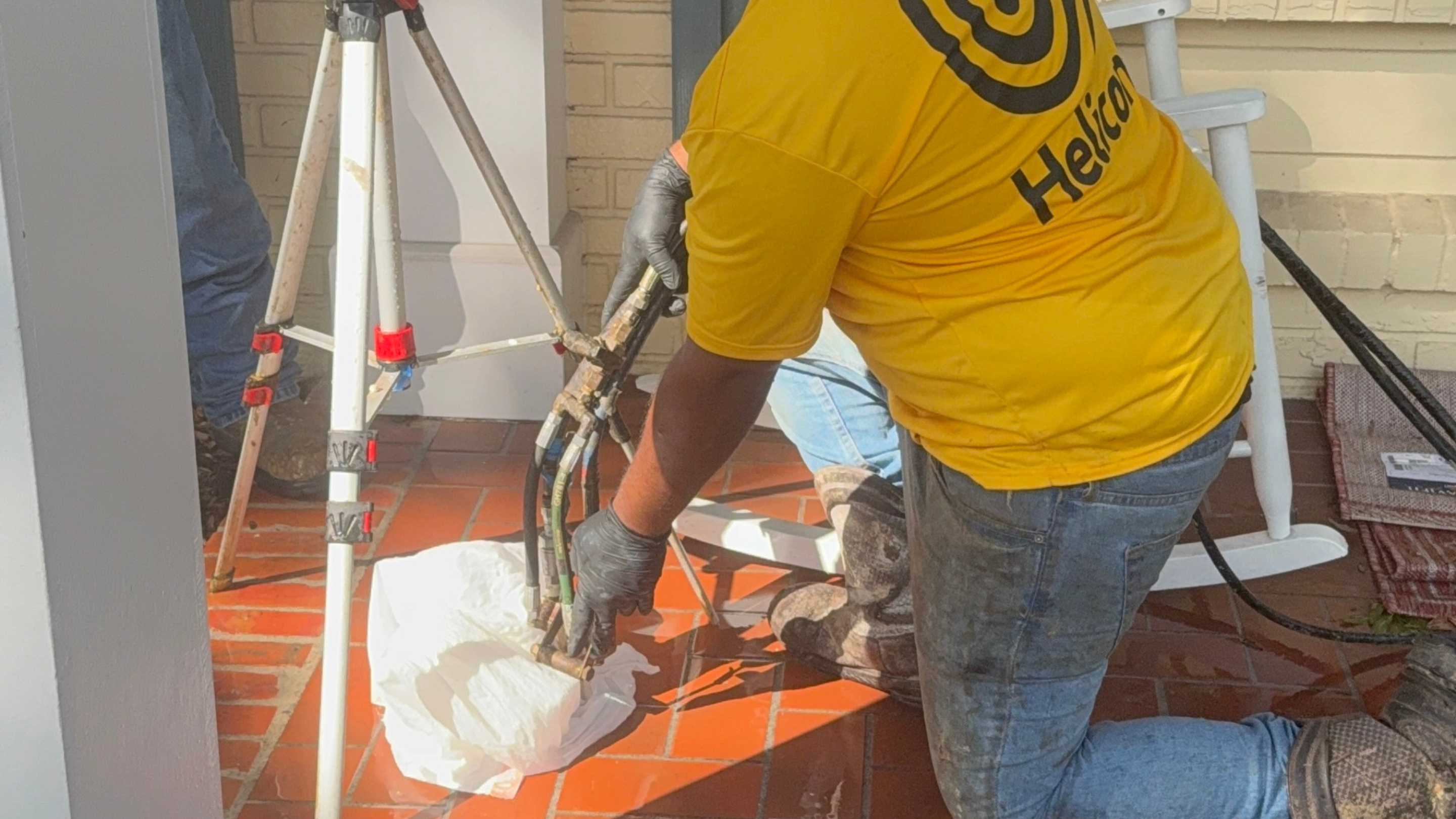
After the push pier portion of the repair, Helicon completed structural polyurethane injections.
The soil-injection scope consisted of:
These injections were used to improve support in the designated treatment areas surrounding the foundation and slab.
The polyurethane reacts after installation and expands within available voids or weaker support zones.
For this project, the injections complemented the push pier system by addressing areas where broader support improvement was beneficial but where additional underpinning was not part of the final scope.
The soil-injection portion helped:
Helicon also installed 44 pounds of two-part structural polyurethane beneath the slab.
The slab injections served a different but related purpose.
While the push piers provided deeper support to the foundation and the soil injections treated designated support zones, the slab injections focused on improving bearing directly beneath the concrete slab.
This helped create a more complete repair system. The project therefore used three layers of structural support:
Deep structural support beneath the affected foundation.
Targeted stabilization in the designated support zones.
Improved contact and support immediately beneath the concrete slab.
Each method addressed a different part of the structural problem.
Key project benefits included:
No contractor should guarantee that a home will never experience movement again. Soil conditions, moisture, drainage, weather, and other factors can change over time.
However, the completed repair substantially improved the structural support within the treated areas.
Foundation problems often begin with small warning signs.
A stair-step crack may seem minor at first. But when movement continues, the condition can become more noticeable and more expensive to address.
Homeowners in Tampa should consider a foundation evaluation when they notice:
Not every home with a crack needs underpinning.
Some properties may need monitoring. Others may benefit from structural polyurethane. Some may require push piers, helical piers, or another form of foundation underpinning.
The correct solution depends on the structure and observed conditions.
Helicon helps Florida homeowners and property owners address foundation settlement, structural movement, sinking concrete, seawall erosion, and other support-related concerns.
Our team works with homeowners, contractors, property managers, and commercial clients to develop repair solutions based on the structure, observed conditions, engineering requirements, and project objectives.
If you are seeing stair-step cracking, foundation settlement, uneven floors, or structural movement around your Tampa home, addressing the underlying condition before cosmetic repairs can help protect your investment.
Helicon provides foundation repair, foundation underpinning, push pier installation, structural polyurethane stabilization, concrete lifting, seawall repair, and related structural services throughout Tampa Bay and communities across Florida.
Call 844-HELICON to schedule a free inspection and learn which foundation repair approach may be appropriate for your property.
FREE INSPECTION REQUEST