- Helicon
- 9
- Port Charlotte Pre-Construction Foundation Support: Helical Piers Help Protect a New Two-Story Home From Future Settlement
Port Charlotte Pre-Construction Foundation Support: Helical Piers Help Protect a New Two-Story Home From Future Settlement
Port Charlotte, FL
Market: Residential
Solution: Galvanized Steel Helical Piers
Services: Pre-Construction Foundation Support
The Project
The project involved a family preparing to construct a two-story residence in Port Charlotte, Charlotte County.
Before the first block was laid, concerns were raised about the ability of the site soils to provide the desired foundation support for the planned structure.
Rather than moving forward and hoping the shallow support conditions would perform as expected, the homeowners elected to incorporate helical piers into the project before vertical construction began.
That decision fundamentally changed the nature of the work.
Typical warning signs may include:
- Stair-step cracking in masonry
- Cracks in interior drywall
- Uneven or sloping floors
- Doors or windows becoming difficult to operate
- Separation between building materials
- Settlement along one side or corner of a home
None of those conditions needed to develop before this project moved forward.
The homeowners chose prevention-oriented foundation support instead of waiting for a completed house to require corrective work.
Why Pre-Construction Foundation Support Can Be So Valuable
Once a home is finished, structural repairs become more complicated.
A foundation contractor may have to work around:
- Exterior walls
- Finished flooring
- Landscaping
- Driveways and patios
- Plumbing and utilities
- Interior finishes
- Occupied living areas
By comparison, pre-construction work provides greater access to the future foundation footprint.
That allows the construction team to install deep foundation components before the house, finishes, landscaping, and surrounding improvements are in the way.
For the Port Charlotte homeowners, incorporating helical piers from the beginning meant that the foundation system could be built around those supports rather than retrofitted around a completed structure later.
It is an important difference.
Foundation repair fixes or stabilizes an existing structural problem. Pre-construction support is intended to reduce the risk of that problem developing in the first place.
The Challenge
Variable Subsurface Conditions
Nearer the surface, the soils were described as relatively loose and sandy. Deeper layers created greater resistance during pier installation.
That meant the crew could not approach every pier as though subsurface conditions would be identical from one location to the next.
Helical piers are advanced by rotating them into the ground. As the pier moves deeper, installation resistance provides important information about the material the helix plates are encountering.
The objective is to establish the required support within suitable bearing material according to the project design and installation criteria.
For this Port Charlotte project, some piers extended to depths of up to approximately 25 feet.
That depth illustrates why evaluating the soil below the future footing is so important.
What appears stable at ground level does not necessarily tell the complete story of the support conditions below.
The Solution
Galvanized Steel Helical Piers
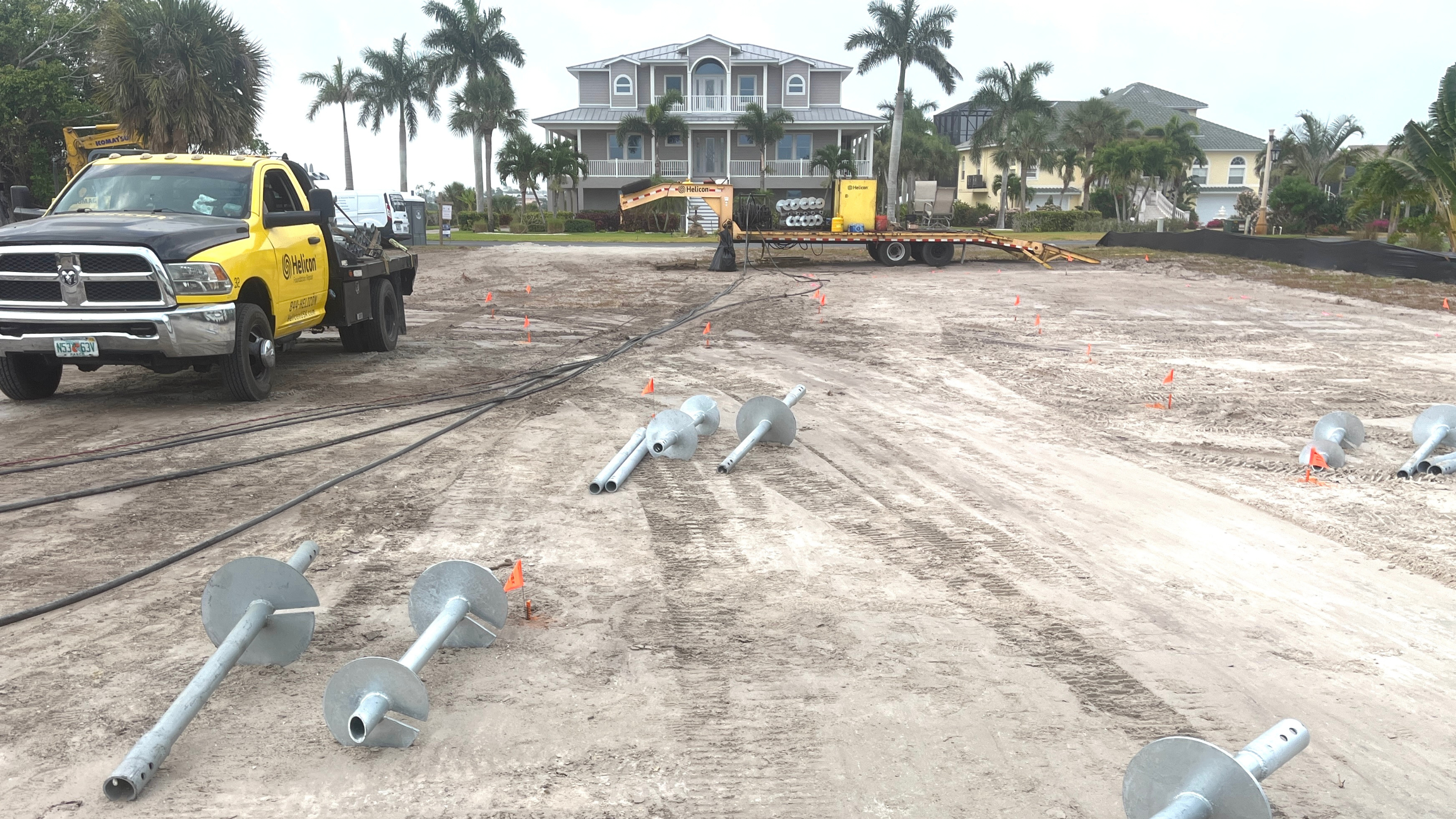
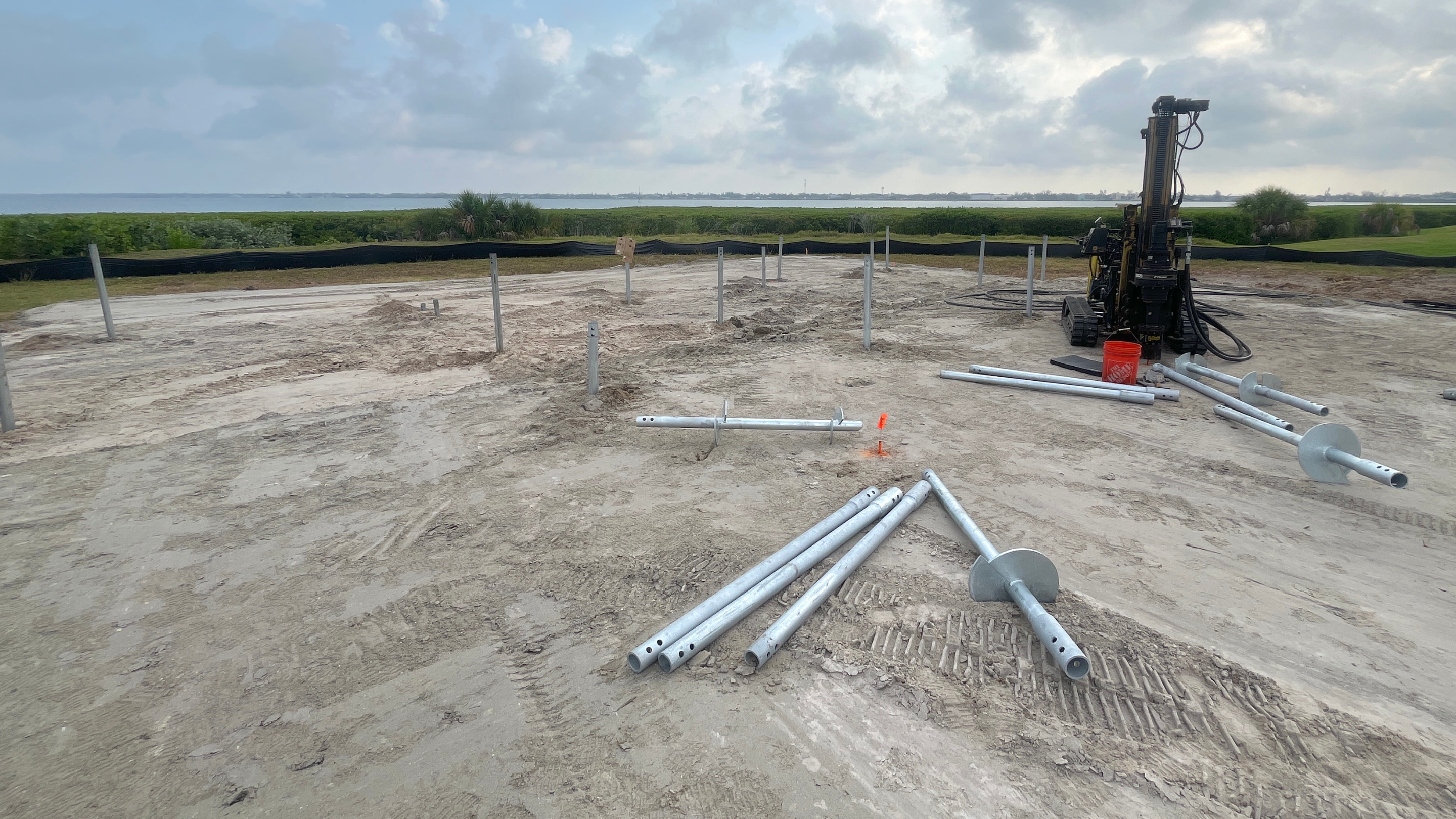
Helicon installed 77 galvanized steel helical piers across the future home’s foundation footprint.
The piers were advanced to depths reaching up to approximately 25 feet, where the installation could engage more competent load-bearing material.
Galvanization was also significant for a Florida project because it provides additional corrosion protection for the steel components.
After installation, the piers were fitted with foundation brackets designed to integrate with the concrete footings during construction.
This allowed the deep-foundation system and the new home’s foundation to work together from the beginning.
Rather than building the house first and later attempting to strengthen the foundation, the structural support was incorporated directly into the construction process.
How Helical Piers Work
A helical pier is a steel foundation element with one or more helix-shaped plates attached to the shaft.
The pier is mechanically rotated into the ground.
As it advances, the helix plates move through the soil until the pier reaches the conditions required by the project design and installation criteria.
Once installed, the system can help transfer structural loads away from weaker or less dependable shallow material and into deeper supporting strata.
For new construction, this can create a direct load path between the future structure and the deeper foundation-support system.
That is why helical piers can be used both for new construction and for certain foundation repair and underpinning applications.
The underlying technology is similar, but the timing and purpose are different.
What Is Underpinning?
The term underpinning is frequently used in foundation repair, so the distinction is worth explaining.
Traditional underpinning generally refers to strengthening or stabilizing the foundation of an existing structure.
For example, if one corner of a completed home settles, a contractor may install push piers or helical piers beneath the existing footing to provide deeper support. That would commonly be described as foundation underpinning.
This Port Charlotte project was different because the house was still being constructed.
Technically, the work is better described as pre-construction deep foundation support using helical piers rather than corrective underpinning.
However, homeowners researching “foundation underpinning in Port Charlotte” or “foundation repair with helical piers” may encounter the same technology.
The important difference is that this family installed the system before settlement damage developed, not afterward.
Why Proactive Foundation Planning Matters in Southwest Florida
Port Charlotte sits within one of Helicon’s major Southwest Florida service regions.
New construction continues throughout communities including:
- Port Charlotte
- Punta Gorda
- North Port
- Cape Coral
- Fort Myers
- Estero
- Bonita Springs
- Naples
Subsurface conditions can vary significantly from property to property.
That is why the correct foundation strategy should be based on the actual project, structural design, and site conditions rather than assumptions about an entire city or neighborhood.
For some homes, conventional shallow foundations may be appropriate.
For others, additional foundation-support measures may be recommended.
The Port Charlotte homeowners chose to address those considerations before construction rather than after the home was completed.
Foundation Brackets Connected the Pier System to the Future Footings
Installing the piers was only part of the process.
Once the helical piers reached their required support conditions, they were prepared to integrate with the home’s future foundation.
That connection is essential.
A deep foundation element is useful only if the structural load can be transferred into it effectively.
The bracket and footing system creates that connection between the building above and the helical pier below.
This allows the pier system to become part of the home’s engineered foundation rather than functioning as an isolated underground component.
Why This Was a Strategic Investment
The biggest advantage of the project was not that Helicon repaired severe structural damage.
It was that the homeowners acted before severe structural damage existed.
By installing the helical piers during construction, they were able to:
- Incorporate deep foundation support into the original build
- Reduce reliance on less dependable shallow soils
- Avoid retrofitting piers around a completed residence
- Give the two-story home a more robust structural support system
- Reduce the risk of settlement-related foundation problems associated with the treated support condition
That does not make the system immune to every future structural issue.
It does, however, create a stronger starting point than knowingly building over support conditions that had already raised concerns.
Results and Project Benefits
The completed Port Charlotte foundation-support project included:
- 77 galvanized steel helical piers
- Installation depths reaching up to approximately 25 feet
- Deep foundation support across the future building footprint
- Foundation brackets prepared for integration with the concrete footings
- A proactive structural-support strategy completed before construction of the two-story home progressed
The principal result was a foundation design that no longer relied solely on the shallower support conditions that had concerned the homeowners.
Instead, the future structure gained a deep-foundation system designed to transfer loads into more competent supporting material.
For the homeowners, that meant addressing foundation risk at the point when access was easiest and before settlement-related cosmetic or structural repairs became necessary.
About Helicon
Whether you are planning a new home or dealing with settlement in an existing structure, the right foundation solution starts with understanding the support beneath the building.
Helicon provides foundation repair, underpinning, helical pier installation, push pier systems, pre-construction foundation support, soil stabilization, concrete lifting, and related structural solutions throughout Port Charlotte, Charlotte County, Southwest Florida, and communities across the state.
For an existing structure, foundation underpinning may be used to provide deeper support beneath settled sections of a home or commercial building.
For new construction, helical piers can be incorporated into the foundation design before settlement damage ever develops.
Call 844-HELICON to schedule an evaluation or pre-construction consultation.
FREE INSPECTION REQUEST