
Plant City, FL
The Project
The Challenge
The Solution
FREE INSPECTION REQUEST

Market: Commercial
Solution: Foundation Repair
Services: Helical Piers / Deep Foundation Support System
The building involved in this project was an older concrete commercial structure in Plant City that had started to show the early but important warning signs of settlement. The visible symptom was light stair-step cracking on the wall, but the underlying issue was not the crack itself. The real problem was below the foundation, where loose sandy soils were no longer providing the kind of support the building needed over time.
For commercial property owners, these early signs are especially important. Commercial buildings often carry repeated live loads, operational use demands, and long-term ownership responsibilities that make foundation movement more than just a maintenance issue. Once the structure begins to settle, the consequences can extend beyond a single wall crack to broader building performance concerns.
That is why the owner chose to act before the movement worsened. The goal was to get the building back on solid ground and install a support system capable of carrying the load safely past the weak upper soils.
Stair-step cracking in a masonry or concrete wall is one of the most familiar warning signs in foundation repair. It often indicates that one portion of the structure is moving differently than another, which is exactly what happens when bearing conditions beneath the foundation become inconsistent.
In this Plant City building, the cracking was still relatively light, but that did not make it harmless. Small stair-step cracking often marks the stage where a structure is telling you something important early enough to still address it strategically. If that message is ignored, the distress can become more obvious, more expensive, and far more disruptive to correct.
By acting while the signs were still early, the owner gave the project a much better chance of staying focused on stabilization instead of emergency correction.
One of the most important details from the field notes is that the building was founded over weak, loose, sandy soil. This is a common challenge in Florida, where near-surface sands may be easy to build over initially but can become unreliable when long-term support, moisture variability, and structural loads interact over time.
For this building, the shallow soils were no longer sufficient. The repair needed to bypass them altogether. That is exactly what a deep foundation system is built to do.
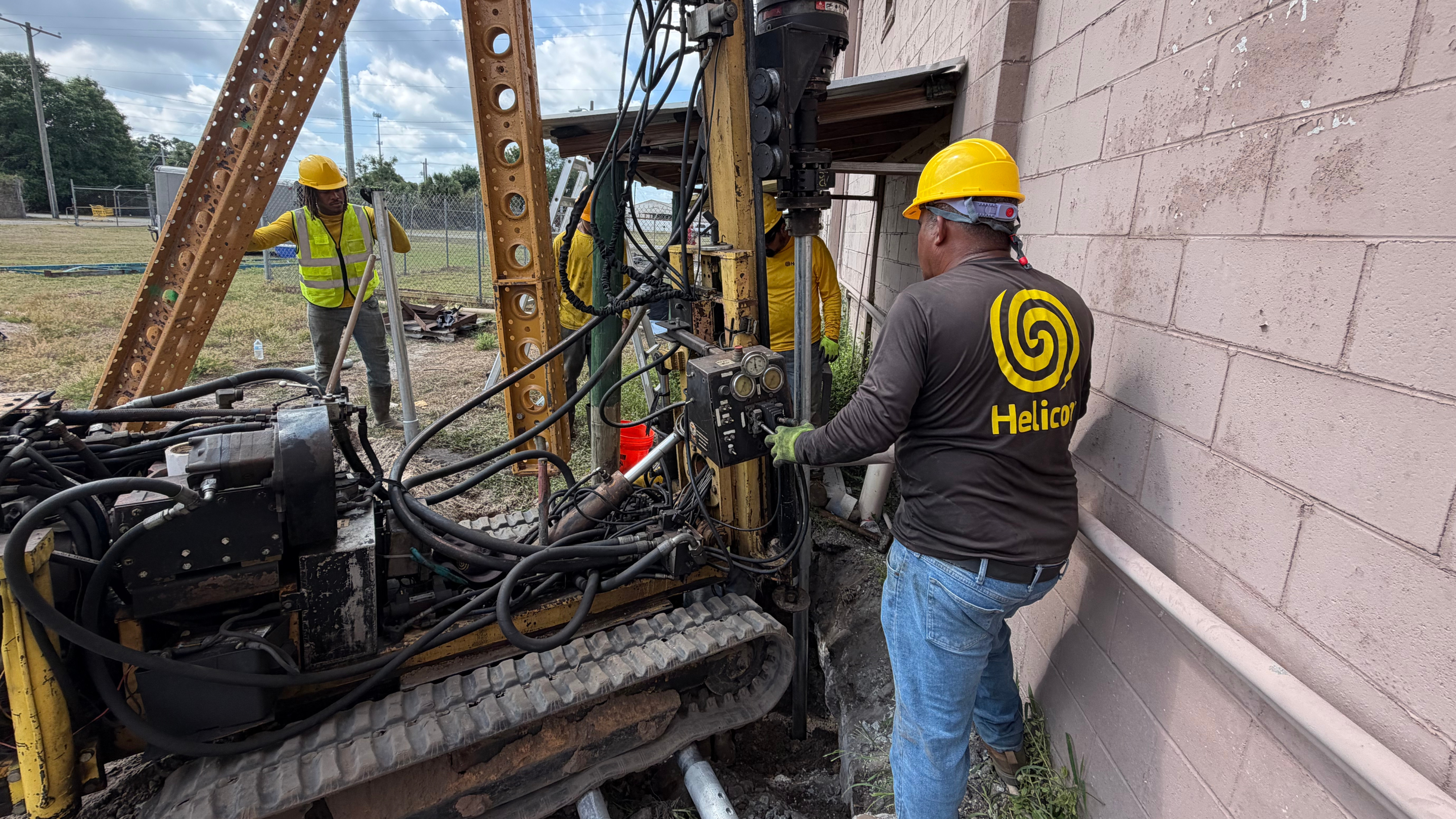
The project also revealed a practical construction reality: the crew encountered very thick concrete at the foundation edge. That meant the installation was not just about advancing helical piers into the ground. It also required substantial preparation at each location so the brackets could be properly attached to the foundation once the piers were in place.
This project came with two major field challenges that shaped how the work had to be executed.
The first challenge was the amount of concrete the team had to work through. Helicon found very thick concrete that had to be removed or opened to attach the brackets to the foundation. That added labor, equipment time, and precision requirements to every pier location.
The second challenge was depth. This was not a project where shallow installation would be enough. The helical piers had to be advanced deep enough to reach the critical load-bearing strata that could actually support the building. On this project, that meant installing piers down to 50–60 feet and confirming suitable resistance at 6,000 foot-pounds of torque.
If the crew had failed to reach those depths, the building would still have been depending on weak upper soils. In other words, this was a job where accuracy mattered more than speed. Each pier had to be installed correctly, each hole had to be prepared properly, and each bracket had to be fixed into place with the full deep-support strategy in mind.
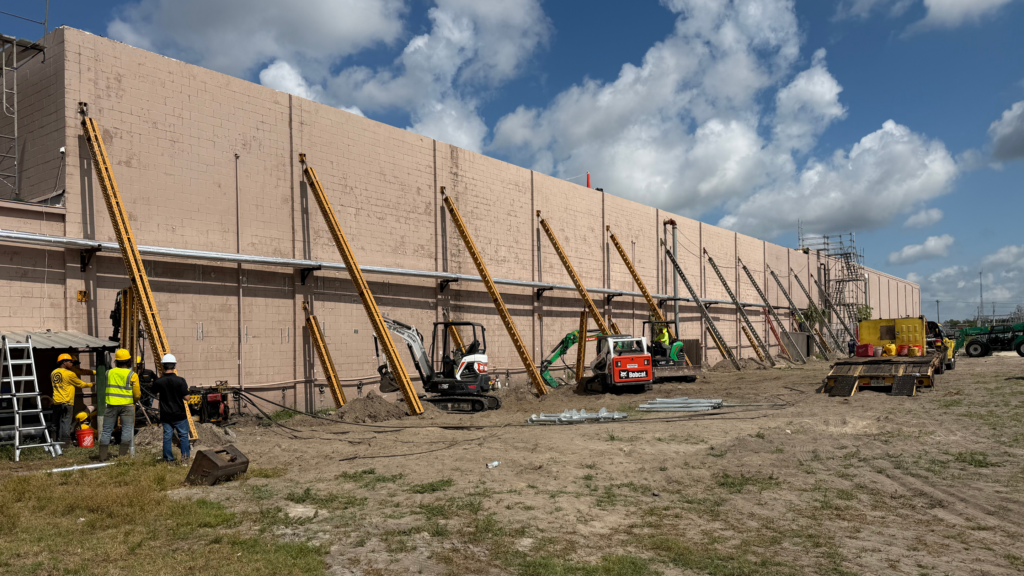
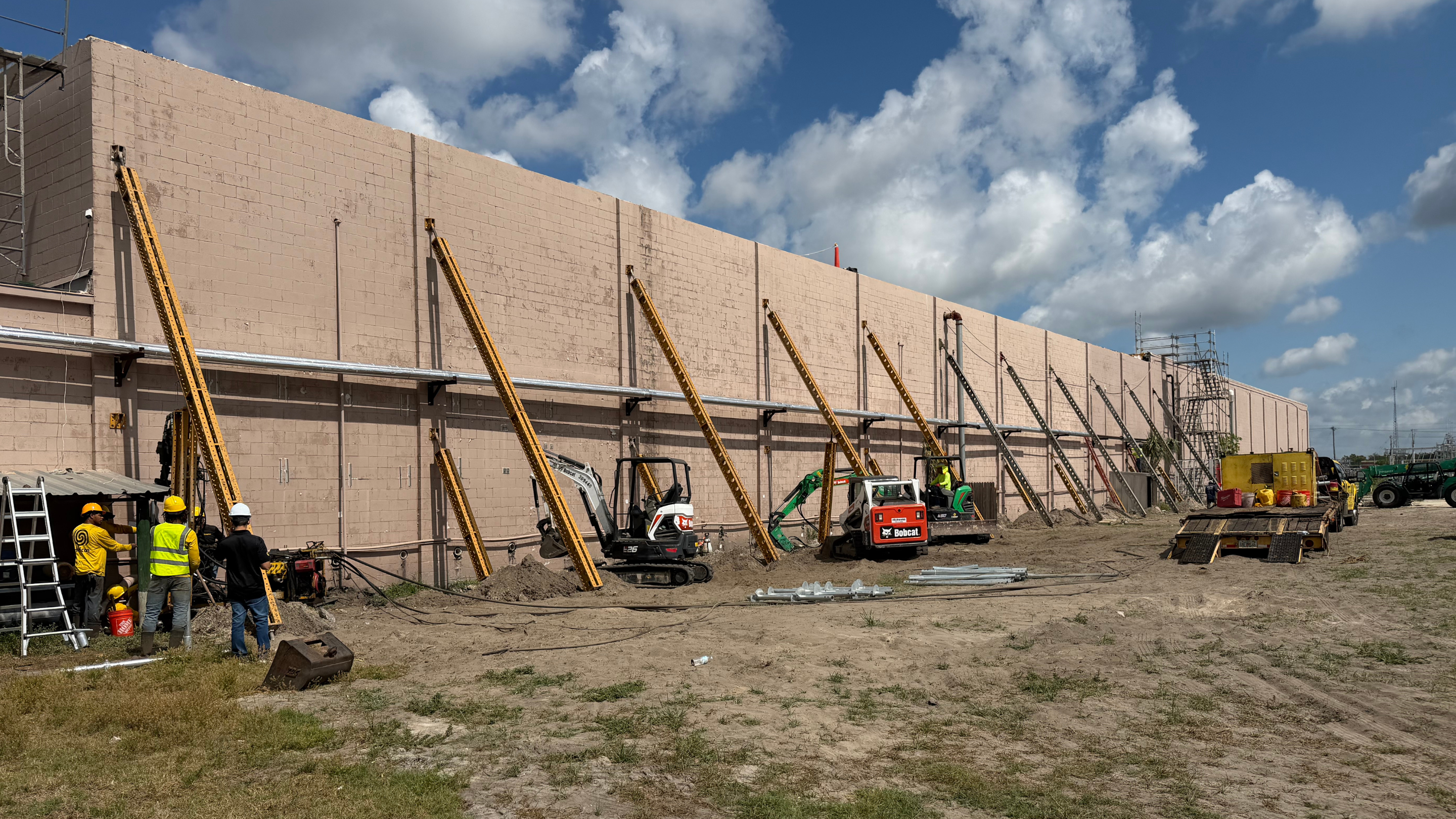
Helicon’s solution was to install 32 helical piers along the affected length of the wall through underpinning. These piers were designed to create a new load path for the building, one that bypassed the unstable shallow sands and transferred the structure’s weight into deeper, more competent soils.
The process followed a clear sequence:
Once a pier had been inserted to the correct depth, the team would slide a steel bracket underneath and fix it into place to support the foundation. That sequence was repeated down the length of the wall until the building had a continuous deep-support system where it was needed most.
This type of repair is highly effective because it does not require the weak soil to be improved. Instead, it removes the building’s dependence on those weak soils by creating a new, deeper support system.
On large helical pier projects, success depends on repetition without shortcuts. Every pier location must be treated with the same precision, even when the job involves dozens of placements. That is especially true with older commercial buildings, where each support point contributes to the overall performance of the wall line.
Once the project was complete, the building had a much stronger structural support condition than before.
Most importantly, the project did not just hide the symptoms of movement. It corrected the support condition at the source.
This project worked because the repair method matched the real cause of the problem. The building was not failing because of one visible crack. It was settling because the shallow soils could not be trusted to carry the load reliably anymore.
Helical piers were the right solution because they gave the building something entirely new: a deep, engineered support path that no longer depended on the weak sand near the surface. That is why the project could honestly be described as putting the building “back on solid ground.”
If your commercial or residential building is settling, cracking, or showing early signs of foundation movement, Helicon can help. Whether your project needs helical piers, push piers, micropiles, or another deep foundation support system, our team can evaluate the structure and develop the right solution for your site.
Call 844-HELICON to schedule your free inspection and learn how Helicon can help put your structure back on solid ground.
FREE INSPECTION REQUEST