- Helicon
- 9
- Cape Coral Interior Floor Stabilization and Lift: Two‑Part Polyurethane Soil and Slab Injections
Cape Coral Interior Floor Stabilization and Lift: Two‑Part Polyurethane Soil and Slab Injections
Cape Coral, FL
Market: Residential
Solution: Concrete Repair & Soil Stabilization
Services: Two Part Polyurethane Injections (Soil and Slab Support/Lift)
The Project
Property Type: Single‑family residence
Location: Cape Coral (Lee County), in an established neighborhood with typical sandy subgrade and seasonal groundwater variation.
Owner Goals:
- Stop ongoing settlement at the interior slab areas.
- Re‑establish uniform support under finished floors.
- Attempt concrete lifting where feasible to reduce trip edges and improve doors/trim.
- Avoid invasive methods and keep the home usable during work.
Observed Conditions (Pre‑Work):
- Uneven thresholds between rooms and subtle trip edges.
- Localized hairline cracks and grout separations.
- Doors binding at the top/bottom—signs of racking related to slab movement.
- No evidence of plumbing leaks or broad karst activity; symptoms were localized to slab support rather than deep sinkhole behavior.
The Challenge
Interior slab recovery projects succeed when we balance expectations, engineering control, and occupied‑home logistics.
- Lift is never guaranteed. The chief objective is stability—closing voids and restoring contact. If the slab and soils respond uniformly, we pursue measured lift using short, metered foam shots while monitoring finishes and thresholds in real time.
- Multiple mechanisms can overlap. Loose sands, organics from past landscaping, variable backfill, and seasonal moisture swings all contribute to support loss. The plan must both fill voids and tighten the soil matrix to reduce future movement drivers.
- Low‑impact delivery. Work must protect finishes and maintain safe pathways: small ports, compact gear, rapid cure, dust/odor control, and tidy housekeeping at day’s end.
The Solution
Two‑Part Polyurethane, Soil + Slab Injections
Helicon deployed a two‑tier injection strategy:
1) Soil Injections
We advanced injection probes into the influence zone that directly supports the slab (generally within the top 2–3 feet). The two‑part foam flows to low‑resistance pathways (voids, loose pockets, decayed organics) and expands to re‑couple grains, creating a denser, more uniform bearing layer.
Benefits:
– Fills hidden voids and locks soils together
– Adds minimal dead load (lighter than cementitious fills)
– Moisture‑tolerant and inert after cure
2) Slab Injections (Void Fill + Controlled Lift)
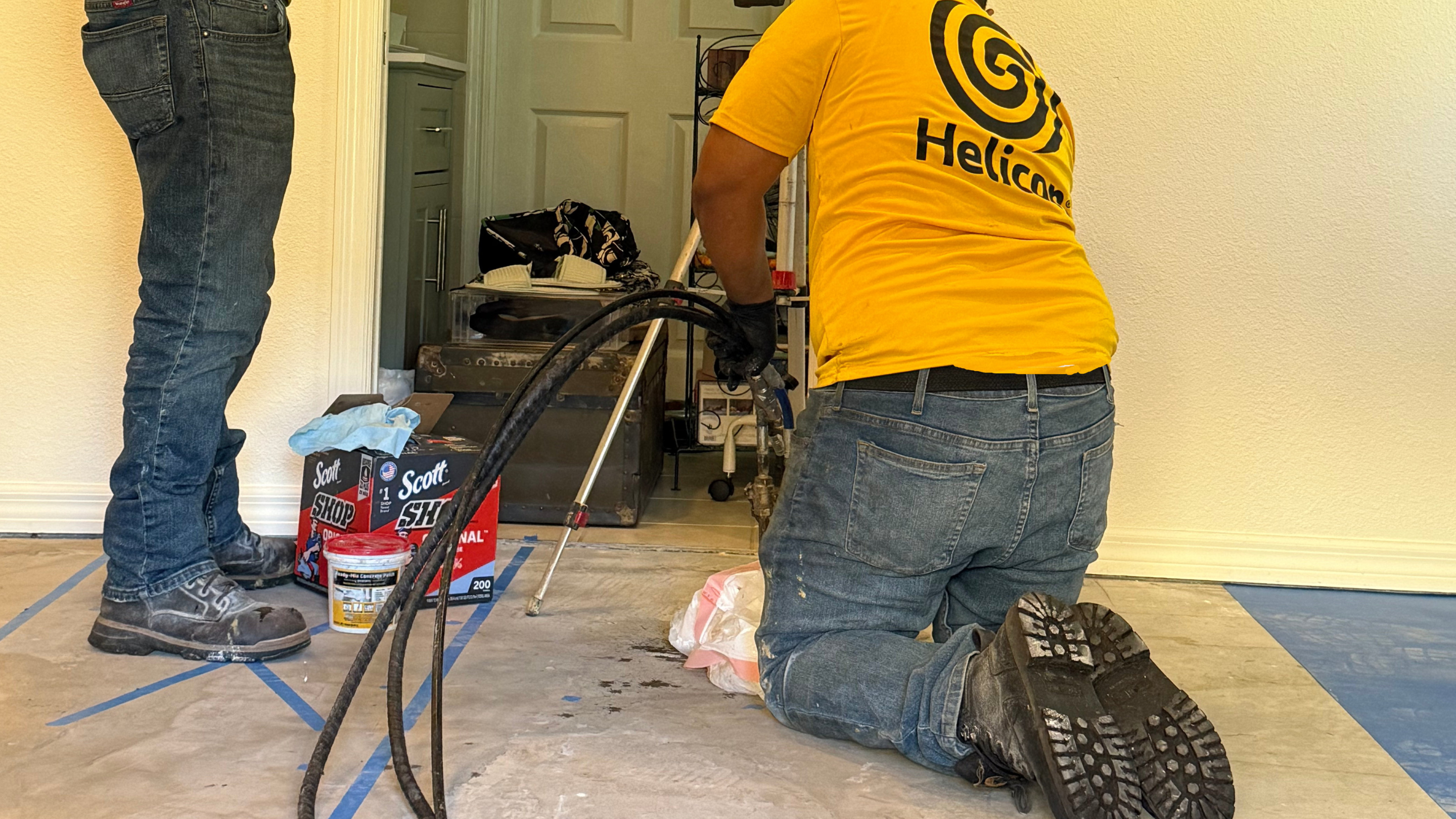
Through penny‑sized ports, we injected at the slab interface to restore contact and, where responses were uniform, to meter small lifts. Crews watched thresholds and crack gauges while injecting in short, controlled shots to avoid over‑correction.
Benefits:
– Re‑establishes slab‑to‑soil contact
– Allows incremental elevation recovery
– Rapid cure supports quick return to service
Materials & Volume
- Two‑part structural polyurethane: ~270 lbs total across mapped points.
- Port density: Higher near transitions/doorways; lighter where soils stiffened quickly.
- Aesthetics: Ports patched flush to blend with finishes or underlayment.
Results & Benefits
- Soil Stabilization Achieved: Voids filled and the bearing layer tightened—producing a uniform platform beneath the slab.
- Measured Lift Where Feasible: Select rooms saw noticeable elevation recovery, improving function and feel without over‑stressing finishes.
- Low Disruption: Small ports, rapid cure, and tidy staging allowed the homeowner to remain in residence; rooms were placed back in service quickly.
- SWFL‑Ready: The method directly addresses loose sands and moisture variability typical of Cape Coral and Fort Myers neighborhoods.
Homeowner FAQs
Can you guarantee perfectly level floors?
No. We guarantee a best‑practice attempt at lift only after stabilization is achieved and only within what the slab and structure safely allow. Many projects see meaningful improvement in levelness and function.
How long does the foam last?
Once cured, the foam is inert and resists moisture. Longevity depends on drainage, loading, and avoiding new organics in backfill. With good drainage practices, performance is long‑lasting.
Will there be a mess or strong odor?
Work is completed through small ports; dust is contained at the source and surfaces are cleaned. Any curing odor dissipates with ventilation and is short‑lived.
What if movement shows up elsewhere later?
Polyurethane is modular—we can extend treatment to adjacent rooms with minimal disruption if future symptoms appear.
Maintenance & Prevention Tips
- Drainage Discipline: Keep downspouts extended and slope soils away from slab edges to minimize saturation.
- Backfill Hygiene: Never bury organic matter (roots, mulch) beneath or beside slabs; as organics decay they create voids.
- Point Loads: Distribute heavy items (safes, aquariums, stone counters) to avoid over‑stressing edges.
- Seasonal Check‑Ins: Photograph thresholds and hairline cracks quarterly over the first year to verify stable conditions.
- Call Early: Address small symptoms promptly – small voids are faster and more economical to treat than large, interconnected cavities.
About Helicon
Helicon is Florida’s trusted partner for foundation repair, soil stabilization, concrete lifting, and sinkhole remediation. We serve homeowners across Lee County and SWFL, delivering engineered, minimally disruptive solutions that protect your property for the long term.
Seeing soft spots, trip edges, or sinking floors in Cape Coral, Fort Myers, or North Fort Myers? Helicon’s polyurethane program stabilizes soils, fills voids, and can often recover elevation—without demolition.
Call 844‑HELICON to schedule a free inspection and get a plan tailored to your home.
FREE INSPECTION REQUEST